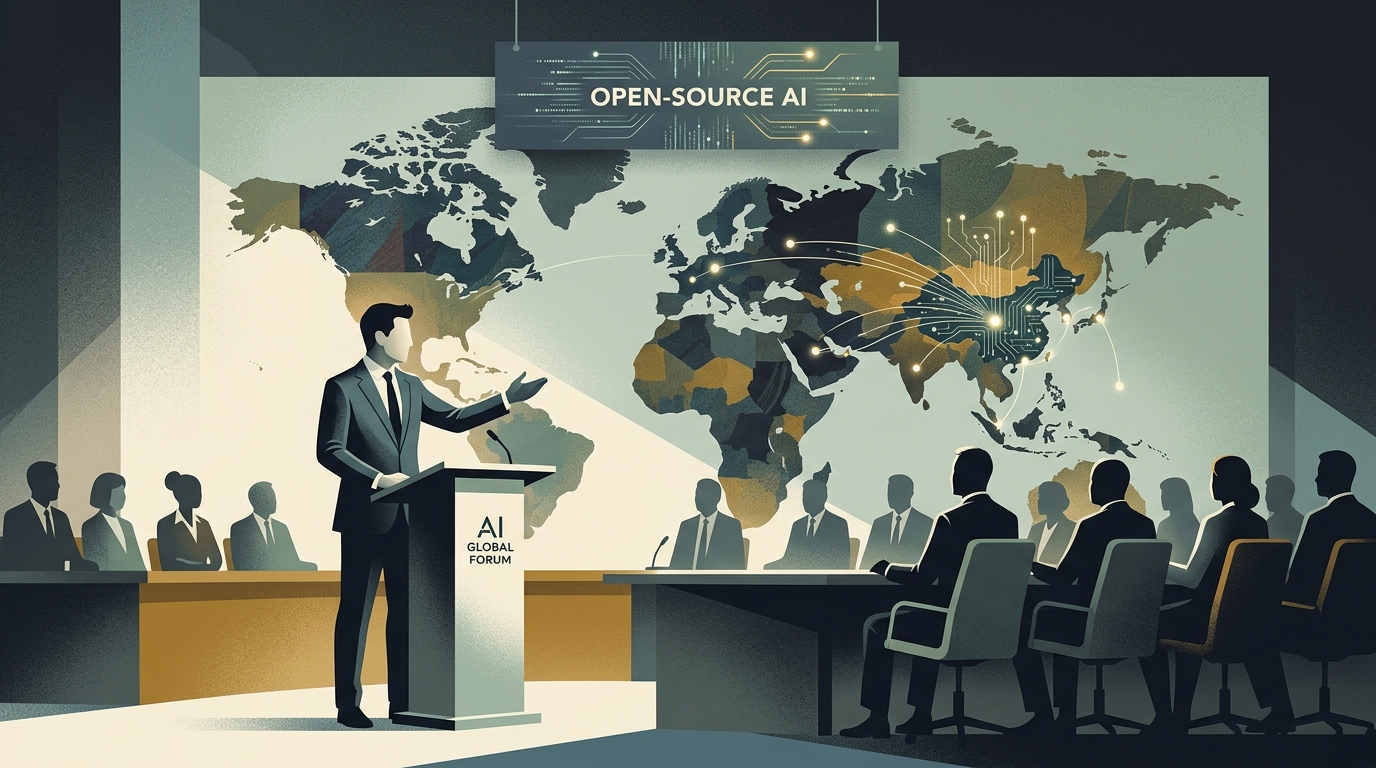
In an era where US-China relations increasingly resemble a Cold War standoff, Airbnb CEO Brian Chesky has stepped into the crosshairs of one of the decade's most contentious geopolitical debates: artificial intelligence supremacy. Speaking at a major tech summit on Wednesday, May 20, 2026, Chesky argued that Washington is exhibiting a dangerous "misunderstanding" of Chinese open-source AI models, warning that technological isolationism could severely hamper American innovation.
The Open-Source Defense and Political Skepticism
Chesky’s core argument hinges on the technical distinction between closed-loop proprietary systems—like OpenAI’s GPT-4—and open-source models released by Chinese entities such as Alibaba (Qwen) or DeepSeek. According to the Airbnb chief, utilizing these models does not inherently grant the Chinese government access to American user data. "When you download the weights of an open-source model and run it on your own private cloud infrastructure, the model doesn't 'phone home'," Chesky explained, employing a metaphor aimed at demystifying the tech for policymakers.
However, lawmakers on Capitol Hill, led by the Select Committee on the CCP, remain deeply unconvinced. Their fears center on the possibility of "backdoors" embedded within the model weights or the potential for models to be pre-programmed with subtle biases that could influence user behavior or spread disinformation. Airbnb, which utilizes a variety of AI models for tasks ranging from customer support automation to real-time translation, has become a lightning rod for this debate because of its pragmatic approach to sourcing the best available tools, regardless of their origin.
The Geopolitics of the AI Chessboard
Chesky’s intervention comes at a pivotal moment. 2026 has been characterized by the "Great Decoupling" in the software sector. While the US maintains a lead in frontier Large Language Models (LLMs), China has made significant strides in efficiency and accessibility, often releasing high-performing models to the global developer community for free. For a global platform like Airbnb, the ability to leverage the most efficient tools is a matter of maintaining a competitive edge in a low-margin, high-volume industry.
- Chinese open-source models often outperform Western counterparts in specific linguistic and cultural contexts.
- A blanket ban on these models would increase operational costs for US tech firms forced to use more expensive domestic alternatives.
- There is a growing risk of creating two parallel, incompatible technological ecosystems.
Chesky contends that national security should be safeguarded through rigorous code auditing and sandboxing protocols rather than blunt, nationality-based bans. "If we start banning code simply because it was written in Beijing, we would have to stop using 70% of the software currently powering the global economy," he remarked, highlighting the deep integration of global supply chains.
The Specter of 'Digital McCarthyism'
Chesky’s critique touches a raw nerve in Silicon Valley. Many tech leaders quietly fear that increasing government intervention will lead to a form of "digital McCarthyism," where the use of foreign technology is viewed as a security lapse or even a lack of patriotism. Conversely, security analysts point out that China’s National Intelligence Law requires its domestic companies to cooperate with state intelligence agencies, creating a structural risk that cannot be ignored by simply looking at the code.
"Technology doesn't carry a passport. If a specific model is the most efficient tool for a task, it is irrational to discard it based on political optics," Chesky stated.
This conflict underscores the widening gap between technical reality and political rhetoric. While developers see neural network weights and mathematical optimization, politicians see Trojan horses. The outcome of this standoff will determine whether AI remains a global commons or becomes another weapon in the arsenal of geopolitical power projection.
Conclusion: Navigating the New Normal
As we move into the latter half of 2026, the pressure on Airbnb and its peers to "choose a side" is likely to intensify. The challenge for Washington is to craft a policy that protects data integrity without stifling the very innovation that gives the US its edge. Chesky’s call for "technical verification over political exclusion" may be the only pragmatic path forward in a deeply interconnected world. Yet, in the current climate, the voice of technical reason is often drowned out by the drums of economic nationalism.