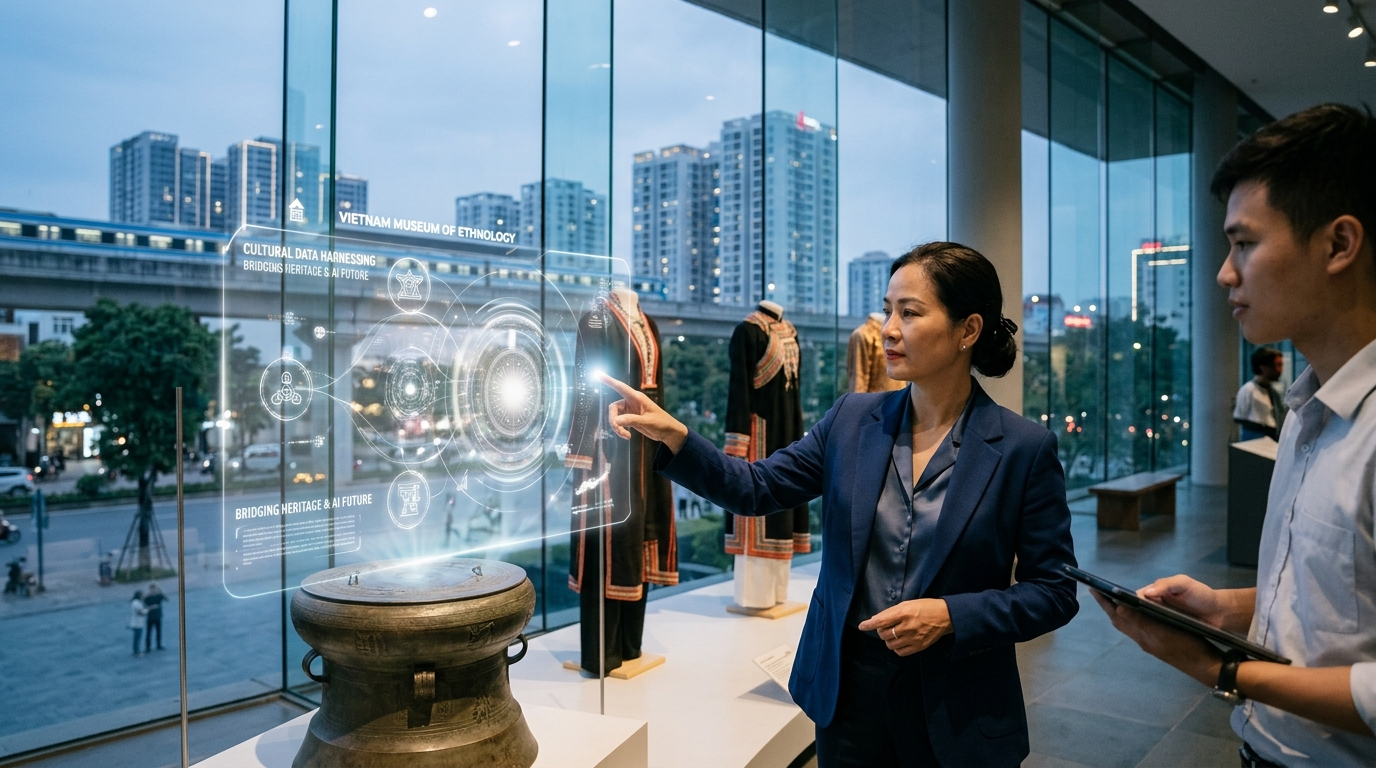
In the heart of Hanoi, the Vietnam Museum of Ethnology (VME) is no longer just a repository for ancient artifacts and traditional dwellings. As we move through 2026, the museum has evolved into a vibrant laboratory of digital innovation, proving that Artificial Intelligence (AI) is not an adversary of tradition, but its most potent ally. The museum's recent initiative to integrate advanced AI systems into the visitor experience and archival management marks a new era for cultural heritage in Southeast Asia.
The Digital Renaissance of Ethnography
Vietnam is a nation of immense ethnological wealth, officially recognizing 54 distinct ethnic groups. Documenting and showcasing this diversity has always been a monumental task. By adopting AI, the VME is transcending the physical limits of traditional exhibitions. Through Machine Learning algorithms, the museum has begun creating a 'digital twin' of its collection, allowing researchers and the global public to interact with rare exhibits in augmented reality (AR) environments.
The use of Generative AI enables the reconstruction of lost rituals or linguistic nuances that are at risk of extinction. For instance, using voice samples collected over decades, AI can now recreate dialogues in dialects that are no longer widely spoken, offering visitors an authentic acoustic experience of the past. This is not mere entertainment; it is a profound scientific endeavor to preserve intangible cultural heritage.
Personalized Experience and Inclusivity
One of the most striking features of the museum's new digital strategy is the 'Smart Guide.' This is an application powered by Large Language Models (LLMs) that tailors the tour to the knowledge level and interests of each visitor. Whether it is an academic researcher looking for details on Hmong weaving techniques or a child curious about stilt houses, the AI constructs a unique narrative in real-time.
- Real-time Translation: Breaking down language barriers for international tourists.
- Interactive Exhibits: Sensors that trigger audiovisual content based on visitor movement.
- Accessibility: Specialized AI features for the visually or hearing impaired, converting images to audio and vice versa.
This approach transforms the museum into an inclusive space where technology acts as a mediator between a global audience and local history. Museum leadership emphasizes that the goal is not to replace physical presence but to enhance it through technological immersion.
Challenges and Ethical Dilemmas
Despite the enthusiasm, the application of AI in ethnology is not without its challenges. There is always the risk of 'digital colonialism' or the misinterpretation of sacred symbols by algorithms trained primarily on Western datasets. The VME has taken steps to ensure that the training of its AI models is done in close collaboration with the ethnic communities themselves, ensuring cultural accuracy and respect.
"Artificial intelligence must be the tool, not the master of our history. We must ensure that the voices of our 54 ethnicities remain authentic, even when transmitted through digital code," a museum official stated.
Furthermore, the issue of cybersecurity and the protection of visitor data remains a priority. In a world where information is the new currency, the museum must protect the intellectual property of the communities it represents, preventing the commercialization of sacred knowledge by third parties.
Conclusion: A Blueprint for the Future
The Vietnam Museum of Ethnology is leading the way for cultural institutions worldwide. At a time when museums struggle to remain relevant to younger generations, the adoption of AI offers a solution that merges education with experience. Vietnam, a country rapidly advancing technologically, is using its heritage as a springboard for its digital future. The VME is no longer just a mirror of the past, but a beacon for how humanity can preserve its identity within the vast ocean of digital information.