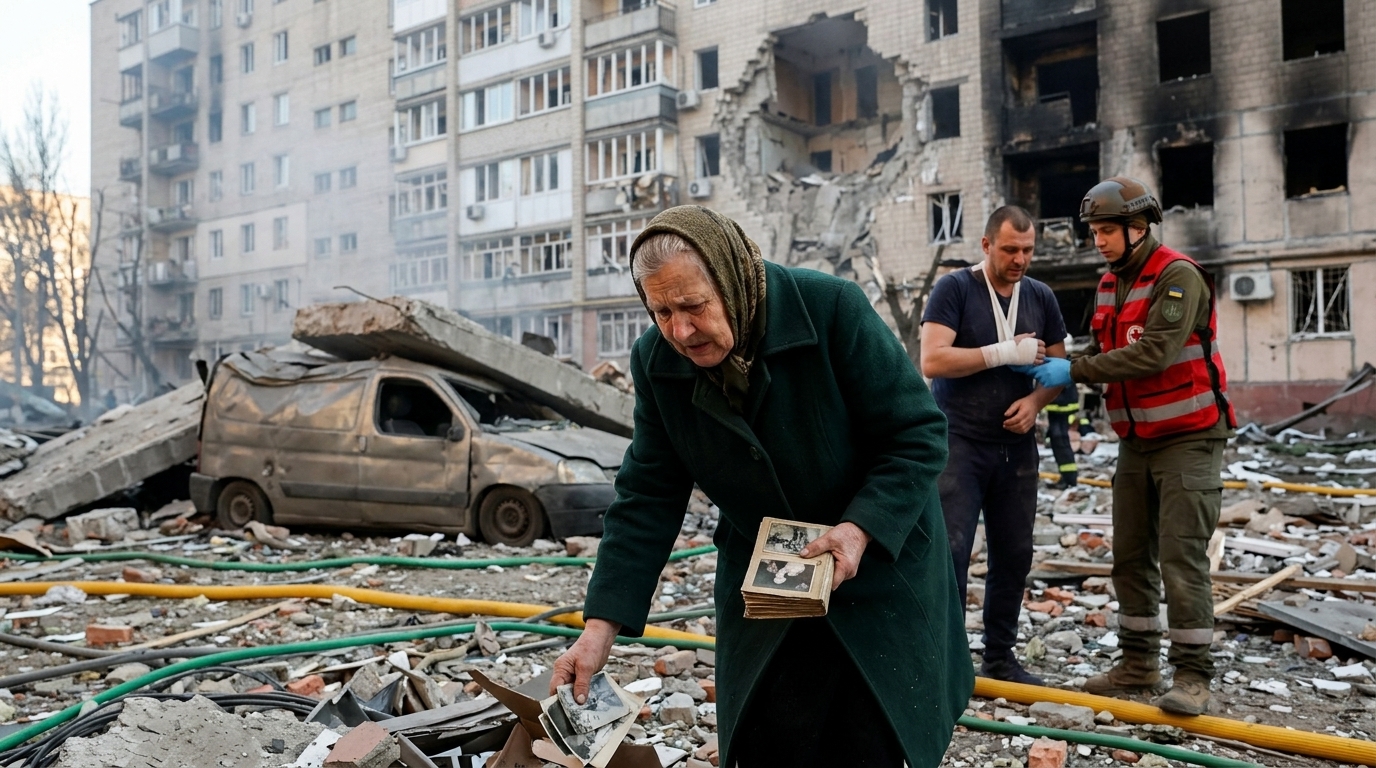
The night of April 24-25, 2026, will be recorded in military chronicles as the moment when the theory of 'saturation warfare' was applied on its most nightmarish scale. According to the Ukrainian Air Force, Russia launched a coordinated assault using a total of 660 assets—a combination of kamikaze drones, cruise missiles, and ballistic projectiles. The result was tragic: four dead and dozens injured, as the country's infrastructure buckled under the weight of a volume of threats that could exhaust even the most sophisticated air defense systems in the world.
The Strategy of Mass Saturation
Using 660 assets in a single night is not merely a show of force, but a calculated tactic of attrition. Russian forces appear to have perfected the use of 'swarms,' where hundreds of inexpensive drones, such as the advanced Geran-3 (based on Iranian Shahed designs), are sent first to force Ukrainian air defenses to expend their costly interceptors from Patriot and IRIS-T systems. Once the defenders' stockpiles are depleted or their radars are overwhelmed by data volume, precision missiles follow.
According to military analysts in Kyiv, this attack differed from previous ones due to the level of drone autonomy. Many of these units no longer rely exclusively on GPS signals, which are easily jammed by electronic warfare (EW) systems. Instead, they utilize edge-based computer vision to recognize terrain and targets, making them 'immune' to traditional jamming methods. This marks a critical turning point: Artificial Intelligence is no longer an experimental tool but the central pillar of the Russian war machine in 2026.
The Human and Infrastructural Cost
The regions hit include not only Kyiv but also strategic hubs in western and central Ukraine. The central energy sector sustained severe damage again, causing widespread blackouts reminiscent of the dark days of 2022 and 2023. However, the greatest tragedy remains the loss of human life. Four civilians perished when a swarm of drones struck a residential complex, highlighting the impossibility of fully protecting urban centers against such massive assaults.
- Destruction of critical electrical substations.
- Strikes on grain silos affecting global exports.
- Increasing pressure on the healthcare system to treat the wounded.
The Ukrainian side managed to intercept a significant percentage of the threats, but the mathematical reality is relentless: even with a 90% success rate, 66 drones and missiles will penetrate the defense. In this case, the density of the attack was such that defensive missiles simply were not enough for the number of targets appearing simultaneously on radar screens.
Geopolitical Dimension and Western Response
This attack comes at a time when Western aid is under constant scrutiny. The need for cheap, disposable anti-drone systems is now more pressing than ever. Ukraine is urgently requesting laser technologies and AI-guided cannons that can down drones at a cost of a few dollars per shot, rather than the millions required for interceptor missiles.
"We cannot continue to shoot down $20,000 drones with $2 million missiles. It is a war of economic attrition that we cannot win long-term without technological superiority," stated a senior official from the Ukrainian Ministry of Defense.
Moscow, on the other hand, seems to have converted its economy into a full-scale war machine, with factories operating 24/7 to produce thousands of drones per month. Cooperation with Tehran and domestic development of microprocessors for military use have allowed Russia to maintain this pace of attacks despite international sanctions.
Conclusions for the Future of Warfare
This event serves as a warning to the entire world. The warfare of the future is already here, and it is automated, massive, and asymmetric. The ability of a nation to produce thousands of autonomous lethal assets at low cost can neutralize the qualitative superiority of traditional forces. For Ukraine, the challenge is survival. For the West, it is a lesson in the need for a radical overhaul of defense strategy and production bases. April 25, 2026, was not just a day of mourning, but a day when the geopolitical balance was shaken by the sound of 660 engines approaching from the horizon.