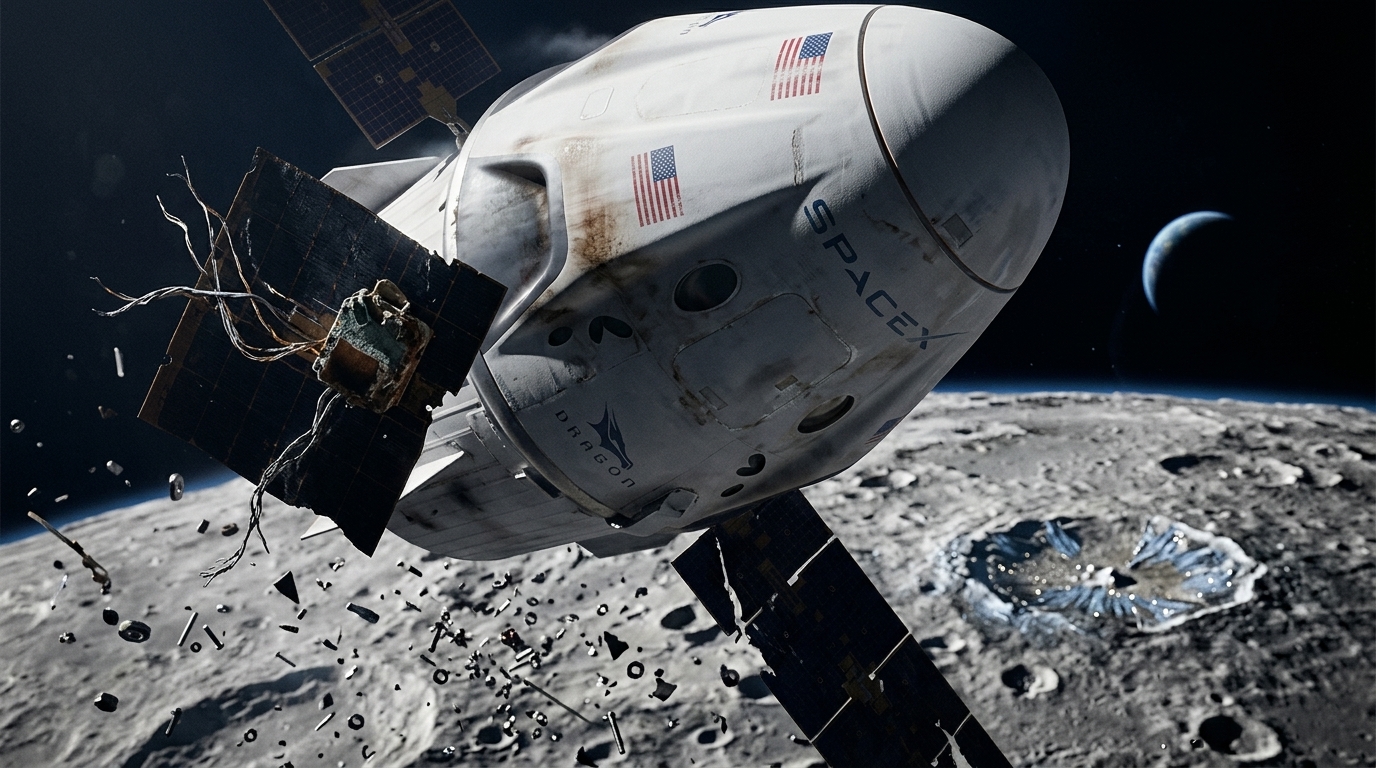
The news that a SpaceX Falcon 9 rocket stage — or potentially a Chinese Long March stage, as deep-space identification remains a complex exercise — found itself on a collision course with the Moon is not merely an astronomical curiosity. It is the prelude to a new era where human activity begins to leave indelible, and often destructive, marks on celestial bodies beyond our own planet. As 2026 finds humanity closer than ever to establishing permanent lunar bases through the Artemis program, the management of space debris is shifting from a theoretical exercise into an urgent necessity for survival.
Anatomy of a Predicted Impact
This particular rocket stage, weighing approximately four tons, has been traveling through the void for nearly a decade. Following the launch of the DSCOVR satellite in 2015, the rocket's second stage lacked the fuel to either return to Earth's atmosphere or escape the Earth-Moon gravitational system. The result was a chaotic orbit that culminated in a violent impact on the far side of the Moon. While the Moon is constantly hit by meteorites, this marks the first time a piece of 'space junk' has accidentally collided with its surface.
This incident highlights a critical weakness: the lack of systematic tracking for objects far from Low Earth Orbit (LEO). While we closely monitor thousands of objects around Earth to protect our satellites, deep space remains a 'gray zone.' The initial confusion regarding the rocket's origin — whether it belonged to Elon Musk's company or the Chinese space agency — proves that transparency and accountability in space are still in their infancy.
The Legal and Ethical Vacuum
The Outer Space Treaty of 1967, which serves as the cornerstone of international space law, dictates that nations bear responsibility for the activities of their national entities, including private corporations. However, the treaty was written at a time when the idea of private commercial exploitation of space seemed like science fiction. Today, with companies like SpaceX launching thousands of satellites annually, the legal framework appears desperately outdated.
- Who pays for the cleanup of debris in space?
- What are the penalties for 'contaminating' the lunar surface with human artifacts?
- How are sites of historical or scientific significance on the Moon protected?
This collision does more than just create a new crater. It creates a rift in our perception of space as a pristine environment. Scientists worry that the uncontrolled deposition of materials could contaminate regions containing water ice, which is vital for future missions. If the Moon becomes our new junkyard before we even manage to colonize it, the consequences for astronomy and planetary geology will be irreversible.
The Economics of Space Debris Removal
On the other hand, this crisis is giving birth to a new market. The need for Active Debris Removal (ADR) services is becoming increasingly imperative. Already, startups and government agencies are experimenting with nets, magnets, and 'space tugs' to clean up our orbits. However, the costs are staggering and the technology is still in the testing phase. The question remains: will the companies causing the problem be forced to fund the solution, or will the burden fall once again on taxpayers through state agencies?
"Space is no longer the vast void we once thought; it is a finite resource that we are managing with the same irresponsibility we showed toward our oceans," industry analysts note.
In conclusion, the rocket impact on the Moon is a warning shot. Unless international 'rules of the road' and waste management protocols for space are established immediately, we risk being trapped on a planet surrounded by a cloud of scrap metal, making any future exploration impossible. The Moon watches us, reminding us that our mistakes on Earth have a tendency to follow us everywhere.