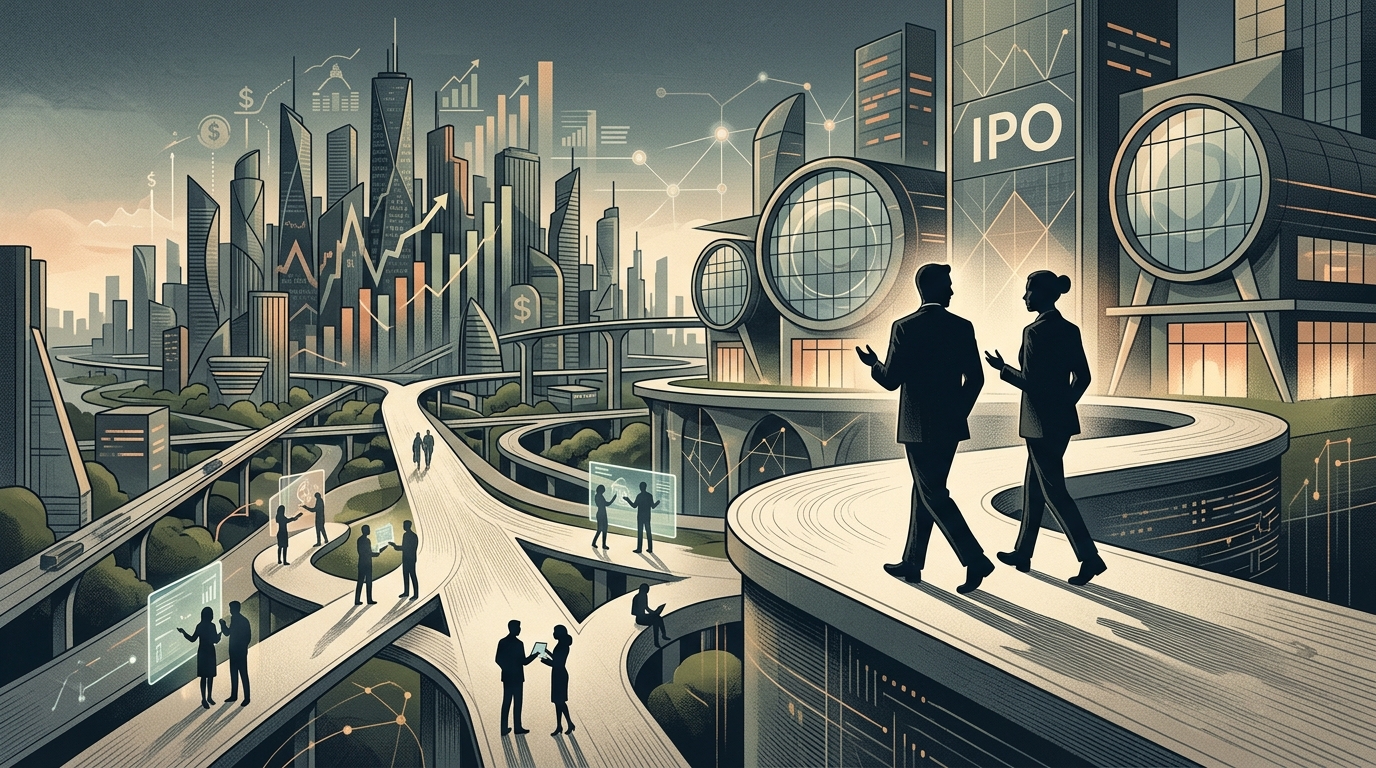
In less than two years, the narrative surrounding Artificial Intelligence has shifted from existential dread and the imminent collapse of the labor market to a softer, almost reassuring approach. Sam Altman of OpenAI and Dario Amodei of Anthropic, the two most powerful figures in the Generative AI space, appear to be revising their earlier, ominous prophecies of a white-collar "apocalypse." This 180-degree turn is no coincidence; it coincides with intense speculation and preparation for what could be the largest initial public offerings (IPOs) in tech history.
From Universal Basic Income to Job Augmentation
Only months ago, Sam Altman was openly discussing the necessity of Universal Basic Income (UBI), preparing humanity for a world where AI would render many traditional jobs obsolete. However, he recently stated he is "delighted to be wrong," adopting a stance that aligns more closely with executives like Goldman Sachs' David Solomon and Box’s Aaron Levie. The latter have consistently argued that AI will not eliminate jobs but will instead function as a powerful "copilot," increasing efficiency without displacing the human element.
This shift is strategic. To convince Wall Street investors, AI companies must present their technology as a growth tool rather than a factor of social destabilization. A future with mass unemployment is a nightmare for consumption and economic growth—two pillars upon which multi-billion dollar valuations are built. Amodei, for his part, has begun emphasizing "complementarity," arguing that AI will create new categories of professions that we cannot even imagine today.
Market Pressure and the "Solomon Doctrine"
Goldman Sachs' David Solomon has been one of the most vocal proponents of the view that the economy will absorb the shocks of AI. His logic is simple: every technological revolution, from the steam engine to the internet, has created more jobs than it destroyed. Banks and large corporations see AI as a way to reduce costs and increase profit margins, not necessarily to fire their entire staff. If Altman and Amodei continued to sound the alarm about social collapse, they would risk frightening institutional investors who seek stability and long-term viability.
- OpenAI is targeting a valuation exceeding $150 billion.
- Anthropic positions itself as the "ethical and safe" alternative but needs capital to compete with Microsoft's compute power.
- Regulators in the US and EU are closely monitoring CEO statements regarding employment impacts.
Aaron Levie of Box recently commented that the "doomerism" surrounding AI was a necessary stage to grab the attention of lawmakers, but now that the technology is maturing, the focus is on implementation. Wall Street wants to hear about subscriptions, enterprise deals, and productivity gains, not philosophical dilemmas about the end of work.
The Paradox of Adaptation
Is this shift sincere, or merely a PR maneuver? The history of Silicon Valley is rife with leaders who changed their rhetoric as soon as an exit or an IPO neared. AI remains a disruptive force. Even if we don't witness an "apocalypse," the shift in required skills is violent and rapid. The companies that will survive are those that manage to convince the public—and their shareholders—that their technology is a "benevolent giant."
"Technology is not destiny. It is a choice we make about how we want to organize our society," a market analyst recently noted, commenting on Altman's pivot.
In conclusion, the job apocalypse may not have been canceled, but it has certainly been shelved for the sake of profitability. As we move through 2026, the challenge for OpenAI and Anthropic is to prove they can be simultaneously innovative and reassuring, securing the coveted investments that will define their future.