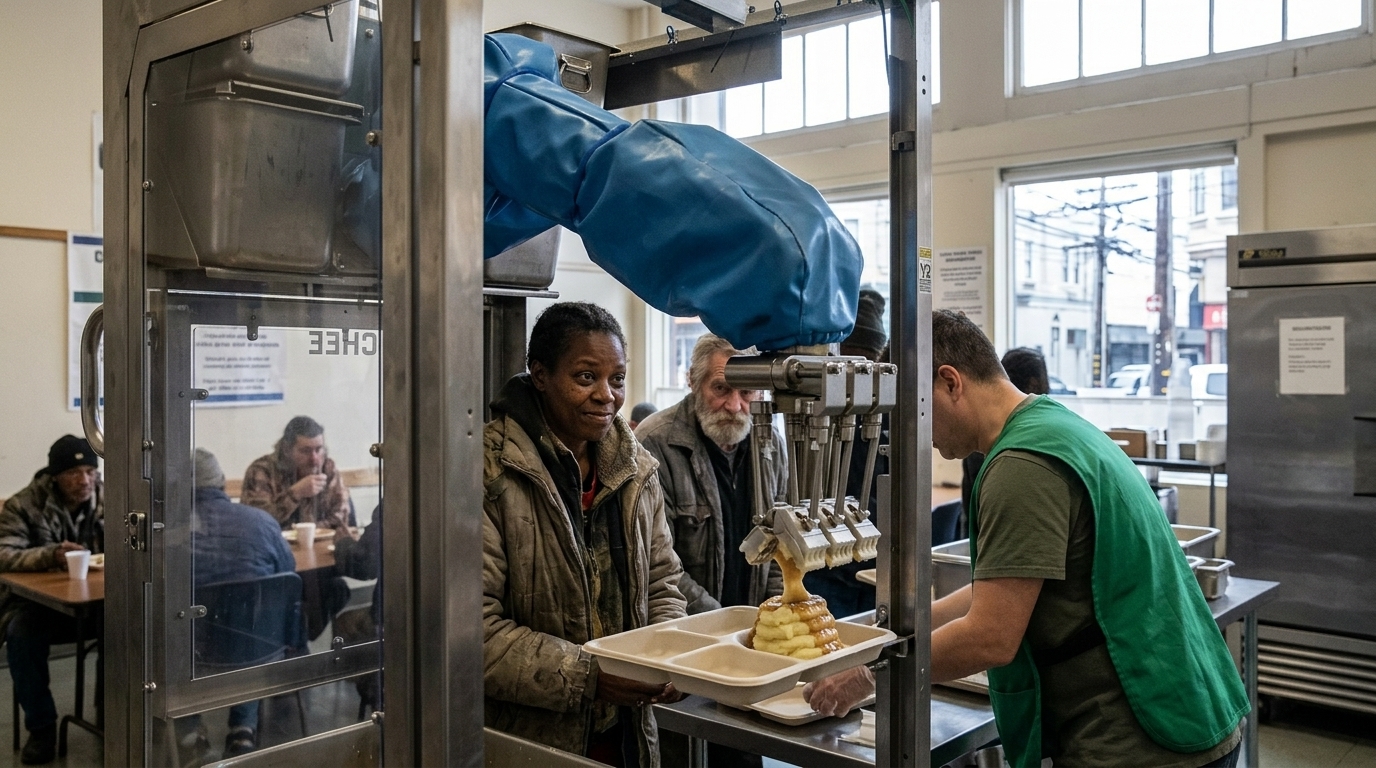
In the heart of San Francisco, in an area where extreme poverty meets technological excess, the Tenderloin has for decades been the stage for a social crisis that seems insurmountable. However, within the walls of the St. Anthony’s Foundation, a new form of aid has emerged, sparking both admiration and questions. It is not a new army of volunteers, but "Alfred," a robotic arm developed by Dexai Robotics, which has taken on the critical task of preparing meals for the city's homeless and needy populations.
Necessity as the Mother of Innovation
The decision to adopt robotics did not stem from a desire for a technological showcase but from a harsh reality: a shortage of human hands. Following the pandemic, volunteerism saw a sharp decline nationwide in the US. St. Anthony’s, which serves thousands of meals daily, faced a daunting problem. Needs were rising, while the volunteers who traditionally formed the backbone of its kitchen became increasingly scarce. Dexai Robotics' solution offered a way out that guarantees stability, speed, and, most importantly, the ability to continue service without interruption.
Alfred is not a humanoid robot from a science fiction movie. It is a sophisticated arm that can be retrofitted into any standard kitchen, using regular utensils to scoop and plate ingredients with gram-level precision. In the Tenderloin, this robot takes over repetitive and often strenuous tasks—such as scooping hot food or mixing large quantities of ingredients—allowing the limited human staff to focus on more complex duties and direct contact with the people in need.
The Paradox of the Tech Capital
Using robots to feed the poor in the "AI capital of the world" carries a heavy symbolism. On one hand, it is proof that technology can have a direct social impact, improving the efficiency of social structures. On the other, it highlights the staggering wealth gap in San Francisco. It is a city where the companies developing these robots are worth billions, while just steps away from their offices, people sleep on the pavement.
Critics argue that automating charity risks stripping the "human element" from a process built on empathy. However, the leadership at St. Anthony’s responds that dignity begins with a well-cooked, warm meal provided on time. If a robot can ensure that no one goes hungry because there weren't enough volunteers that day, then the technology has served its purpose. Furthermore, Alfred’s precision helps reduce food waste, a critical issue for any nonprofit operating on limited resources.
The Future of Social Welfare
The Tenderloin case may serve as a blueprint for the future of nonprofits worldwide. As the cost of robotic technology decreases and its reliability increases, we are likely to see similar applications in food banks, shelters, and refugee centers. The challenge will be integrating these tools in a way that complements, rather than replaces, human care.
At St. Anthony’s, the experiment seems to be working. The people coming for a meal do not seem bothered by the sight of the robotic arm; on the contrary, many view it with curiosity and appreciation for the speed with which it serves them. In a rapidly changing world, the ability to use our most advanced tools to solve our most ancient problems—such as hunger—is perhaps the most promising aspect of the technological revolution. The story of Alfred in the Tenderloin reminds us that innovation is not just about profits and speed, but also about the ability to offer a helping hand (even if that hand is made of steel and wires) where the need is greatest.