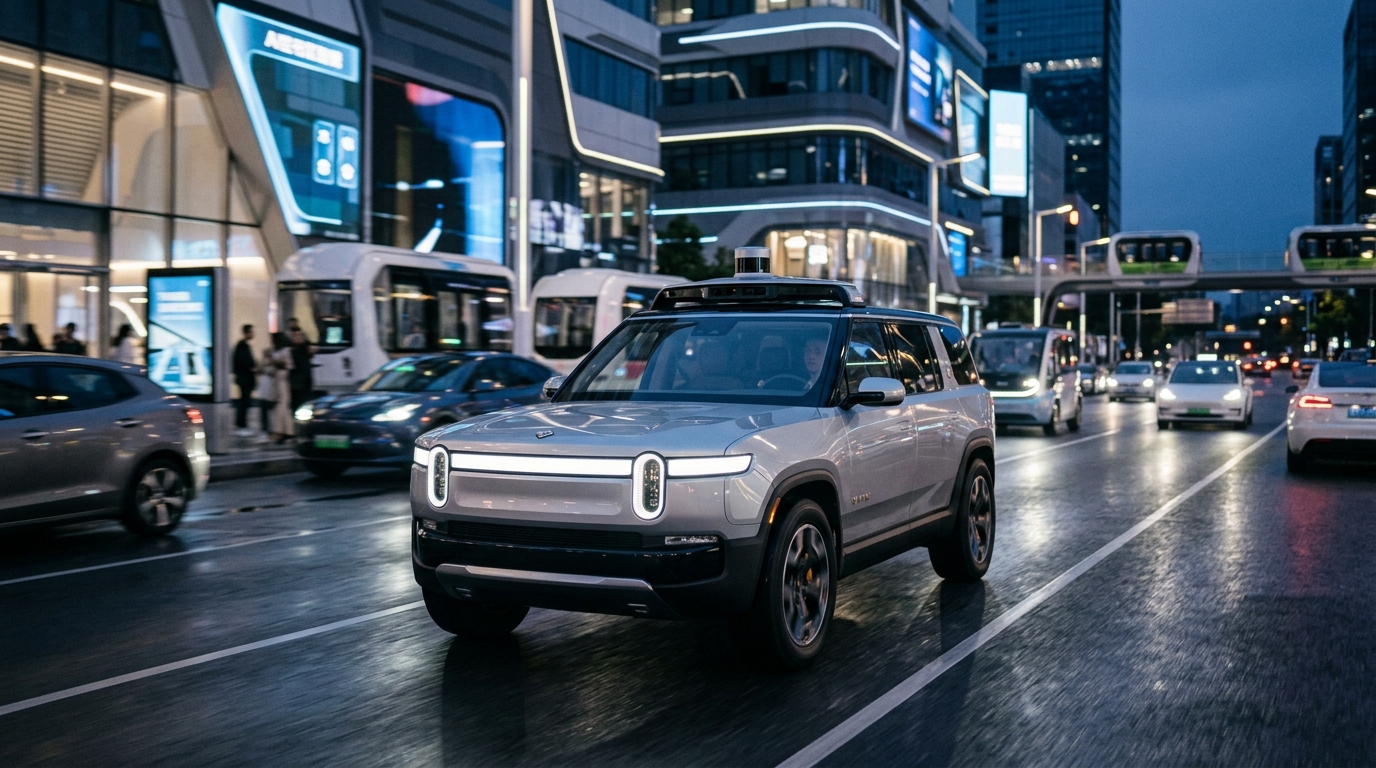
In the rapidly evolving landscape of electric mobility, 2026 is proving to be a watershed year. The focus has shifted from mere battery range and charging speeds to the cognitive capabilities of the vehicle. Rivian Automotive Inc., led by the visionary RJ Scaringe, is positioning itself at the epicenter of this transformation. In a recent interview with Bloomberg, Scaringe articulated a bold vision: the upcoming R2 SUV is not just a vehicle designed to scale sales—it is the essential engine for the company’s AI-driven autonomous future.
The Power of Data Scale
For Rivian, the R2 represents a pivot from a high-cost, niche brand to a mass-market contender. But the true value of this transition lies in data. Modern AI, particularly the end-to-end neural networks used for driving, requires staggering amounts of real-world data to achieve reliability. Until now, Rivian’s fleet of R1S and R1T vehicles, while impressive, lacked the sheer numbers to compete with the data-harvesting giants. The R2 is set to change that by putting hundreds of thousands of sensor-laden vehicles on the road.
“Scale is the ultimate unlock,” Scaringe noted. “Every R2 we deliver is effectively a mobile data lab. As our fleet grows, our ability to train models on 'edge cases'—those rare, unpredictable road events—increases exponentially. This is how we move from driver assistance to true autonomy.” This strategy mirrors Tesla's playbook but with a distinct emphasis on integrating hardware and software from the ground up to avoid the technical debt of legacy systems.
Next-Generation AI Architecture
The R2 isn't just about the quantity of data; it’s about the architecture used to process it. Rivian has overhauled the vehicle’s electronic nervous system, implementing a “zonal architecture” that drastically reduces the number of electronic control units (ECUs). This streamlined approach allows for high-speed data transmission between the vehicle’s high-resolution cameras, radars, and its central AI computer.
- Integration of high-fidelity sensors for 360-degree environmental awareness.
- A custom-designed AI compute platform capable of trillions of operations per second.
- Robust Over-the-Air (OTA) update capabilities to refine driving behavior post-purchase.
Rivian is targeting Level 3 autonomy for highway driving, which would allow drivers to disengage from the steering wheel and the road under specific conditions. Unlike some competitors who rely solely on vision, Rivian continues to advocate for a multi-modal sensor suite, arguing that redundancy is non-negotiable for consumer safety and regulatory approval.
Economic Stakes and Market Positioning
The financial implications of this AI pivot are profound. Rivian is currently in a race to reach gross profitability, and the R2 is the vehicle expected to carry them across that line. However, building the infrastructure for AI—including massive data centers for model training—requires significant capital. Scaringe believes the investment will pay off through software-as-a-service (SaaS) revenue streams. Autonomous features, offered via subscription, represent high-margin income that could transform Rivian’s balance sheet.
“We are no longer a car company that adds technology. We are a technology company that builds cars,” Scaringe stated during the Bloomberg interview.
Wall Street is watching closely. The success of the R2 will determine if Rivian can maintain its status as a premier independent EV maker. The company’s recent partnership with Volkswagen Group suggests a growing recognition that software is the primary battlefield. By leveraging the R2 to dominate the AI space, Rivian aims to prove that its value lies in its code as much as its chassis.
Conclusion: The Autonomous Horizon
Rivian’s strategy with the R2 highlights a fundamental truth: the future of transportation is autonomous, and data is the new oil. The ability to translate physical movement into digital intelligence is what will separate the winners from the losers in the next decade. If Rivian can successfully harness the data from the R2 fleet, it won't just be selling an SUV; it will be selling the future of mobility itself. As we look toward 2027 and beyond, the R2 may well be remembered as the moment when AI truly took the wheel.