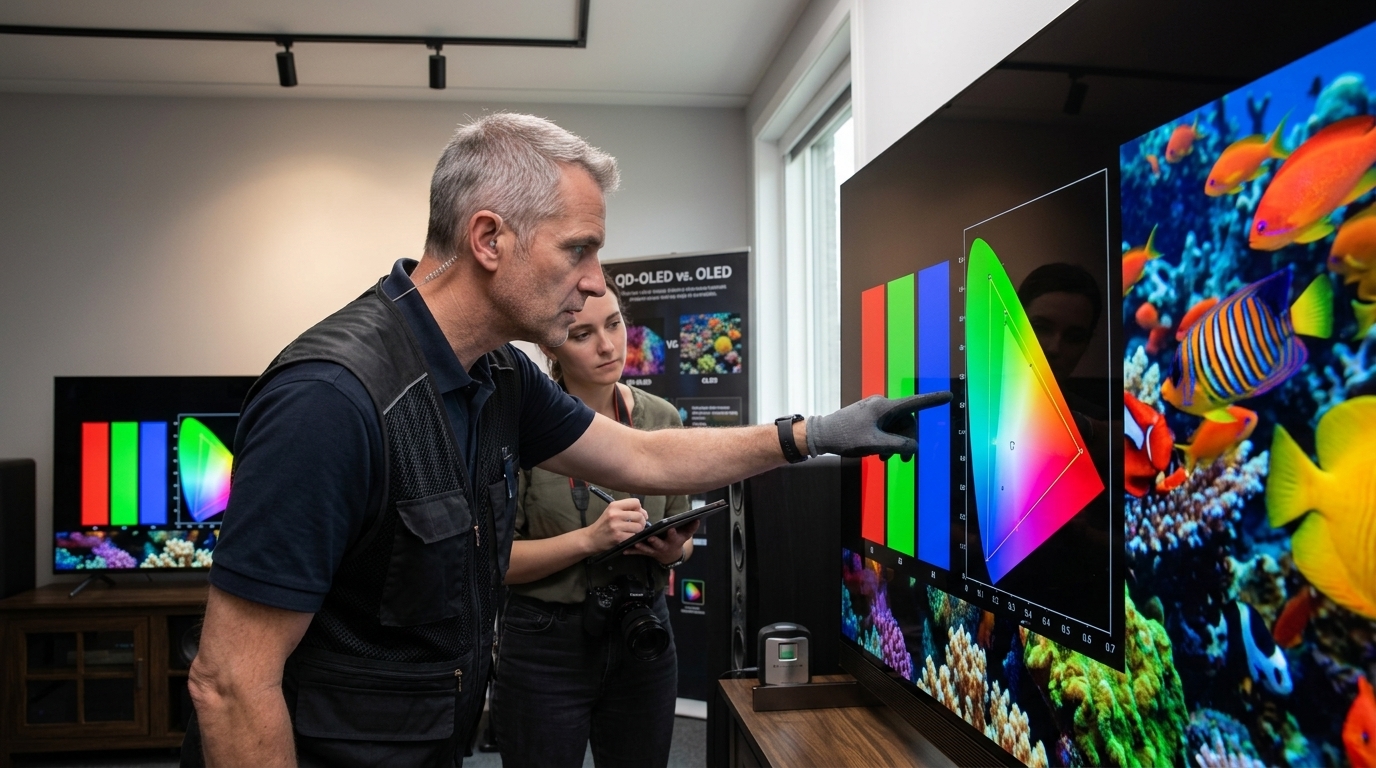
In the labyrinthine corridors of the Los Angeles Convention Center, where the display industry gathers annually for Display Week, a quiet revolution is taking place behind closed doors. Nanosys, the undisputed leader in Quantum Dot (QD) technology, posed a bold question: Can an LCD screen enhanced with the new Super Quantum Dot (SQD) technology outperform a pure-breed RGB LED display? The answer, according to the company itself, is a resounding "yes."
Side-by-side, two 85-inch displays competed for the attention of experts. On one side, a Mini-LED panel equipped with Nanosys’s latest Super Quantum Dots. On the other, an RGB LED screen, which until recently was considered the gold standard for color fidelity. The difference wasn't just visible; it was a statement about the future of home entertainment. SQD technology promises to bridge the gap between the affordability of LCDs and the visual splendor of OLEDs, while offering brightness levels that the latter struggle to reach.
The Science Behind the Glow
To understand why this development is significant, we must dive into the microscopic world of nanocrystals. Quantum Dots are nanometer-scale semiconductors that have the property of emitting light at very specific wavelengths when excited by an energy source. The size of the dot determines the color: larger ones emit red, smaller ones blue or green.
Nanosys's new generation of Super Quantum Dots is not just an improvement; it is a redesign of the crystals' chemical structure. This allows for greater efficiency in light conversion, reducing energy loss and increasing color purity. While traditional RGB LED displays rely on separate colored LEDs that may exhibit non-uniformity over time, the SQD system uses a uniform backlight (often blue Mini-LEDs) that is "filtered" by the quantum dots to produce a color gamut reaching 90% of the Rec. 2020 standard—something considered unthinkable for consumer products just a few years ago.
The Economic and Manufacturing Advantage
But why would a company choose Super Quantum Dots over RGB LEDs? The answer lies in manufacturing complexity. Producing large RGB LED panels is an extremely difficult and expensive process, requiring the precise placement of millions of tiny diodes of different colors. Any failure leads to defective pixels and low production yields.
In contrast, Nanosys technology allows manufacturers to use existing LCD and Mini-LED production lines, simply adding a film or an inkjet-printed layer of quantum dots. This dramatically reduces costs, allowing 85-inch screens with top-tier image quality to hit store shelves at prices the average consumer can afford. Furthermore, the energy efficiency of SQDs is superior, as less power is required to achieve the same brightness—a critical factor in an era where EU regulations on TV energy consumption are becoming increasingly strict.
Toward the Future: Electroluminescence
Despite current success, Nanosys and its competitors are not stopping here. The "holy grail" of display technology is electroluminescent quantum dots (EL-QD). In this scenario, the dots themselves emit light when an electric current passes through them, completely eliminating the need for a backlight. This would allow for the creation of displays as thin as paper, with the perfect blacks of OLED but the lifespan and brightness of Quantum Dots.
The demonstration at Display Week 2026 shows that we are closer than ever to this future. As Nanosys continues to refine its materials, the dominance of traditional LEDs seems to be wavering. For the end-user, this means more choices, better image quality, and, most importantly, cutting-edge technology that doesn't require a small fortune. The battle of the nanocrystals has just begun, and the results are, to say the least, dazzling.