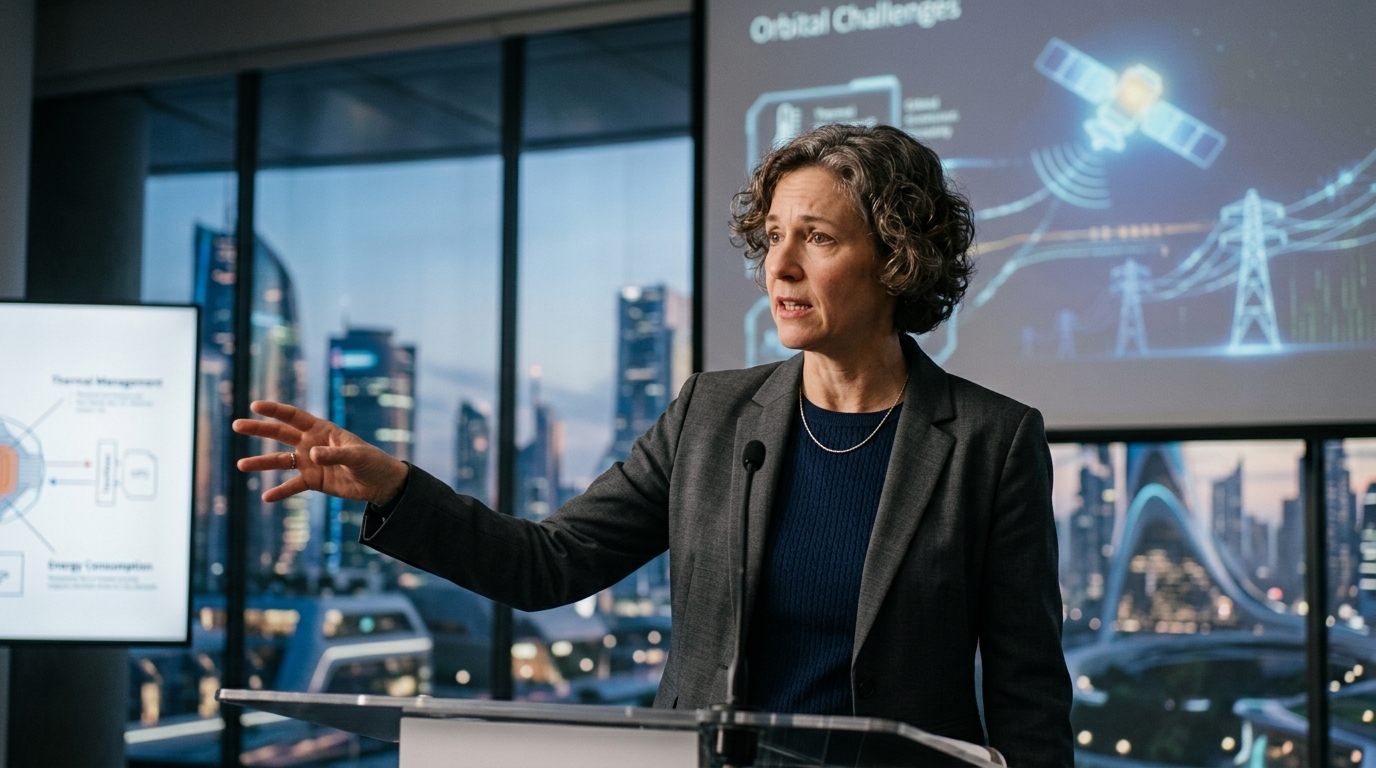
The concept of moving the "Cloud" beyond the confines of Earth's atmosphere is no longer a science fiction trope but an emerging industrial ambition. However, as companies like SpaceX and Lonestar Data Holdings push for the deployment of orbital computing power, experts are sounding an alarm. Makenzie Lystrup, principal consultant at Peridot Services and former director of NASA’s Goddard Space Flight Center, recently highlighted on Bloomberg Tech that orbital data centers face challenges that extend far beyond mere launch costs.
The core argument for space-based data centers rests on the promise of unlimited solar energy and the avoidance of terrestrial land and water usage for cooling. Yet, Lystrup points out that the reality of space engineering is far more complex than the glossy brochures of Silicon Valley startups suggest.
The Thermal Paradox of the Vacuum
The most significant misconception about space is that because it is "cold," cooling servers will be effortless. In reality, space is an excellent insulator. On Earth, data centers are cooled via convection—transferring heat to air or water. In the vacuum of space, there is no medium to carry heat away. The only method of shedding thermal energy is through radiation.
As Lystrup explained, this requires massive radiator surfaces that drastically increase the size, weight, and complexity of the satellite. "You can't just put a server rack on a satellite and expect it to work," she noted. Managing the heat generated by high-performance processors, especially those running AI models, requires innovations in materials and thermal engineering that have yet to be scaled for commercial use.
The SpaceX Factor and the Cost of Orbit
The rise of SpaceX and the promise of Starship have lowered the cost of access to space, creating an illusion that anything can be launched profitably. However, Lystrup warns that launch cost is only one part of the equation. Maintenance, upgrades, and hardware replacement in orbit remain prohibitively expensive.
- Hardware Lifespan: Terrestrial servers are refreshed every 3-5 years. In space, radiation degrades electronics much faster, and replacing them requires entirely new launches.
- Energy Density: While the sun provides energy, converting it into a stable supply for thousands of processors requires massive solar arrays that create stability issues for the satellite's orbit.
- Latency: For speed-sensitive applications, such as high-frequency financial trading, the distance from orbit to Earth adds latency that negates many of the location's perceived advantages.
"Physics doesn't care about your business plan. Managing power and heat in a closed system in a vacuum is one of the hardest challenges in aerospace," Lystrup states.
Geopolitics and Data Sovereignty
Beyond technical hurdles, there is a security dimension. Orbital data centers are marketed as solutions for "data sovereignty," allowing nations or organizations to store information outside national jurisdictions. However, this creates a legal gray area. What law applies to a server floating over international waters at an altitude of 500 kilometers?
Furthermore, the increasing density of objects in Low Earth Orbit (LEO) heightes the risk of collisions. A data center destroyed by space debris is not just a financial loss but an environmental disaster for orbital sustainability. Lystrup emphasizes that the international community must establish stricter regulations before space becomes an unregulated junkyard for digital infrastructure.
Conclusion: A Niche Market for the Future
Despite these challenges, Peridot Services does not entirely dismiss the idea. Instead of massive data centers replacing those of Amazon or Google on Earth, the future likely belongs to niche applications. Processing data directly in space for Earth observation satellites (edge computing in space) can reduce the volume of data that needs to be transmitted back, saving precious bandwidth.
As we head toward 2027, the industry will have to prove it can defeat thermodynamics. As Lystrup concluded, ambition is necessary, but engineering requires humility in the face of the laws of nature.