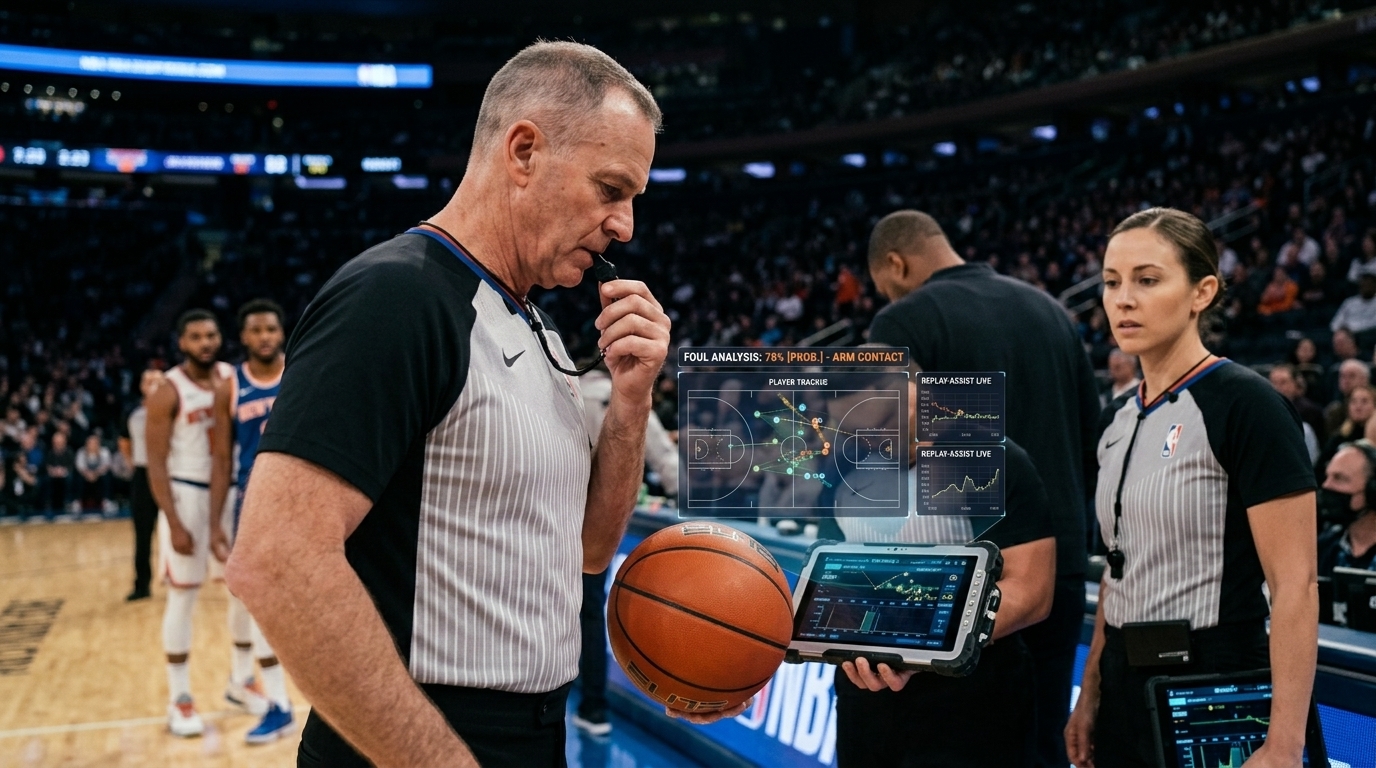
In an era where a tenth of a second and a millimeter can determine the fate of a multi-billion dollar championship, the NBA is preparing for the most significant technological revolution in its history. League Commissioner Adam Silver recently confirmed that the world's premier basketball league is in advanced stages of testing the integration of Artificial Intelligence (AI) into officiating, aiming to automate decisions deemed "objective."
The Transition from Human Eyes to Sensors
This move is no surprise to industry observers. The NBA has been using sophisticated systems like Second Spectrum for data analysis for years, but using AI for real-time decision-making fundamentally changes the rules of the game. The technology relies on a network of high-speed cameras surrounding the court, capable of tracking 29 points on each player's body, as well as ball movement, thousands of times per second.
According to Silver, the initial applications will focus on plays that leave no room for interpretation: whether the ball went out of bounds, whether a player's foot was on the three-point line, or shot clock violations. "There are areas where technology is simply better than humans," the Commissioner admitted, highlighting that the speed of the modern game has surpassed the biological limits of human vision.
Objectivity vs. Subjectivity: The Great Dilemma
The big question occupying the basketball community is where the machine ends and the human begins. While AI can rule with absolute precision on an out-of-bounds line, judging a foul or a technical remains deeply subjective. The NBA appears to be taking a phased approach, separating "geometric" decisions from "interpretive" ones.
- Automated Decisions: Out of bounds, 2/3 pointers, goaltending, clock violations.
- Human Officiating: Fouls, contact, flopping, unsportsmanlike conduct.
However, AI integration isn't just about accuracy; it's about the pace of play. Constant interruptions for replays at the Secaucus Replay Center have drawn sharp criticism from fans for destroying game flow. AI promises "instantaneous" confirmation, sending a signal to the referee's watch or headset in fractions of a second, eliminating the need for five-minute huddles in front of a monitor.
Impact on Betting and Integrity
Beyond the competitive aspect, the entry of AI into officiating has massive implications for the world of sports betting. With the legalization of betting in many US states, the pressure for flawless decisions is higher than ever. A single missed call can cost millions, and the league wants to shield its product from suspicions of bias or human error.
"Credibility is our currency. If fans and players don't trust the integrity of the decisions, the sport is at risk," a league executive stated.
The use of AI acts as a "digital witness" that lacks emotion, is unaffected by home-court advantage, and doesn't fatigue in the final minutes of a game. Nevertheless, traditionalists worry that full automation will remove the "drama" and human imperfection that make sports compelling.
The Future of Officiating
The NBA isn't the only league experimenting. Soccer already has VAR and semi-automated offside technology, while tennis has replaced line judges with Hawk-Eye. The difference in basketball is the density of plays and the proximity of players, making the technical undertaking much more complex. In the future, we might even see AI suggesting penalties for "flopping" by analyzing the physics of a player's fall relative to the force of impact.
In any case, Adam Silver makes it clear that referees are not going to disappear. Instead, they will transform into "system managers," equipped with tools that allow them to focus on the mental and psychological side of the game, leaving the mathematics to the machines. The era of "Ref-Tech" is here, and the NBA is once again leading the way, charting the course for 21st-century sports.