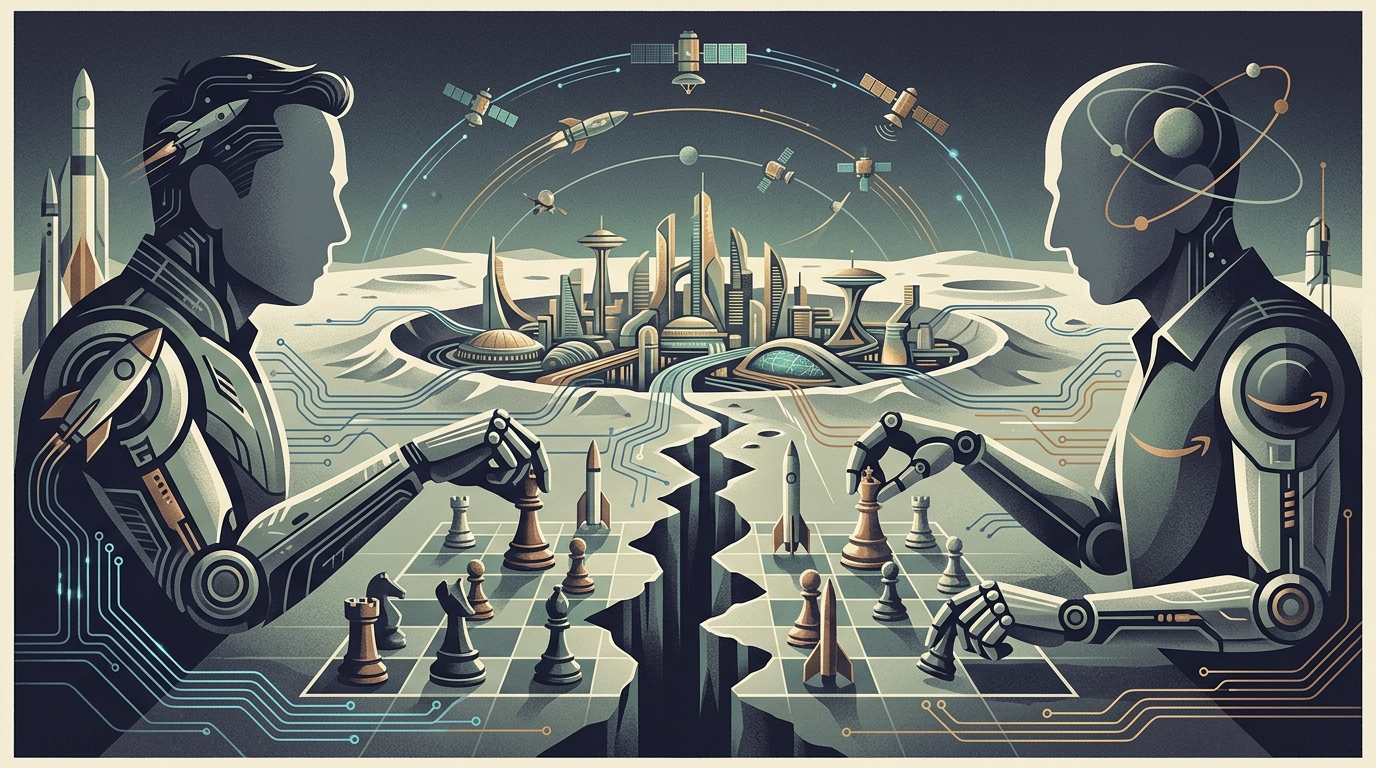
The history of humanity has been marked by great rivalries, but none has been as costly, technologically advanced, or literally "out of this world" as the one between Elon Musk and Jeff Bezos. As we navigate through 2026, the competition between SpaceX and Blue Origin is no longer just about prestige or satellite launches. It is a strategic battle for lunar dominance, the establishment of permanent bases, and the control of future resources. In this context, Artificial Intelligence (AI) is not merely a support tool but the central pillar that will determine the victor.
The Moon as the New Economic Frontier
For decades, the Moon was regarded as a dead rock, a symbol of Cold War supremacy. Today, this perspective has shifted radically. The discovery of water ice at the lunar poles has transformed our satellite into a potential "gas station" for the solar system. Water can be split into hydrogen and oxygen, providing rocket fuel and breathable air for astronauts. Bezos envisions the Moon as an industrial hub, where heavy industry will be moved off-Earth to protect our home planet. In contrast, Musk views the Moon as an essential testing ground for Starship, the vehicle intended to carry humanity to Mars.
NASA, through the Artemis program, has fueled this rivalry by awarding contracts to both. SpaceX secured the initial Human Landing System (HLS) contract, sparking a fierce reaction from Blue Origin, which eventually won its own share for later missions. This tug-of-war has accelerated development but has also highlighted the need for systems capable of operating autonomously in environments where human intervention is limited or impossible.
AI: The Invisible Commander of Space Missions
Why is AI so critical in this battle? The answer lies in the complexity of modern space operations. In space, communication latency—even with the Moon—means that decisions in critical moments, such as landing or a sudden malfunction, must be made in milliseconds by machines.
- Autonomous Navigation and Landing: The computer vision systems SpaceX is developing for Starship use neural networks to identify craters and obstacles in real-time, selecting the safest landing spot without human guidance.
- Resource Management (ISRU): Blue Origin is investing in AI systems to manage the extraction and processing of lunar ice. Optimizing energy consumption in a base where every watt counts is a task only advanced AI can handle.
- Predictive Maintenance: In an environment as hostile as the Moon, a failure can be fatal. AI analyzes millions of data points from sensors to predict when a component will fail, long before it happens.
"The conquest of space is no longer a matter of raw rocket power, but a matter of computational strength and algorithmic intelligence," say industry analysts.
The Geopolitical Dimension and the Clash of Ideologies
Behind the technology lies a deep ideological divide. Bezos represents the "old school" of engineering, with his "Gradatim Ferociter" (Step by step, ferociously) approach. Blue Origin is methodical, slow, and often criticized for its bureaucracy. Musk, on the other hand, applies the Silicon Valley philosophy: "move fast and break things." SpaceX accepts failure as part of learning, as evidenced by the early Starship tests.
However, the Musk-Bezos battle does not take place in a vacuum. China, with its ILRS (International Lunar Research Station) program, represents a common adversary. Beijing's use of AI to automate its own lunar missions has forced the US to accelerate its cooperation with the private sector. The Moon is becoming the arena where the dominant economic and political model of the 21st century will be decided. AI will be the referee and the accelerator of this process.
Toward a Permanent Lunar Economy
As we approach the end of the decade, the focus is shifting from visiting to staying. The creation of the Lunar Gateway, a space station orbiting the Moon, will be the hub where AI plays its most critical role. The station must operate autonomously for long periods without a crew. AI will manage life support systems, defense against micrometeoroid activity, and telecommunications with Earth.
The future envisioned by Musk and Bezos is a world where humanity is multi-planetary. Whether it's Bezos's giant rotating colonies or Musk's domed cities, Artificial Intelligence will be the connective tissue. The battle for the Moon is, in reality, the battle for who will write the code for future human existence in the cosmos.