Nature has a paradoxical way of turning destruction into inspiration. For decades, the scientific community has struggled to solve the greatest challenge of renewable energy: storage. While the sun provides us with an abundance of energy, our ability to keep it for "rainy days"—winter or night—has been limited by expensive and environmentally taxing lithium batteries. However, the solution seems to lie in a mechanism that most of us consider an enemy: the sunburn.
The Biological Inspiration: DNA as a Blueprint
When ultraviolet (UV) light hits human skin, it causes damage to our DNA. Specifically, DNA bases like thymine absorb the energy and form new chemical bonds with neighboring molecules, creating what biologists call "dimers." This process is essentially a form of energy storage at a molecular level, though for humans, it translates into cellular damage and pain. Researchers, primarily from Chalmers University of Technology in Sweden, wondered: Could we design a synthetic molecule that does the same thing, but releases that energy on demand?
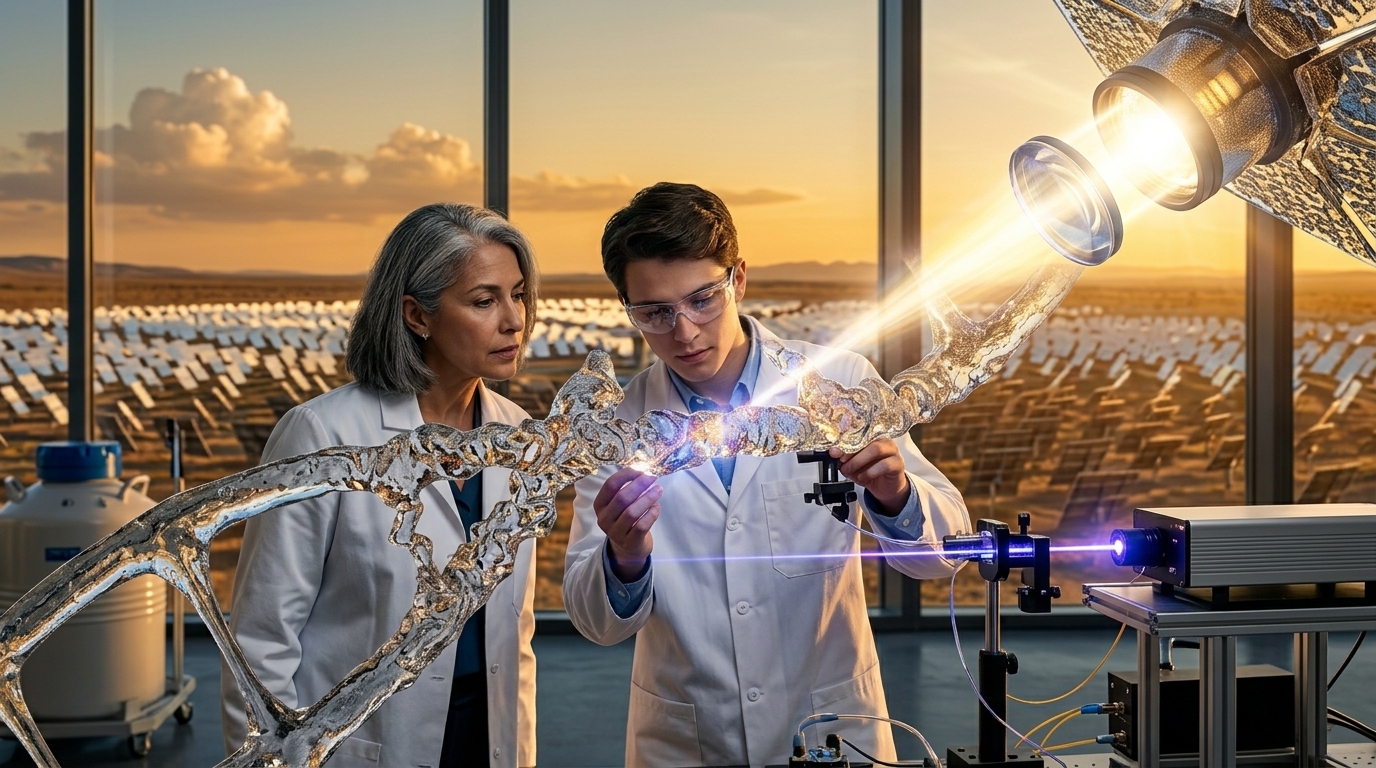
The result is the MOST (Molecular Solar Thermal Energy Storage) system. This is a specialized liquid molecule composed of carbon, hydrogen, and nitrogen. When this molecule is exposed to sunlight, it changes its structure, transforming into an energy-rich "isomer." What is impressive is not just the conversion, but the stability: this "charged" liquid can be stored at room temperature for up to 18 years without losing its energy.
How the MOST Technology Works
The process is elegant in its simplicity. The liquid circulates through a solar collector, which looks like a traditional water heater but operates at a molecular level. Light forces the chemical bonds of the molecule to rearrange into a tighter, energy-dense form. When we need the heat—for instance, on a cold February night—the liquid passes through a special catalyst. The catalyst "unlocks" the bonds, the molecule returns to its original shape, and releases the stored energy as heat.
This heat can reach up to 63 degrees Celsius above the ambient temperature, making it ideal for home heating systems, industrial processes, or even electricity generation via thermoelectric generators. The most significant advantage? The system is closed-loop. The liquid is not consumed; it is recycled indefinitely, charging and discharging without CO2 emissions or the need for rare earth metals.
The Role of AI in Material Discovery
This is where modern technology meets chemistry. Finding the ideal molecule for the MOST system was not accidental. Scientists used advanced Artificial Intelligence and machine learning algorithms to simulate millions of potential atomic combinations. "Materials Informatics" allowed researchers to predict which molecules would have the highest energy density and the longest shelf life before even stepping into the lab.
AI also helped in optimizing the catalyst. The catalyst must be efficient yet durable, so it doesn't degrade after thousands of cycles. Without the computational power of AI, developing this technology would have required decades of trial-and-error experimentation. Today, AI is accelerating the energy transition, allowing us to "design" the future of energy at a molecular level.
Political and Social Implications
The implementation of such a technology could radically change the energy map, especially in sun-drenched countries like Greece. Imagine buildings whose facades don't just generate electricity but store the summer's heat to use in the winter, reducing dependence on natural gas or heating oil. Furthermore, the lack of need for lithium or cobalt—materials often mined under controversial conditions—makes molecular storage an ethically and environmentally superior solution.
However, challenges remain. Scaling the production of these specialized molecules to an industrial level requires investment and political will. Traditional energy giants might see this decentralized technology as a threat to their control model. But the promise of energy "trapped" in a bottle, ready to be used years later, is too powerful to ignore. The sunburn, once a symbol of neglect, is being transformed into a beacon of hope for a planet desperately seeking sustainable solutions.