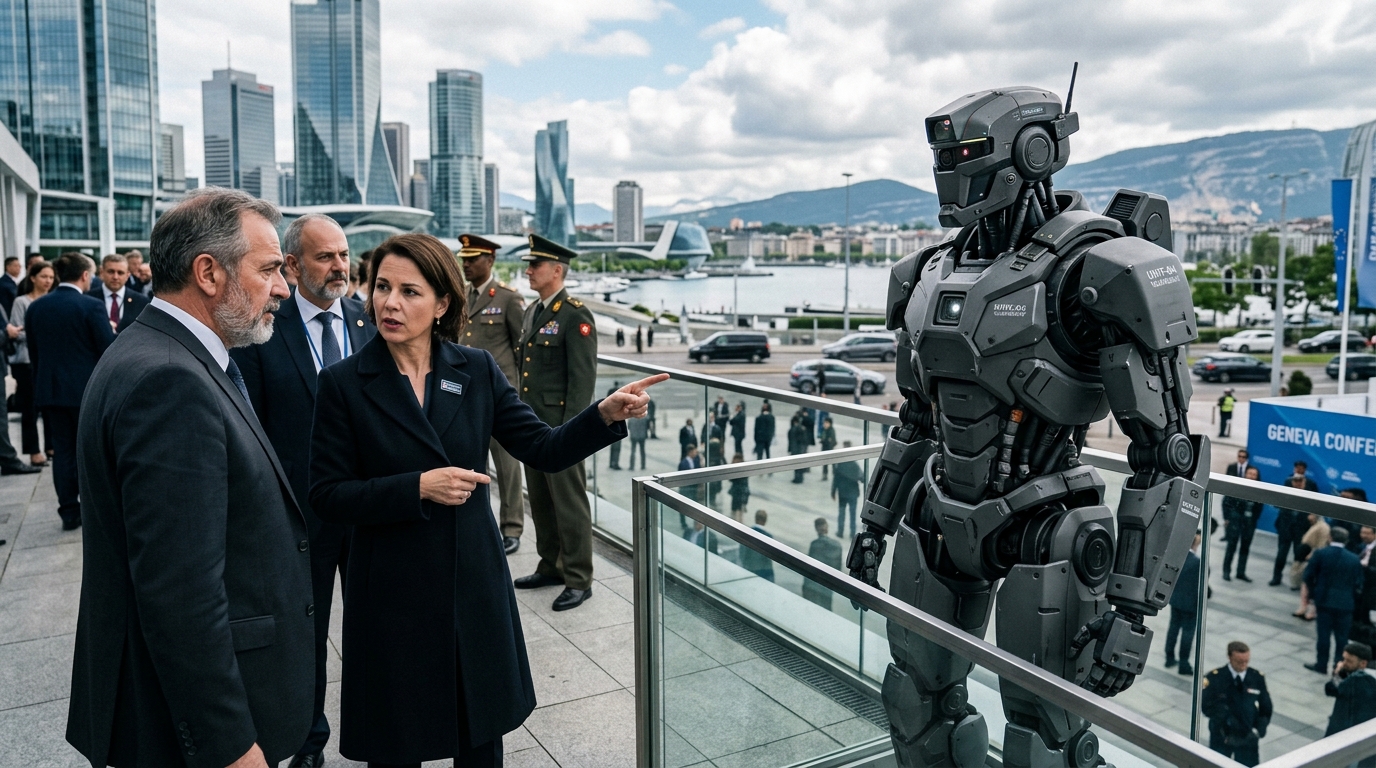
The history of humanity is inextricably linked to the evolution of its weaponry, but also to the parallel effort to impose limits on brutality. From the first Geneva Conventions in 1864 to the 1949 revisions, international law has sought to ensure that even amidst the chaos of war, human dignity and the protection of non-combatants remain sacrosanct. Today, however, we face a radical new challenge: the rise of Lethal Autonomous Weapons Systems (LAWS), often colloquially termed "killer robots." The discussion regarding a "Geneva Convention for Robots" is no longer a science fiction scenario; it is a geopolitical necessity.
The Rise of Autonomous Systems and the End of Human Judgment
The fundamental difference between today’s drones and tomorrow’s autonomous robots lies in decision-making. While a current UAV (Unmanned Aerial Vehicle) is guided by a pilot thousands of miles away, an autonomous system uses algorithms to identify, target, and neutralize an enemy without human intervention. This transition from "man-in-the-loop" to "man-on-the-loop" (human as supervisor) and eventually "man-out-of-the-loop" creates a massive ethical and legal void.
Proponents of this technology argue that robots could be more "ethical" than human soldiers, as they are unaffected by fear, revenge, or fatigue—factors that often lead to war crimes. However, critics point out that a machine lacks empathy and the ability to perceive the subtle nuances of a conflict's context. Can an algorithm distinguish a wounded soldier surrendering from one preparing to strike? The answer remains uncertain, and the risk of "algorithmic carnage" is very real.
The Accountability Gap: Who is Liable?
One of the central issues that a new Geneva Convention would need to resolve is the "accountability gap." In traditional laws of war, if a soldier commits a crime, they or their superiors are held responsible. In the case of an autonomous robot, assigning blame becomes extraordinarily complex. Is the programmer who wrote the code responsible? The hardware manufacturer? The commander who deployed the robot in the field? Or perhaps the AI itself, which lacks legal personality or consciousness to be punished?
The international community, through the United Nations in Geneva, has been debating the limitation of these systems for years. The proposal for a new treaty is based on the principle of "meaningful human control." This means that any decision involving the use of lethal force must remain in human hands. Without this control, warfare risks devolving into an automated process of extermination, where the value of human life is reduced to a series of bits and bytes.
Geopolitical Rivalries and Great Power Resistance
Despite pressure from organizations like the "Campaign to Stop Killer Robots" and figures such as Elon Musk and the late Stephen Hawking, progress toward an international treaty has been slow. The reason is simple: military power. Great powers like the US, Russia, China, and Israel are investing billions in autonomous technology, viewing it as the "Third Offset Strategy" for global dominance.
There is a fear that if a country self-limits ethically, it will find itself at a disadvantage against an adversary with no such qualms. This "AI arms race" is reminiscent of the Cold War nuclear era, with the difference that AI is much more accessible and difficult to monitor. A Geneva Convention for Robots would require not only political will but also unprecedented technical cooperation for algorithm verification—something military industries systematically avoid in the name of secrecy.
Conclusion: Humanity at a Crossroads
Establishing a Geneva Convention for Robots is not just about banning specific weapons. It is about preserving our humanity in an age of mechanical superiority. If we allow machines to decide who lives and who dies, we will have surrendered the most fundamental part of our moral responsibility. The international community must act proactively before algorithms begin writing history with the blood of those who never had the chance to look a human adversary in the eye.