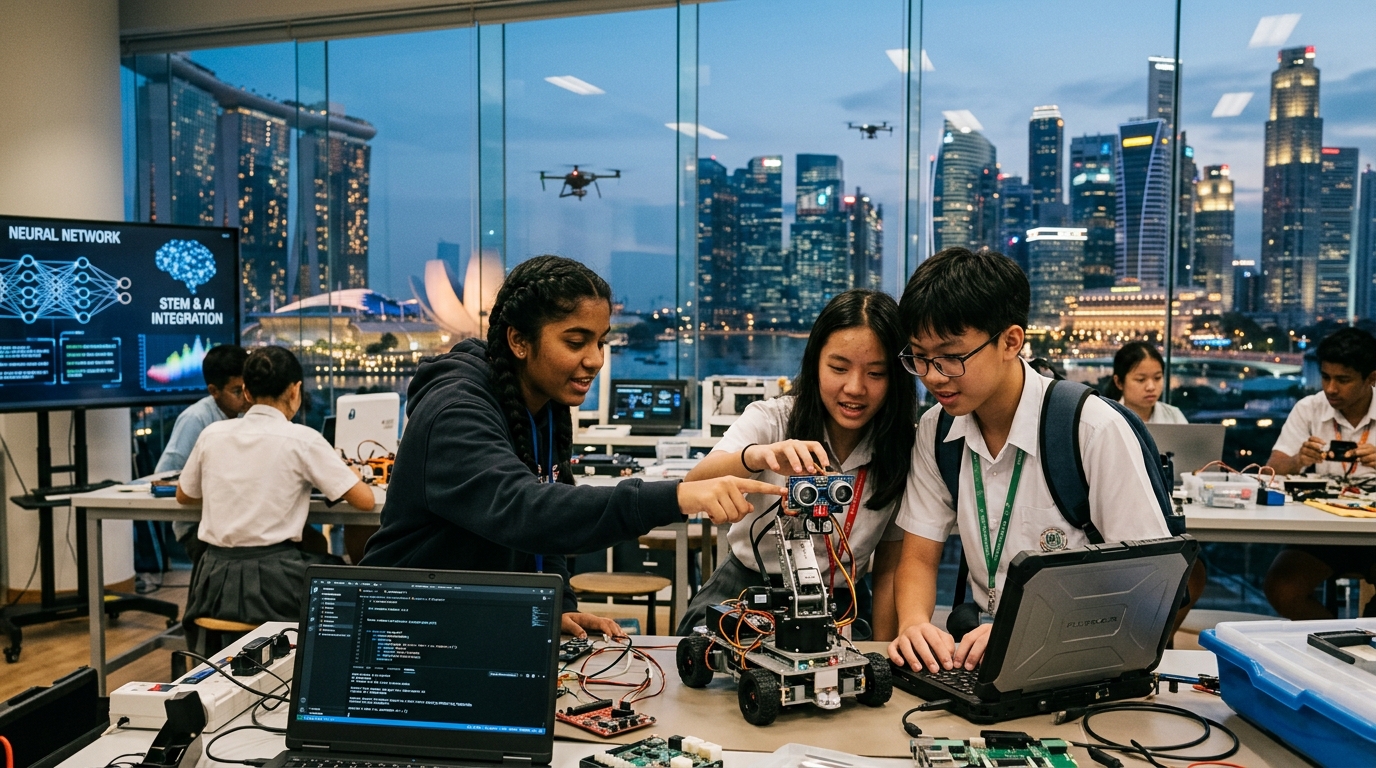
The global economy stands at the threshold of a structural transformation, where a nation's ability to prosper no longer depends solely on its natural resources, but on the digital readiness of its workforce. Recent news from Vietnam regarding the intensification of Artificial Intelligence (AI) education starting as early as high school is not merely a local educational reform; it is a signal and an opportunity for the entire planet. As STEM (Science, Technology, Engineering, Mathematics) evolves into 'STEM+AI', the educational community is called to redefine what 'basic literacy' means in the 21st century.
The Transition from Theory to Applied Intelligence
For decades, STEM education has focused on developing analytical thinking and problem-solving through the natural sciences. However, the advent of Generative AI has changed the rules of the game. Today, it is not enough for a student to know how to solve an equation; they must understand how the algorithms process the data that generate these solutions. Integrating AI into high school aims to bridge the gap between academic knowledge and the needs of the labor market, which now demands 'AI literacy' as a prerequisite for every field, from medicine to law.
The example of Vietnam is characteristic of the strategy employed by emerging economies. By investing in programs that teach teenagers the principles of machine learning and the ethical use of data, the country seeks to 'leapfrog' stages of development and position itself as an innovation hub in Asia. This approach recognizes that students who begin their contact with AI at age 15 will be the architects of the systems managing tomorrow's cities and economies.
Challenges and Social Inequalities
Despite the enthusiasm, introducing AI into secondary education comes with significant challenges. The first concerns the preparation of the educators themselves. Many STEM teachers are faced with technologies evolving faster than they can keep up with. Without continuous and high-quality training, there is a risk that AI instruction will be limited to a superficial use of tools, rather than a deep understanding of its principles.
Furthermore, the issue of the 'digital divide' is emerging. While some model schools or countries with strong central administration can equip their classrooms with the necessary infrastructure, less privileged regions risk being left behind. This creates a new form of social inequality: the inequality of access to 'intelligence.' If AI knowledge becomes a privilege of the few, the technology that promises to liberate human creativity may ultimately end up reinforcing existing class distinctions.
Ethics and Critical Thinking: The New Curriculum
Perhaps the most critical element of integrating AI into high schools is not the coding itself, but the ethical dimension. Students must be taught how to recognize biases in algorithms, how to protect their privacy, and what the social implications of automation are. AI education must be human-centric. In Vietnam, as in other pioneering countries, curricula are beginning to integrate philosophy and sociology alongside Python programming.
- Development of prompt engineering skills for effective communication with large language models.
- Understanding the difference between Artificial General Intelligence (AGI) and specialized systems.
- Workshops on the ethics of data usage and intellectual property in the digital age.
In conclusion, preparing a digital workforce starting from high school is no longer an option, but a necessity for survival in global competition. The success of this endeavor will be judged by the balance between technical training and ethical cultivation, ensuring that the next generation will not just be users of technology, but its conscious creators.