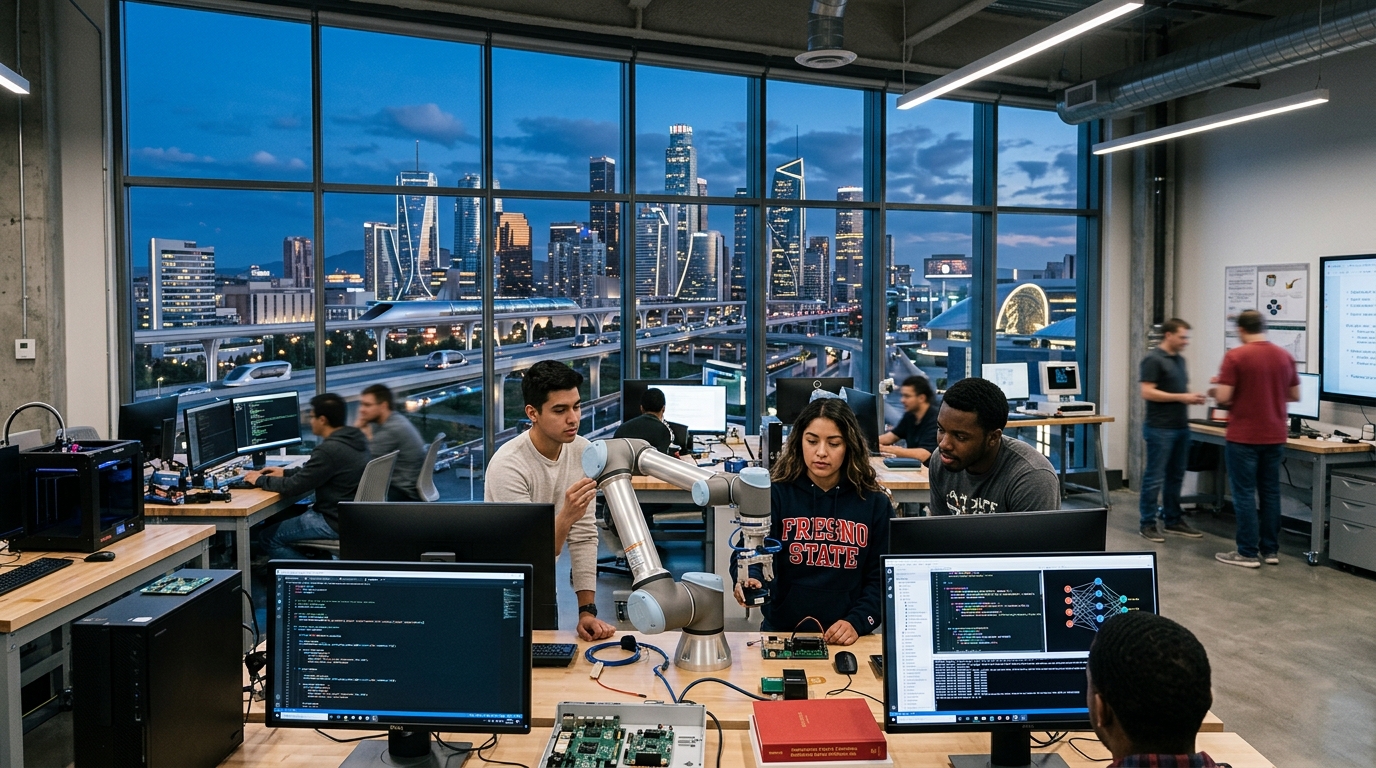
In an era where Artificial Intelligence (AI) is no longer the exclusive domain of computer scientists and software engineers, California State University, Fresno (Fresno State) has taken a landmark step in academic evolution. The announcement of a new minor in Artificial Intelligence, open to students across all disciplines—from nursing and agriculture to fine arts and business—marks a fundamental shift in how we perceive higher education in the 21st century.
Breaking the Silos of Knowledge
For decades, computer science was taught as an isolated discipline, a specialized craft for the few. However, the rise of Generative AI has made it clear that the ability to interact with algorithms is now a horizontal skill, as essential as literacy or numeracy. Fresno State’s program does not merely aim to teach students how to write code; rather, it focuses on how to leverage AI tools to solve complex problems within their own specific fields of study.
Imagine an agricultural student using predictive models to optimize irrigation in the San Joaquin Valley, or a sociology student analyzing massive datasets to identify patterns of urban inequality. This interdisciplinary approach is what makes Fresno State’s initiative so timely. University leadership recognizes that the labor market of 2026 and beyond will not just demand "AI experts," but professionals in every sector who can orchestrate human creativity alongside computational power.
Ethics and Critical Thinking at the Core
One of the most compelling aspects of this new curriculum is its emphasis on the ethical dimension of technology. In a world where algorithms can perpetuate bias or generate sophisticated misinformation, educating future citizens cannot be limited to technical proficiency. Fresno State is integrating courses that examine the social implications of AI, data privacy, and the burning issue of intellectual property.
- Analysis of algorithmic bias in hiring and criminal justice.
- The impact of AI on job automation and the future of work.
- Transparent use of Large Language Models (LLMs) in academic research.
This pedagogical strategy ensures that graduates will not be passive users of tools but critical thinkers capable of evaluating when AI use is beneficial and when it poses risks to democracy and social cohesion. By grounding technical skills in the humanities, the university is building a safeguard against the uncritical adoption of disruptive tech.
Local Growth and Global Competitiveness
The decision to invest in AI education also carries a profound economic weight. Fresno is the heart of America’s agricultural production. Integrating AI into local industries could trigger a new "Green Revolution," where technology helps mitigate the effects of climate change and water scarcity. Furthermore, it provides students from the region—many of whom are first-generation college students—with the tools to compete on equal footing with graduates from elite institutions like Stanford or Berkeley.
"We are not preparing our students for the jobs that exist today, but for those that will be created tomorrow," the university administration stated.
Ultimately, Fresno State’s move serves as a manifesto for the future of education. Knowledge should not be siloed. Artificial Intelligence is the new "operating system" of our society, and understanding it has become a fundamental right and responsibility for every academic citizen. As the program launches, the eyes of the global educational community are on Fresno, waiting to see if this model will become the blueprint for universities worldwide.