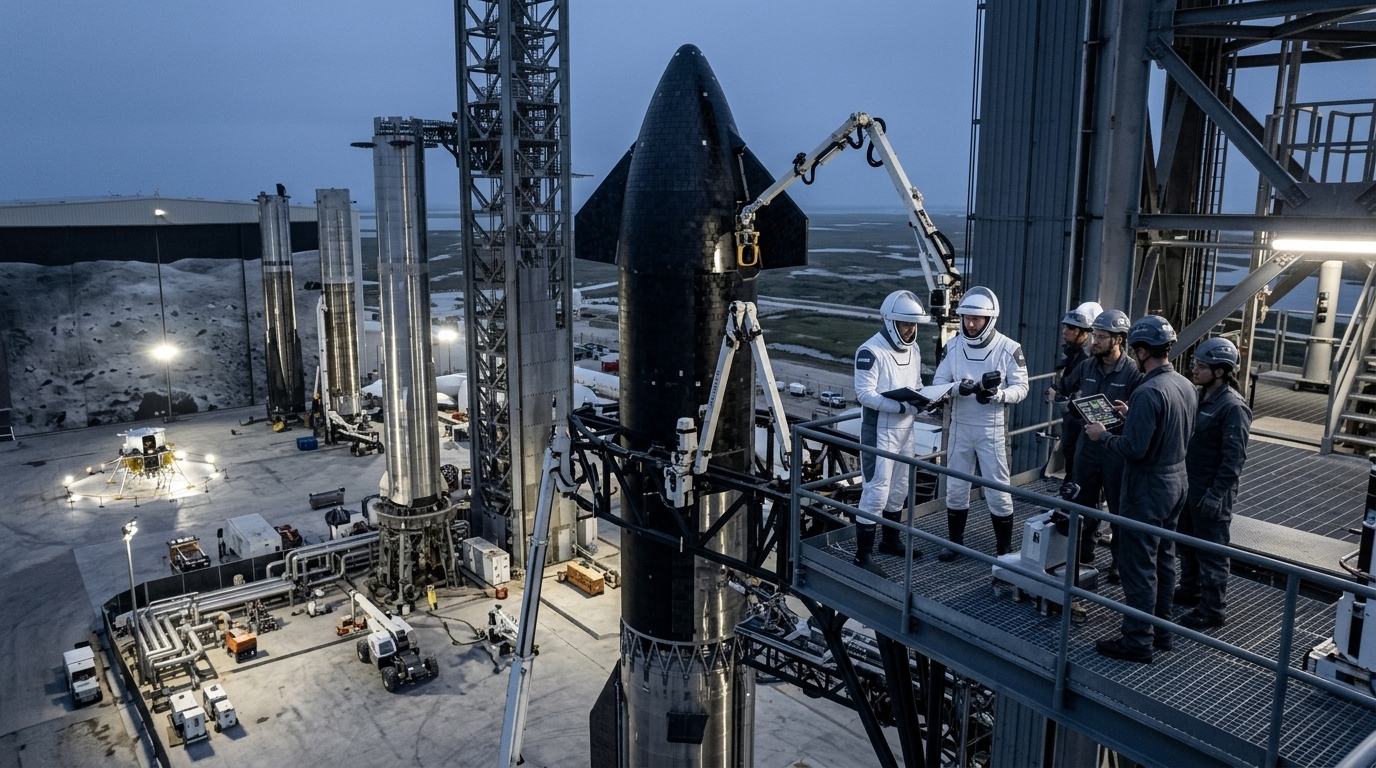
The conquest of the Moon is no longer the exclusive preserve of national space agencies; it has become the new frontier for private enterprise. In a move that redefines the rules of the extraterrestrial economy, the Japanese company Ispace has announced a strategic partnership with Elon Musk’s SpaceX. The objective? To transport cargo to the lunar surface using the massive Starship rocket, starting in 2030. This development signals a shift from isolated exploratory missions to a sustainable and regular "lunar logistics" service.
A Strategy of Resilience: From Failures to the 2030 Roadmap
Ispace’s journey has been anything but smooth. The company gained global attention with its Hakuto-R Mission 1, which in 2023 came agonizingly close to making history as the first private lunar landing, only to crash due to an altitude sensor software error. Despite this setback, Ispace’s leadership demonstrated quintessential Japanese perseverance. Instead of retreating, they expanded their vision, realizing that the key to the future lies not just in landing technology, but in transport capacity and reliability.
Committing 500 kilograms of payload capacity for customers on future Starship flights is a bold statement of intent. Ispace doesn’t just want to "set foot" on the Moon; it aims to become the premier carrier serving future lunar laboratories, mines, and bases for NASA and other international partners. The choice of Starship is strategic. It is the only vehicle promising to drastically reduce the cost per kilogram of payload, making space accessible for commercial activities previously deemed economically unfeasible.
Starship as a Catalyst for the Lunar Economy
SpaceX’s Starship is the "elephant in the room" of the space industry. With the capacity to carry over 100 tons to low Earth orbit and the ambition for full reusability, it is a game-changer. For Ispace, this partnership means access to a platform capable of transporting vast amounts of equipment, from lunar rovers to life-support infrastructure.
- Economies of Scale: Utilizing Starship allows Ispace to offer competitive pricing to governments and private entities.
- Technological Synergy: Ispace will focus on its next-generation lunar landers, which will be released from Starship for the final descent.
- Global Competition: This move places Japan at the forefront, alongside the US, in the race against China’s lunar program.
"Our vision is to create a sustainable ecosystem between Earth and the Moon. Partnering with SpaceX is the foundation upon which we will build the bridges of the future," said a company executive.
Geopolitical and Economic Implications
The Ispace-SpaceX deal is about more than just business; it has profound geopolitical implications. The Moon is now viewed as the "eighth continent," rich in resources like Helium-3 and water ice at the poles, which can be converted into fuel for Mars missions. Japan, through Ispace, is securing a seat at the table for negotiations regarding lunar resource governance.
From an economic perspective, the creation of a lunar logistics service paves the way for the "Cislunar Economy." Analysts estimate that by 2040, this market could be worth billions of dollars. Ispace, having already secured customers for its first 500kg of payload, demonstrates that real demand exists. These customers range from research institutes wanting to send sensors to telecommunications companies aiming to establish lunar 4G/5G networks.
Challenges and the Path to 2030
Despite the optimism, significant hurdles remain. Starship technology is still in the testing phase, and the challenges of landing on the Moon—given the lack of atmosphere and the hazardous lunar dust (regolith)—remain immense. Furthermore, the legal framework for resource ownership in space remains murky, despite the Artemis Accords.
Ispace must prove it has learned from past mistakes. Its upcoming Mission 2 will be the ultimate test. If it achieves a successful landing in the coming years, market confidence will soar, making the 2030 milestone not just a goal, but an inevitable reality. The collaboration with SpaceX is not merely a commercial agreement; it is the birth certificate of the interplanetary supply chain.