Urban mobility is at a critical crossroads. For decades, city planning focused almost exclusively on the automobile, relegating bicycling to a secondary, often hazardous option. However, the climate crisis and the demand for more livable cities are forcing planners to seek new solutions. In California, the Santa Barbara County Association of Governments (SBCAG) is now turning to Artificial Intelligence to solve a puzzle that has bedeviled transportation engineers for years: how to build a bike network that people will actually use.
The Data Revolution in Planning
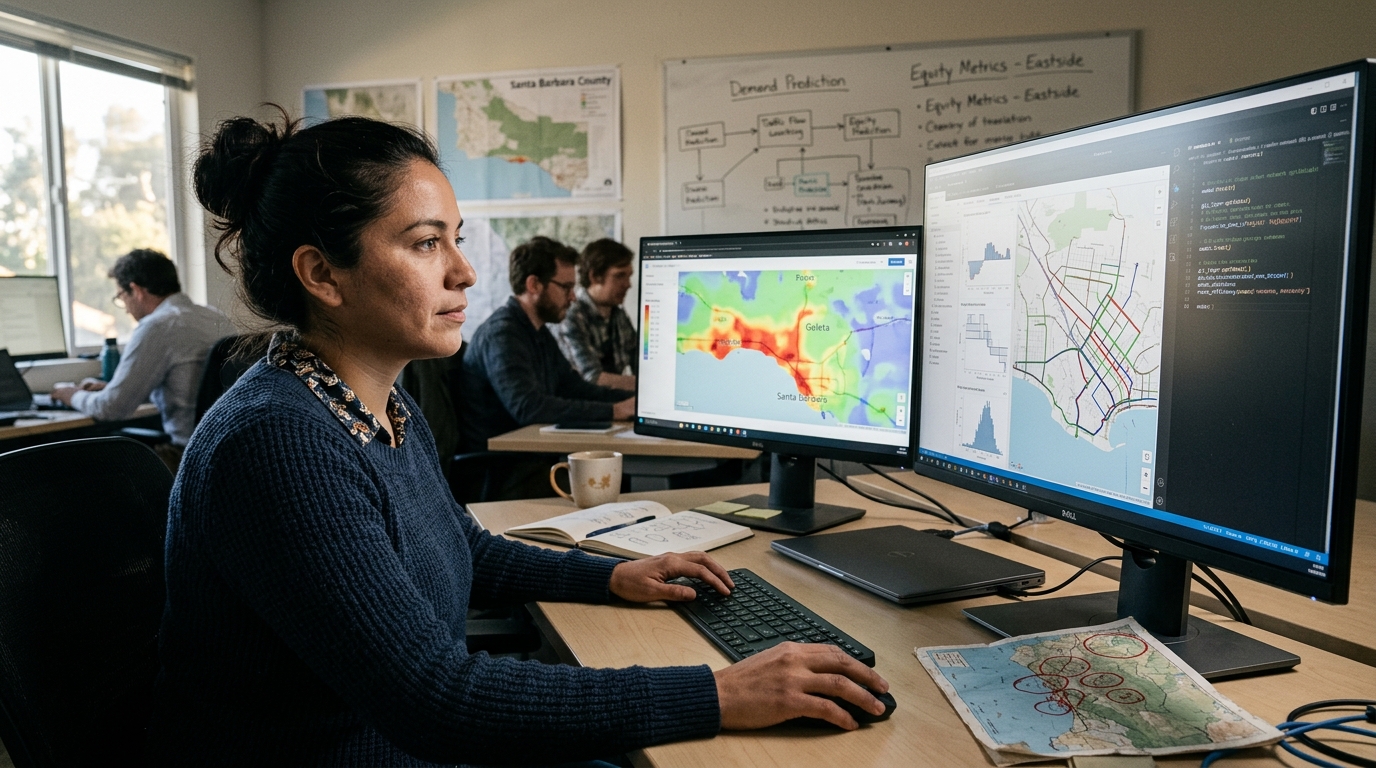
Traditionally, bike lane planning relied on manual counts and static models that often failed to predict real-world human behavior. Santa Barbara's new initiative utilizes the Replica platform, an AI tool that analyzes massive volumes of anonymized data from mobile devices, vehicle sensors, and credit card transactions. This allows planners to create a "digital twin" of the county, where they can simulate how a new bike lane might affect traffic flow, safety, and access to local businesses.
"It's no longer about guesswork. We can see where people are going, why they choose certain routes, and what is preventing them from choosing a bike," says a transportation planning official.
The use of AI enables the identification of "desire lines"—paths that people want to take but avoid due to a lack of infrastructure or perceived danger. By analyzing these patterns, AI can suggest interventions that maximize network utility with minimal expenditure.
Safety and Social Equity
A primary goal of the program is achieving "Vision Zero"—the target of zero traffic-related fatalities. AI can identify "black spots" in the road network that have not yet appeared in official accident statistics by analyzing hard braking events or near-miss maneuvers captured by telematics data. This proactive approach is revolutionary, allowing for interventions before a tragedy occurs.
Furthermore, AI helps address systemic inequities. Historically, cycling infrastructure has been concentrated in affluent neighborhoods. The Santa Barbara model analyzes the commute patterns of low-income workers who depend on bicycles for employment, ensuring that new investments are directed where the need is most acute. The ability of AI to cross-reference demographic data with mobility patterns offers a more equitable distribution of public resources.
Privacy Challenges and the Human Element
Despite the enthusiasm, the use of AI in urban planning raises significant questions. Data privacy is the paramount concern. While companies like Replica claim that data is entirely anonymized and synthetic, the potential for "re-identification" of individuals through unique movement patterns remains a technical and ethical risk. Santa Barbara authorities must balance the need for precision data with the respect for individual liberties.
Moreover, there is a fear of "technocratic blindness." An algorithm might optimize a route for speed but ignore the aesthetic character of a neighborhood or its historical significance. Community engagement remains irreplaceable. AI should function as a consultant, not a decision-maker. Residents must have the final say in how their public space is transformed, using AI data as a tool for dialogue rather than an unquestionable authority.
The Future of Smart Cities
The Santa Barbara experiment is being closely watched by cities globally. If successful, it could serve as a blueprint for a new generation of urban design where technology serves both humanity and the environment. The transition from the "car city" to the "human city" requires courage, innovation, and, as it turns out, a healthy dose of algorithmic intelligence. The stakes are high: proving that high-tech can promote the simplest, most ecological form of transport ever invented.