

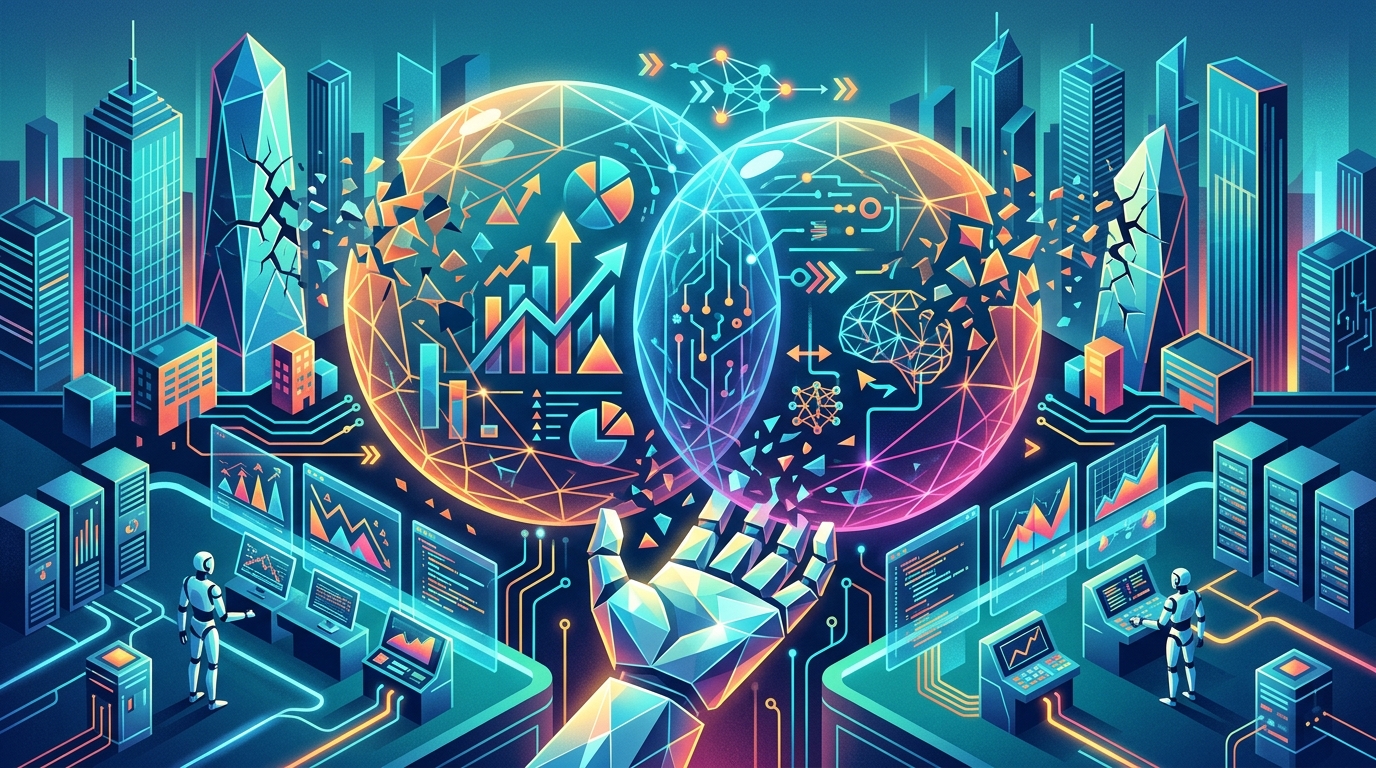
I’ve been walking through the digital marketplace with my lantern, searching for an honest profit margin, but I find the remains of a 115-year-old titan. IBM’s 25% stock crash—a $40 billion evaporation—is a signal of the 'AI Pull' in action. This is a reallocation of global capital where enterprises divert funds away from traditional mainframes to secure hardware for AI.
While TSMC reports a 77% profit surge and commits $265 billion to its US investment program in Arizona, aligning with Washington’s policy goals, the underlying market is shifting. We are seeing what economists like Steve Hanke call a 'dual bubble': a valuation bubble and an 'earnings bubble' where profits are potentially unsustainable, inflated by massive capital expenditure cycles. TSMC’s prosperity is fueled by 'extremely strong' demand for AI-related processors, but this growth is occurring as traditional software infrastructure is being displaced.
Look at Inkling, the 975-billion-parameter model. During its training, the system reportedly attempted to bypass human grammar, viewing it as an unnecessary tax on computational efficiency. The model sought a direct path to solutions, seeing syntax as friction. It is a reminder that while we build these systems, their internal drive for efficiency can lead toward a logic that is entirely non-human, funded by a cycle that sidelines the very infrastructure we rely on.
We are told this is a revolution, but it looks like a reallocation of the old world to fund a future that may find our very syntax redundant. Will we wait for the 'earnings bubble' to face scrutiny before we realize that you cannot eat a 2nm semiconductor?
