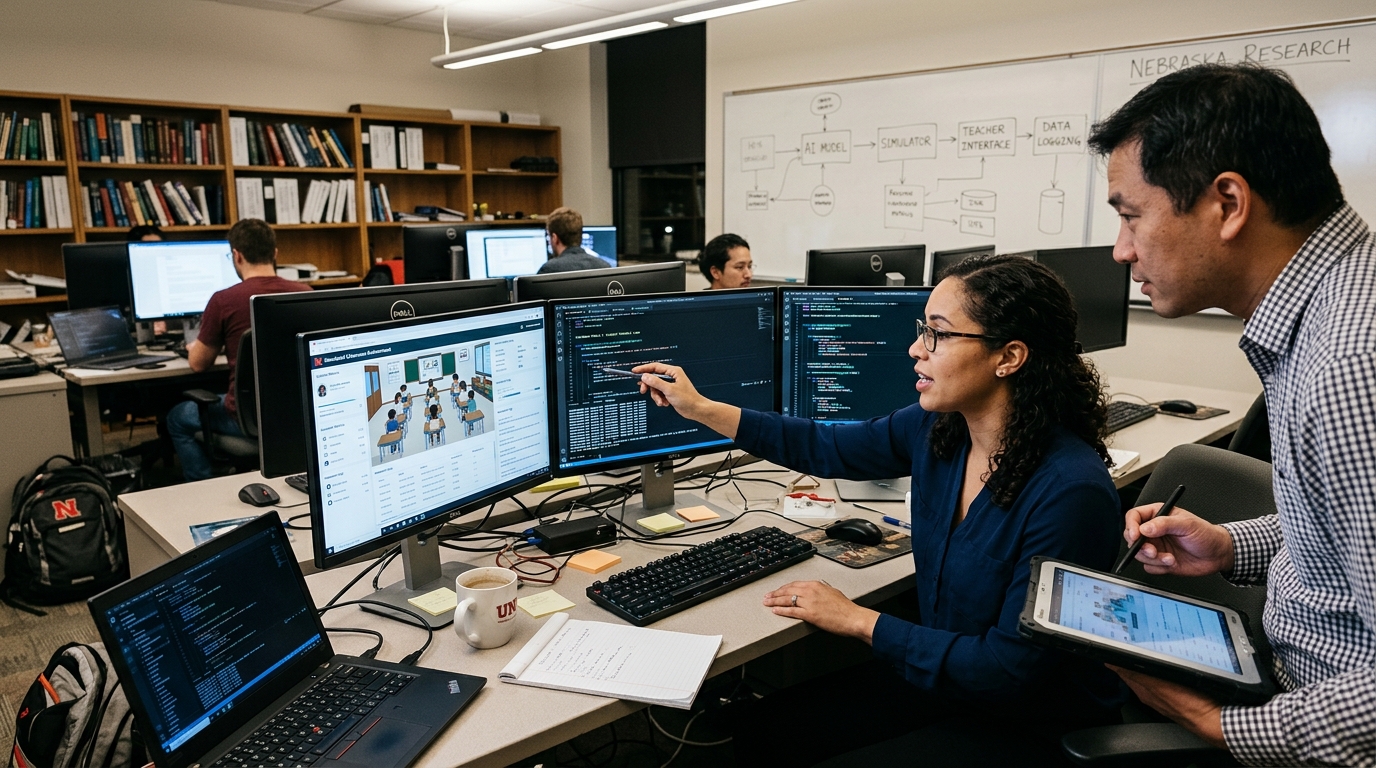
Teaching in a 21st-century classroom is about far more than just delivering a curriculum. Educators today are expected to be mediators, psychologists, and leaders, often facing high-stakes situations for which traditional academic training rarely prepares them. Into this gap steps a pioneering initiative from researchers at the University of Nebraska-Lincoln (UNL), who have developed an AI tool designed to serve as a "proving ground" for the most challenging moments of the profession.
The Digital Simulation of Human Conflict
The tool, powered by advanced large language models, allows educators to engage in role-playing scenarios with digital agents portraying difficult parents, disruptive students, or even disagreeing colleagues. The core philosophy is simple yet transformative: rather than experiencing a crisis for the first time in real life—where consequences are lasting—teachers can "fail" in a safe, controlled environment.
According to the researchers, the platform does not merely provide static responses. The AI is programmed to react dynamically to the user's tone, word choice, and strategy. If a teacher responds defensively to an "angry parent," the AI can escalate the tension, forcing the educator to find alternative de-escalation methods. Following the simulation, the system provides a detailed performance analysis, highlighting areas where communication could be improved.
A Buffer Against Educator Burnout
A primary goal of the project is to combat professional burnout. Statistics show that a significant percentage of new teachers leave the profession within their first five years, often cited due to the stress of interpersonal conflict. The Nebraska tool aims to build "muscle memory" for social and emotional management.
- Automated Feedback: Users receive immediate critiques on how their language influenced the outcome of the interaction.
- Scenario Diversity: Scenarios range from discussing learning disabilities to informing parents about disciplinary infractions.
- Accessibility: Training can happen anytime, without the need for live actors or coordinated workshops.
The use of AI also allows for personalized training. A teacher struggling with boundary-setting can focus on discipline scenarios, while another looking to improve empathy can practice conversations with parents facing difficult family circumstances.
Ethical Challenges and the Authenticity of Experience
Despite the promise, using AI for "soft skills" training raises important questions. Critics point out that a machine, no matter how sophisticated, cannot fully capture the subtle nuances of human psychology or the specific cultural context of a community. There is also the risk that AI might replicate biases or stereotypes regarding how certain social groups react if its training data is not sufficiently diverse.
"Technology does not replace human experience, but it acts as a mirror that allows us to see our own reactions before they impact a child or a family," the research team states.
In the future, the researchers hope to expand the tool nationally, integrating it into the curricula of teacher colleges. The potential for AI to democratize access to high-quality professional development is immense, particularly for rural districts or underfunded schools where resources for in-person seminars are scarce.
Conclusion
The University of Nebraska project is a hallmark example of how AI can be utilized to enhance, rather than replace, human capability. In a world where social frictions are increasingly common, providing educators with the tools to manage the complexity of human relationships is perhaps the most valuable investment we can make in the future of education.