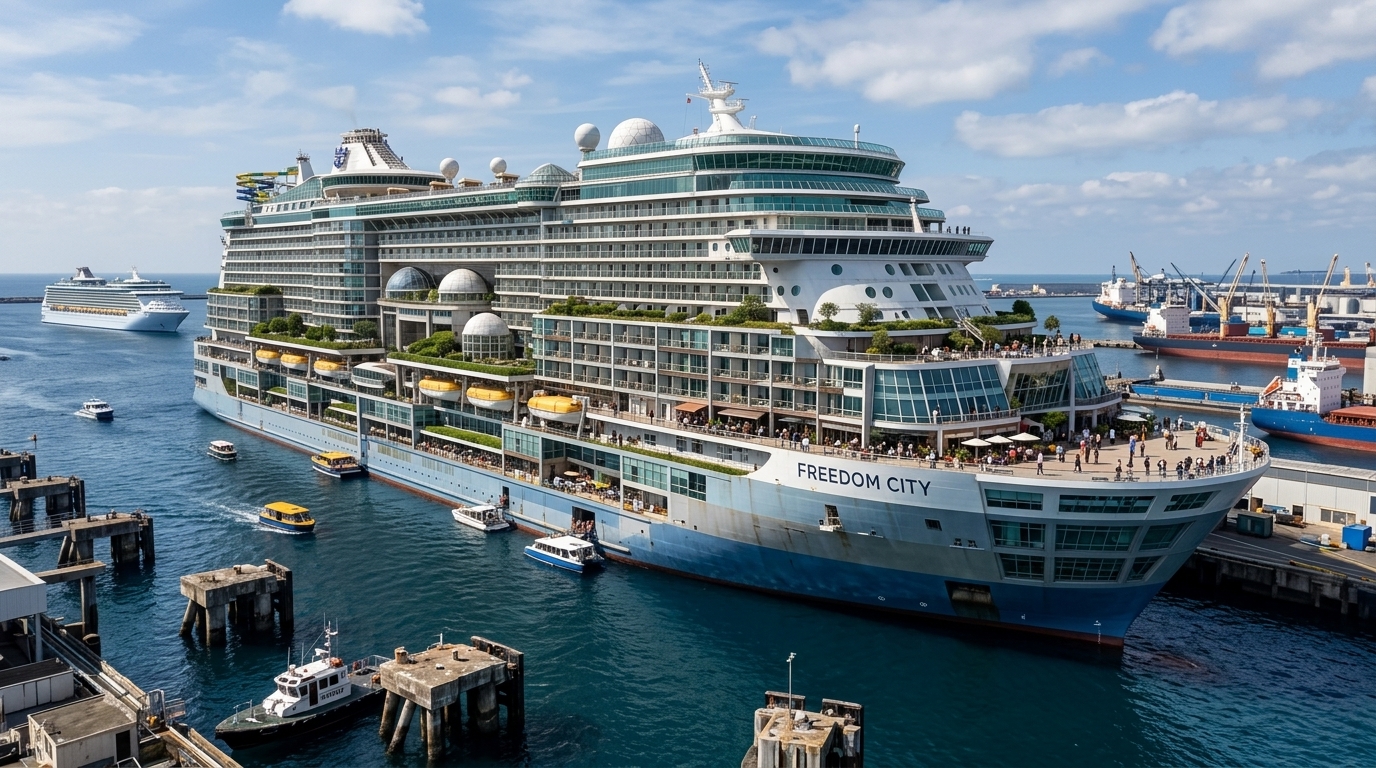
Humanity has always been fascinated by the conquest of the oceans—not merely as a means of transit, but as a space for habitation. The "Freedom Ship," a project resurfacing with renewed vigor in international headlines, is not just a cruise ship; it is a floating metropolis, an attempt to redefine the concepts of sovereignty, community, and urban development. Stretching 1.4 kilometers in length and rising 25 stories high, this ambitious venture promises to house 80,000 people, offering a fully self-sufficient life in international waters.
A City Upon the Waves: Technical Specifications
The sheer scale of the Freedom Ship is awe-inspiring. If constructed, it would be four times larger than the world's current largest cruise ship. Its structure would not resemble a ship in the traditional sense, but rather a massive floating platform. Its roof would feature a full-scale airport capable of accommodating small commercial aircraft and helicopters, allowing residents to commute to and from the mainland with ease. The internal layout includes everything: from luxury apartments and offices to hospitals, schools, shopping malls, and light manufacturing zones.
Powering this gargantuan structure remains one of the greatest technical questions. Designers propose a combination of solar energy, wind power, and advanced propulsion systems that would allow the ship to circumnavigate the globe every two years. However, waste management and the provision of potable water for 80,000 individuals require infrastructure typically found only in major land-based cities, making the environmental challenge immense.
The Political and Economic Dimension: Seasteading as Ideology
Beyond the engineering, the Freedom Ship represents the pinnacle of the "Seasteading" movement. The idea is simple yet provocative: creating permanent dwellings at sea, outside the jurisdiction of any nation-state. For its proponents, such as Peter Thiel, who has funded similar concepts in the past, life in international waters offers the ultimate freedom from state bureaucracy and taxation. The Freedom Ship aspires to operate as a "free economic zone," where businesses can innovate without the constraints of national legislation.
"The Freedom Ship is not just a vessel; it is an experiment in governance. We aim to create a society where individual liberty and entrepreneurship know no borders," the project's backers state.
However, this "freedom" raises serious questions. What law would apply in the event of a crime? How would the rights of workers on the ship be protected? The potential for creating a tax haven for the global elite, insulated from the social responsibilities of the mainland, has sparked backlash from political analysts and international organizations who fear the creation of a "plutocratic dystopia."
Economic Viability and Challenges
The estimated construction cost nears $10 to $12 billion, a figure that has kept the project on the drawing board for decades. Raising such capital requires unprecedented investor confidence, especially in an era of global economic uncertainty. Furthermore, maintaining such a structure in the corrosive environment of the ocean is a financial "black hole." Critics argue that the cost of living fees and maintenance would be so high that only the ultra-wealthy could afford a life on deck.
There is also the issue of security. A vessel of this magnitude is a prime target for piracy or geopolitical pressure. While the plan includes its own security forces, the legal status of a private military force in international waters is a minefield of international law. Despite these hurdles, rising sea levels due to climate change make the research into floating cities more relevant than ever, transforming the Freedom Ship from a wild idea into a potential model for the future of humanity.
- Length: 1,371 meters (nearly 1 mile).
- Population: 40,000 permanent residents, 30,000 visitors, 10,000 staff.
- Infrastructure: Airport, hospital, schools, casinos, shopping malls.
- Movement: Continuous sailing around the world, docking near major ports.
In conclusion, the Freedom Ship remains one of the boldest visions of the 21st century. Whether it is a utopian escape from the problems of the modern world or a realistic solution to space scarcity and the climate crisis, its evolution will define how we perceive the limits of technology and social organization.