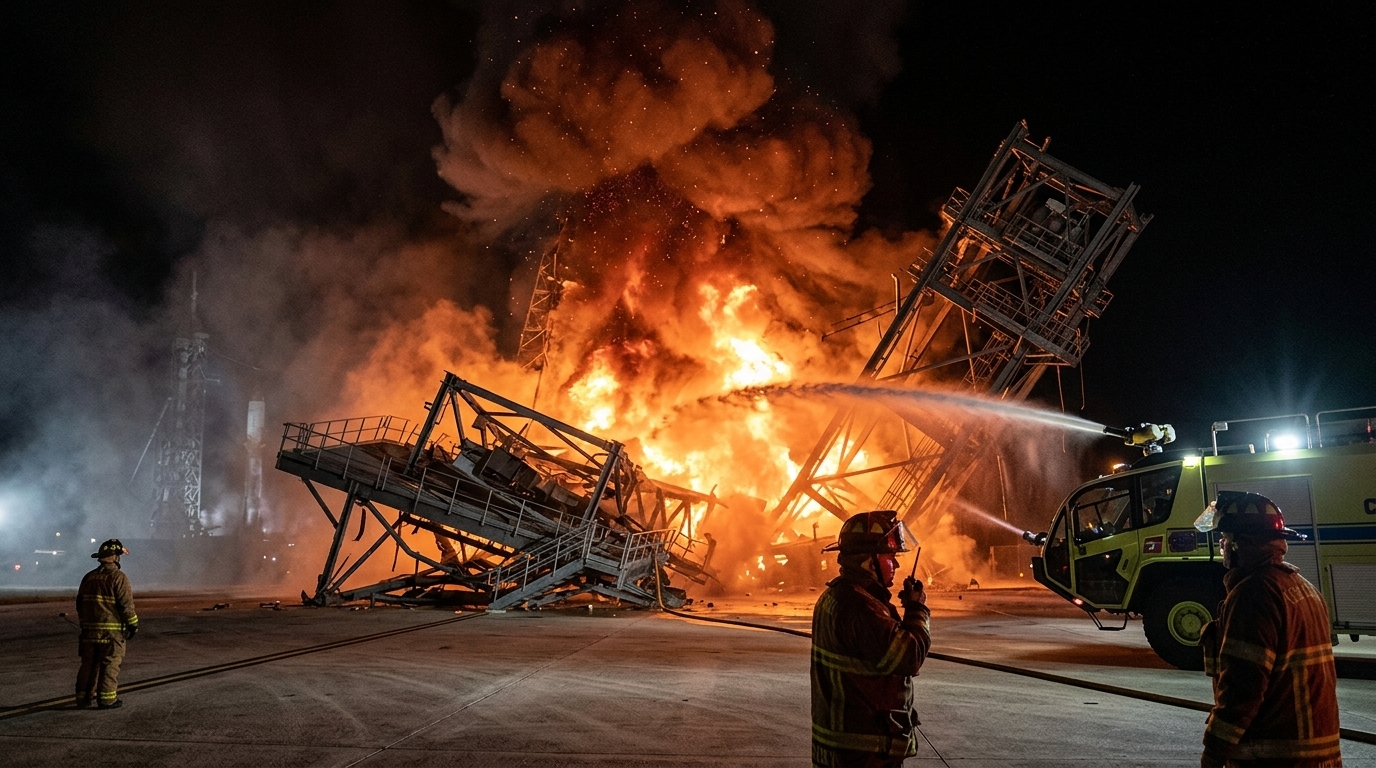
The habitual hum of Florida’s Space Coast was shattered on Friday morning when a Blue Origin rocket vehicle exploded during a critical testing phase at Cape Canaveral. The incident, confirmed by the company shortly after the shockwaves subsided, represents a significant setback for Jeff Bezos’s aerospace ambitions. While the fireball was massive, Blue Origin was quick to report that all personnel were accounted for and safe, a testament to the rigorous safety perimeters maintained at Launch Complex 36.
The Anatomy of an Anomaly
Initial reports suggest the explosion occurred during a static fire test—a standard procedure where rocket engines are ignited at full thrust while the vehicle remains tethered to the ground. Observers near the Kennedy Space Center described a sudden ignition that quickly escalated into a catastrophic failure, sending a plume of dark smoke into the Atlantic sky. It remains unclear whether the anomaly involved the full New Glenn heavy-lift booster or a specific test rig for the BE-4 engines, which are slated to power both Blue Origin’s fleet and the United Launch Alliance’s Vulcan rockets.
Jeff Bezos issued a statement acknowledging the gravity of the event, noting that the investigation is in its "infancy." "Spaceflight is an unforgiving endeavor, but our commitment to the mission remains unshaken," Bezos stated. For industry analysts, however, the event underscores the inherent risks of the 'New Space' era, where the pressure to iterate rapidly often collides with the physical limits of aerospace engineering.
Strategic Implications for NASA and the Space Race
The timing of this explosion could not be more sensitive. Blue Origin is currently under immense pressure to deliver the New Glenn rocket to satisfy a growing backlog of commercial satellite launches, including Amazon’s own Project Kuiper. Furthermore, NASA has a vested interest in the company's success, having awarded Blue Origin a multi-billion dollar contract to develop the Blue Moon human landing system for the Artemis V mission.
- BE-4 Engine Dependency: As the BE-4 is the primary propulsion system for multiple American launch vehicles, any systemic flaw discovered during this investigation could ground not just Blue Origin, but also critical national security launches.
- The SpaceX Shadow: With SpaceX achieving a near-orbital cadence that has become the industry benchmark, Blue Origin’s delays are increasingly viewed through a lens of competitive urgency.
- Financial and Insurance Fallout: The loss of hardware and the subsequent delay in launch schedules will likely trigger complex insurance claims and potentially affect the private valuation of the firm.
Gradatim Ferociter: A Philosophy Tested
Blue Origin’s motto, *Gradatim Ferociter* (Step by Step, Ferociously), has long been contrasted with Elon Musk’s "move fast and break things" ethos. Bezos has historically favored a more methodical, secretive development process. Yet, this high-profile failure at Cape Canaveral suggests that even the most deliberate engineering paths are subject to the violent realities of liquid oxygen and high-pressure combustion.
"Space does not care about your pedigree or your bank account; it only cares about the physics being perfect," remarked a former flight director.
Looking ahead, the Federal Aviation Administration (FAA) will likely oversee the mishap investigation, a process that can take months to conclude. During this time, Blue Origin’s launch pads will remain silent, potentially allowing competitors to widen their lead. As the global powers vie for lunar dominance and orbital infrastructure, the explosion in Florida serves as a sobering reminder that the road to the stars is paved with both fire and fortitude. The recovery from this event will define whether Blue Origin is a true contender for the cosmos or a perpetual runner-up in the billionaire space race.