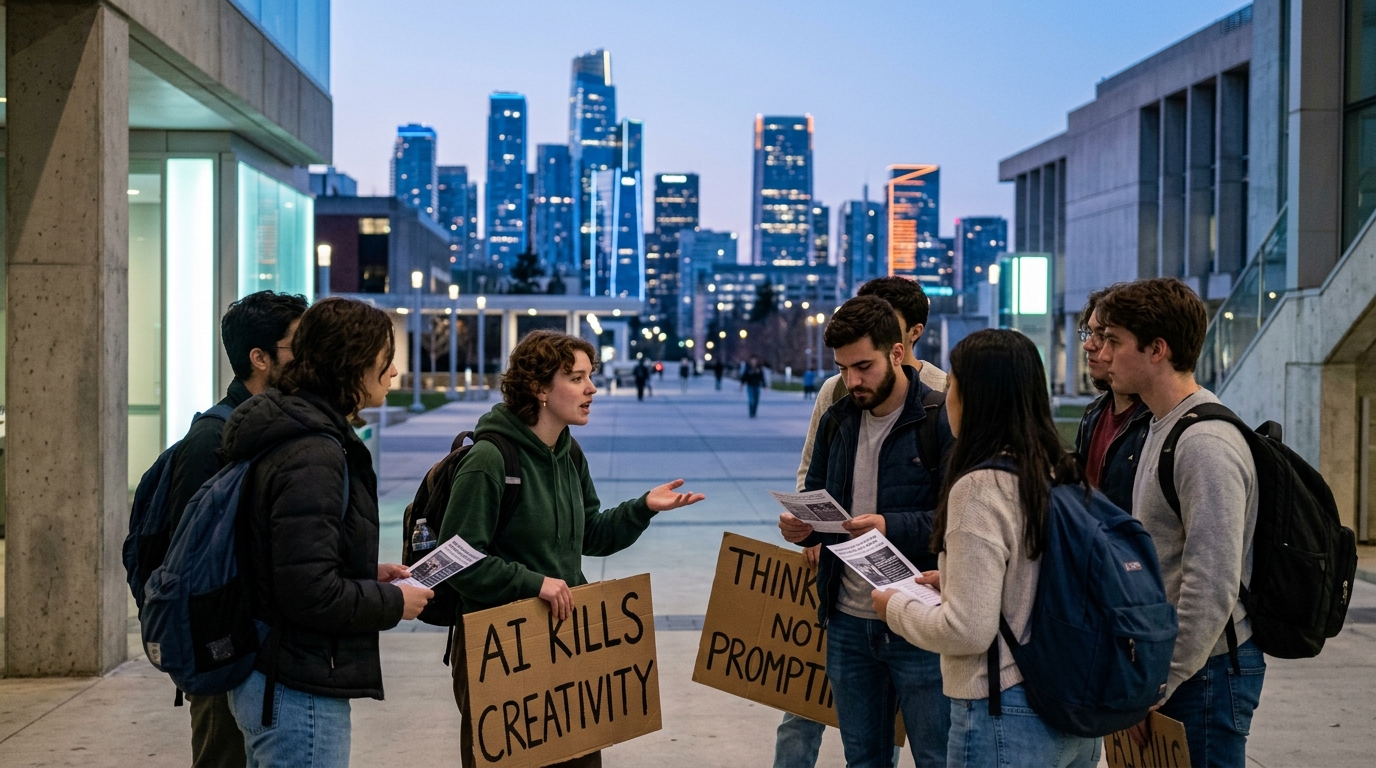
May 2026. The image of a student using ChatGPT to sneakily write an essay is now considered outdated. Today, the conversation has shifted to a much more complex and confrontational arena: the universal, often mandatory, integration of Artificial Intelligence (AI) into every facet of higher education. From automated grading systems to AI "mentors" replacing faculty office hours, the academic experience is being radically transformed, sparking an unexpected but firm pushback from the student body.
According to recent reports from StartupHub.ai and international news outlets, a growing wave of protest is being observed across leading academic institutions. Students are not rebelling against the technology itself, but against the way university administrations are deploying it as a cost-cutting tool, sacrificing educational quality and the human connection that lies at the heart of academic life.
The Devaluation of the Degree and the Fear of 'Automated Knowledge'
The primary argument of student movements is the perceived devaluation of their degrees. In a world where AI can generate high-level academic papers in seconds, students worry that their own hard work is being equated with algorithmic output. "If my professor uses AI to design the course and AI to grade my paper, and I use AI to research it, then what is the point of my being here?" asks Maria Papadopoulou, a student at the National Technical University of Athens.
There is a pervasive sense that the university is turning into a "credential mill" devoid of genuine intellectual cultivation. Students point out that critical thinking and the Socratic method—elements born in the ancient Agora—are at risk of being lost amidst pre-set prompts and standardized responses from Large Language Models (LLMs). This resistance is not about denying progress; it is a demand for an education that remains profoundly human.
The Tuition Paradox and Digital Surveillance
Another critical point of friction is financial. While tuition fees globally continue to rise (or remain high), universities are investing heavily in AI infrastructure that often leads to a reduction in teaching staff. Students feel they are paying a "premium" price for an experience that is becoming increasingly "basic." The replacement of teaching assistants with chatbots is seen by many as a breach of the implicit contract between the institution and the learner.
"We don't pay thousands of dollars to converse with an algorithm. We pay for access to human minds, for the inspiration and guidance that only a teacher can provide," stated a press release from a major US student union.
Furthermore, the use of AI for exam proctoring has sparked a firestorm regarding privacy. Systems that track eye movements, heart rates, or the student's physical surroundings via camera are viewed as invasive and often inaccurate. These systems frequently lead to false accusations of cheating, particularly against neurodivergent students or those who lack ideal study conditions at home.
'Algorithmic Injustice' and the Need for Transparency
Transparency constitutes the third major front. Many universities utilize algorithms to evaluate student progress or even to predict which students are at risk of dropping out. These "black box" decision-making tools often incorporate biases present in their training data, disproportionately affecting minorities and students from lower socioeconomic backgrounds. The demand for "Explainable AI" in education is no longer a technical issue; it is a matter of social justice.
In conclusion, the student pushback of 2026 represents a milestone. It is not a Luddite movement seeking to break the machines, but a conscious effort to redefine the role of technology. AI should be the crutch, not the runner. As we move forward, the challenge for universities will be to find the middle ground: using AI to liberate professors from bureaucracy, allowing them to devote more time to meaningful teaching, rather than replacing them with cold lines of code.