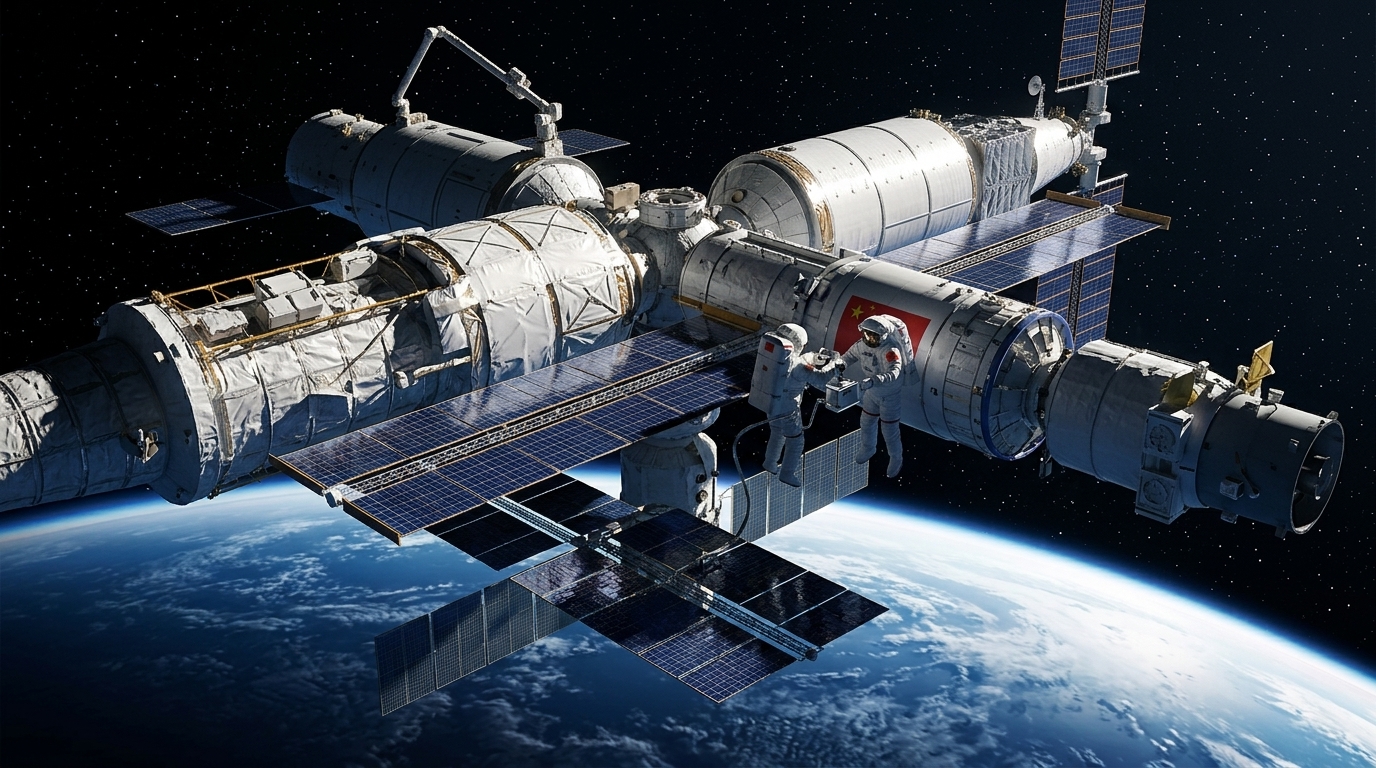
The announcement by the China Manned Space Agency (CMSA) regarding the deployment of a taikonaut to the Tiangong space station for a full year is more than just an attempt to break a national record. It is a strategic milestone in Beijing's roadmap to the Moon. As global competition for space dominance intensifies, China is demonstrating a methodical and disciplined approach, focusing on understanding the long-term effects of microgravity and cosmic radiation on the human body.
This mission, expected to launch within the coming years, will double the typical six-month stay of Chinese crews in orbit. This move aligns with the country's ambitious plans to land a manned mission on the lunar surface by 2030. To achieve this, China's scientific community must answer critical questions regarding the physiological and psychological degradation caused by prolonged living outside Earth's atmosphere.
The Physiology of Survival in Deep Space
Staying in space for a year is one of the harshest tests for the human body. In weightlessness, muscles atrophy and bone density decreases at rates that would be considered pathological on Earth. Despite intensive exercise regimens, astronauts often return with vision problems, redistribution of body fluids toward the head, and weakened immune systems. China, through this mission, aims to collect data that will allow it to develop advanced countermeasures, such as new pharmaceuticals and specialized exercise programs, to ensure that taikonauts stepping onto the Moon are capable of performing their duties.
Furthermore, the psychological dimension is equally vital. Confinement in a closed space, isolation from the natural environment, and constant exposure to danger require exceptional mental resilience. Studying the behavior and cognitive function of a taikonaut over 365 days will provide invaluable insights into how future lunar colonies and, eventually, missions to Mars should be structured.
The Tiangong Station as a Testbed
The Tiangong (Heavenly Palace) space station is the crown jewel of the Chinese space program. Unlike the International Space Station (ISS), which is approaching the end of its operational life, Tiangong is new, technologically advanced, and entirely controlled by a single nation. This gives Beijing the flexibility to conduct experiments without the constraints of international bureaucratic partnerships. The year-long mission will also stress-test the station's life support systems, which must operate continuously and with absolute precision to recycle water and oxygen.
The success of this mission will establish China as the only nation, alongside Russia and the US, to possess the expertise for such long-duration manned flights. It is a demonstration of power and technological sovereignty, especially at a time when geopolitical tensions are shifting from the planet's surface to its orbit.
The New Space Cold War
One cannot examine China's moves without mentioning the American Artemis program. NASA and its partners also aim for a return to the Moon, with the creation of the Gateway station in lunar orbit. China, for its part, leads the International Lunar Research Station (ILRS), an initiative bringing together allies like Russia and other nations of the Global South. The Moon is no longer just a destination for a flag and a few photos; it is the new strategic ground for resource extraction, such as Helium-3, and a base for further exploration of the solar system.
The decision for a year-long mission shows that China is not rushing into a superficial step but is preparing for a permanent presence. This methodicity is what concerns analysts in Washington, as Beijing seems to adhere to its schedules with impressive consistency. While the West often struggles with changes in funding and political priorities, the Chinese space program enjoys steady, long-term support that allows it to plan decades ahead.
Conclusion
Sending a taikonaut into space for a year is the prelude to a new era. It is proof that humanity—and in this case, China—is ready to break Earth's bonds for longer durations. As we approach 2030, Tiangong will remain the central laboratory where the technologies and endurance required for humans to truly become a multi-planetary species will be forged. The question is no longer whether China will reach the Moon, but what it will find there and how it will shape the future of space governance.