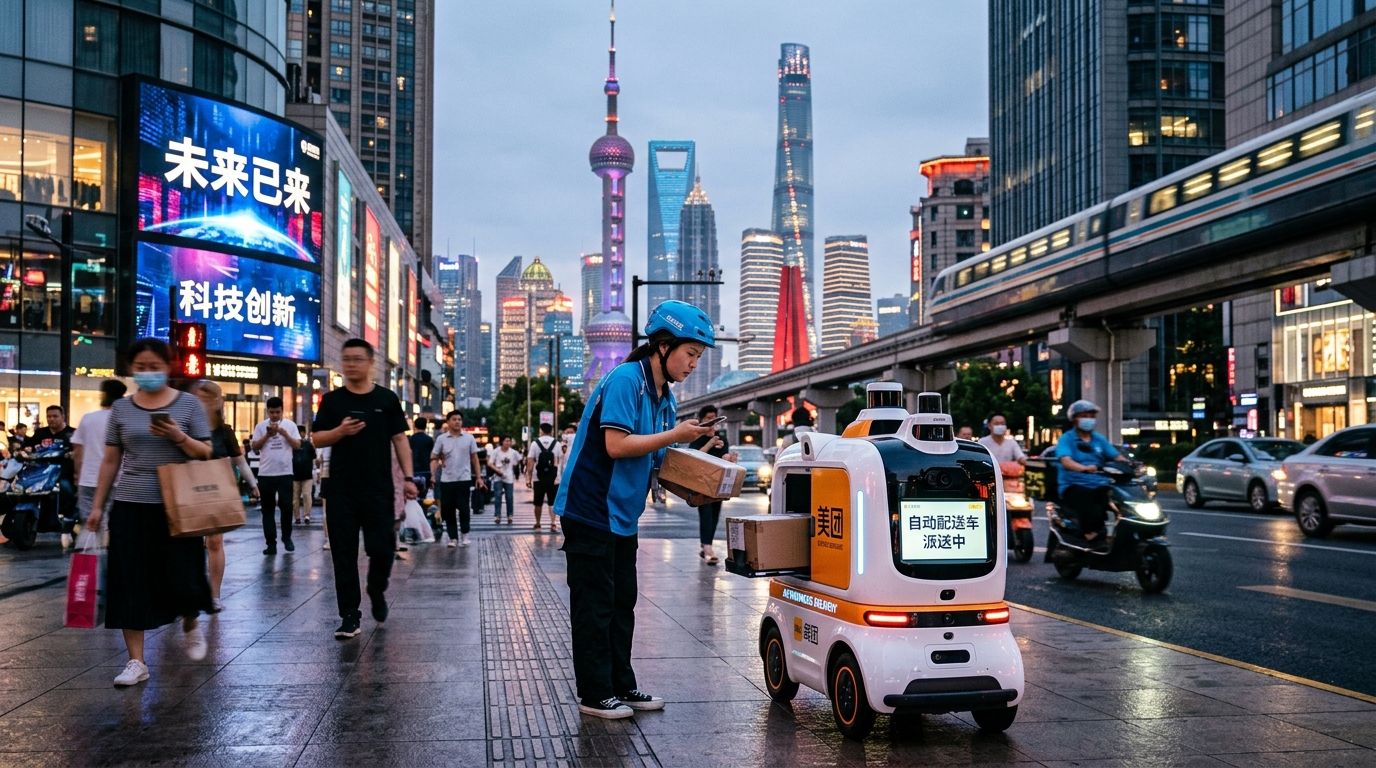
In the streets of Shenzhen and Shanghai, the future depicted in science fiction films is no longer a promise but a tangible, daily reality. While in Europe and the United States, discussions surrounding Artificial Intelligence (AI) often focus on regulatory frameworks, existential risks, and future possibilities, China has moved toward a massive, scalable application of technology that is radically changing the landscape of work, transportation, and social interaction. The country is not waiting for the "next big revolution"; it is already living it.
The Ubiquitous Digital Infrastructure
China's difference lies in the speed of integration. From 2024 onwards, the use of Large Language Models (LLMs) like Baidu's Ernie Bot and Alibaba's Tongyi Qianwen has moved beyond the experimental stage. These systems are not just "chatbots" for writing emails; they form the backbone of industrial automation and customer service. In the retail sector, AI analyzes the preferences of millions of consumers in real-time, adjusting supply chains with a precision that would have seemed impossible a decade ago.
One of the most striking examples is autonomous driving. While robotaxi trials in the West encounter legal and social hurdles, in cities like Beijing and Wuhan, fleets of Apollo Go autonomous vehicles serve thousands of citizens daily. The "Smart City" infrastructure allows vehicles to communicate with traffic lights and the road network, reducing congestion and accidents. This symbiosis of hardware and software is the hallmark of the Chinese approach: AI is not an isolated tool but a layer that covers the entire urban environment.
Strategic Autonomy and the Semiconductor War
This progress was not achieved by chance. Beijing has set a national goal of AI hegemony by 2030. Despite strict US restrictions on the export of advanced chips (such as those from Nvidia), China has invested billions in domestic semiconductor production and the development of algorithms that require less computing power. Huawei, SMIC, and other Chinese companies have managed to create ecosystems that, while lagging in absolute cutting-edge power, excel in specialized applications and energy efficiency.
- Development of domestic GPUs for AI model training.
- Focus on the "Artificial Intelligence of Things" (AIoT) to interconnect billions of devices.
- State support for startups focusing on the industrial application of AI.
This strategy has created a "closed market" fueled by a massive volume of data. With a population of 1.4 billion people using digital payments for everything from subway tickets to grocery shopping, the amount of data available for training AI models is unsurpassed. In China, "data" is the new oil, and its refining is happening at a pace that the West finds difficult to follow due to stricter privacy protection rules.
The Social Dimension: Convenience vs. Privacy
Of course, this rapid adoption does not come without a cost. The use of AI in surveillance and the social credit system remains a controversial issue. In China, the concept of privacy is perceived differently: many citizens seem willing to trade their data for security and convenience. Facial recognition allows for cardless or mobile-less payments, while AI in education helps personalize learning for millions of students in rural areas.
"Artificial Intelligence in China is not a luxury product for the few, but a public service for the many," says a technology analyst in Beijing.
However, the challenge of job displacement is equally intense. With automation invading factories and services, the Chinese government is called upon to manage a massive reallocation of the workforce. Education and retraining of workers are now a priority, as the "old economy" gives way to a structure based almost entirely on algorithms. The bet is whether this transition can occur without social unrest, at a time when the country's economic growth is showing signs of slowing down.
Conclusion: A Lesson for the World?
The example of China shows that AI is not just a matter of code, but also a matter of political will and social acceptance. While the rest of the world watches with awe and skepticism, China has already turned the page. The debate over whether AI "will come" is over; the question now is how it will evolve in an environment where technology is now inseparable from human existence. The West may need to find its own balance, but it can no longer ignore the fact that the center of gravity for digital innovation has shifted eastward.