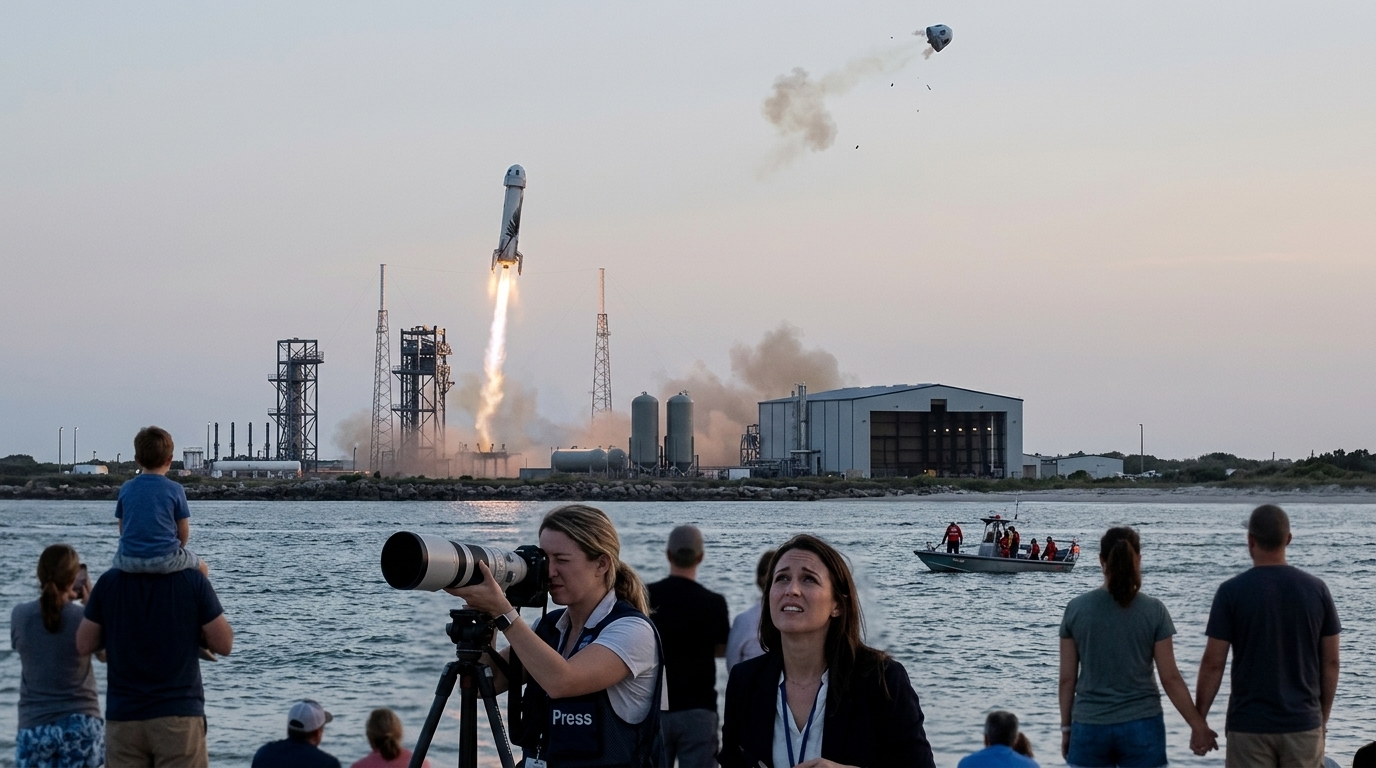
Space exploration has never been a linear path to glory, and Blue Origin's recent mission serves as the most potent reminder of this reality. In a launch that was expected to solidify Jeff Bezos's company as a peer competitor in the heavy-lift market, the result left a lingering sense of incomplete triumph. While the New Glenn booster returned victoriously, proving the viability of the company's reuse technology, the upper stage failed to complete its mission, leaving the payload in an incorrect orbit.
A Mechanical Triumph Overshadowed
The successful landing of the New Glenn booster on the landing platform "Jacklyn" in the Atlantic Ocean is an engineering feat that should not be underestimated. After years of delays and skepticism from industry analysts, Blue Origin proved that its 98-meter-tall behemoth could return and be reused, drastically reducing the cost of access to space. The use of BE-4 engines, powered by liquefied natural gas (LNG) and liquid oxygen, functioned flawlessly during the ascent and descent phases.
However, the celebration at the company's Merritt Island facilities was short-lived. During the firing of the second stage, which is responsible for the final push of the payload into the target orbit, an anomaly occurred that led to a premature engine shutdown. The result was the loss of the mission's operational capability, despite the fact that the "hardest" part—recovering the rocket—had been successfully achieved.
The Price of Complexity and Competition
This failure comes at a critical juncture for Blue Origin. With Amazon pushing for the launch of thousands of satellites for Project Kuiper and NASA relying on the company for the lunar lander of the Artemis program, reliability is the most important currency. Elon Musk's SpaceX has already set the bar very high, with Falcon 9 demonstrating near-perfect reliability and Starship moving through rapid testing phases.
- Reuse reduces costs but increases the need for perfect execution at every stage.
- The New Glenn upper stage is expendable (for now), making every failure extremely costly.
- Blue Origin's customers, such as the Pentagon, demand a level of consistency that the company is still struggling to demonstrate.
According to internal sources, the problem appears to be located in the fuel delivery system of the upper stage, which was exposed to conditions not fully anticipated in ground tests. This highlights the gap between simulation and the harsh reality of the vacuum of space.
Geopolitical Dimensions and the Road Ahead
This is not merely a corporate setback. The ability of the United States to maintain its dominance in space relies on having multiple launch providers. If Blue Origin fails to resolve New Glenn's issues promptly, the market will remain a de facto SpaceX monopoly—a prospect that worries both regulators and strategic planners in Washington.
"The history of aerospace is written with failures that became lessons. The question for Blue Origin is whether it can learn fast enough to remain relevant," says a market analyst.
In conclusion, Blue Origin stands at a crossroads. The success of reuse is a victory for engineering, but the failure of the upper stage is a reminder that in space, there are no half-measures. Jeff Bezos has the capital, but time is a resource that even the world's wealthiest man cannot buy in unlimited quantities.