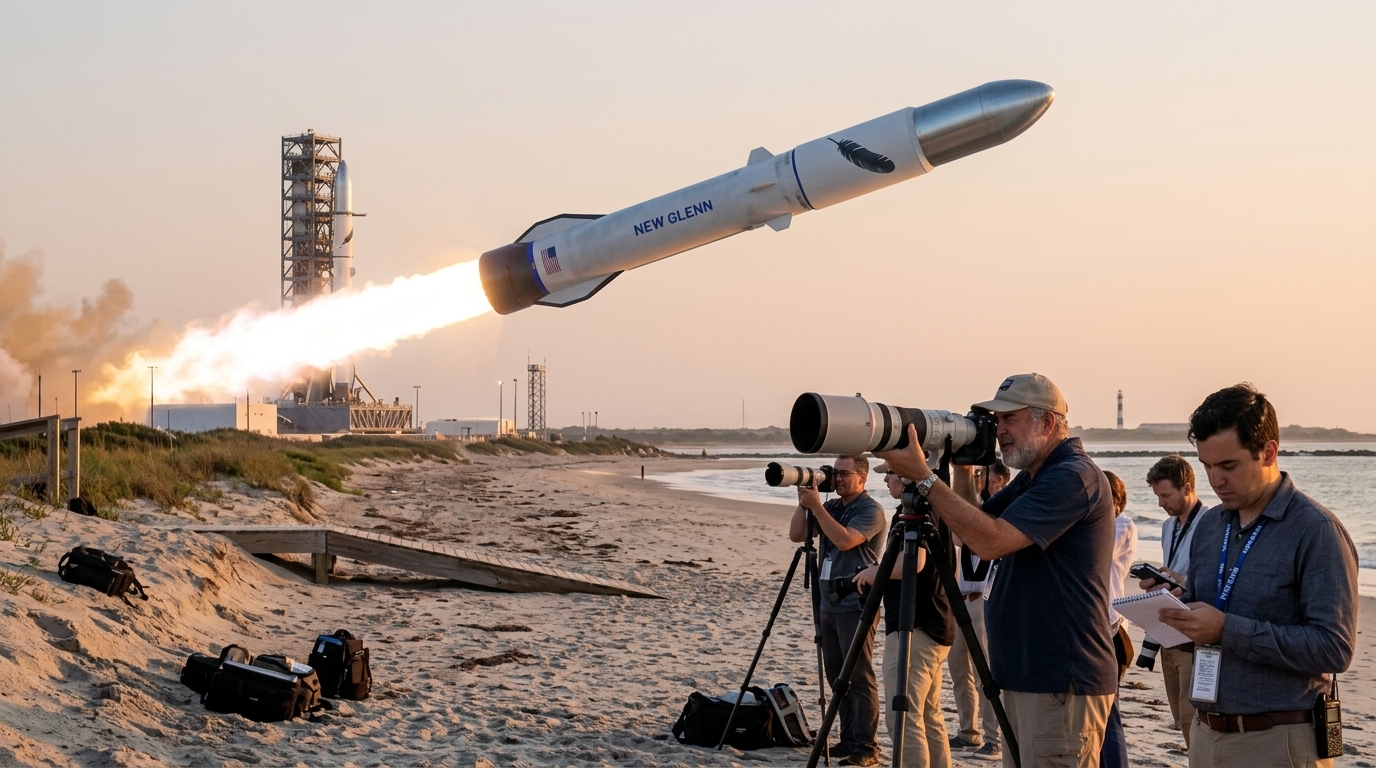
The era of disposable rocketry is rapidly drawing to a close as Jeff Bezos’s Blue Origin reached a pivotal milestone in its quest to become a dominant force in the orbital economy. The recent launch of AST SpaceMobile’s BlueBird 7 satellites was more than just a successful cargo mission; it was the definitive proof that the massive New Glenn rocket can fly, land, and fly again, effectively breaking SpaceX’s long-standing monopoly on reliable heavy-lift reusability.
The Engineering Prowess of New Glenn
New Glenn is no ordinary rocket. Standing at 98 meters tall with a cavernous 7-meter diameter payload fairing, it is designed to carry volumes that other rockets simply cannot accommodate. At its core lie seven BE-4 engines, fueled by liquefied natural gas (LNG) and liquid oxygen. This fuel choice is strategic: LNG burns significantly cleaner than the traditional kerosene (RP-1) used by the Falcon 9, which facilitates the reuse of engines without the extensive carbon-sooting cleanup required in previous generations.
The first-stage booster touched down on Blue Origin’s landing pad with surgical precision. This marked the second time this specific hardware returned intact, demonstrating that Bezos’s promise of "at least 25 flights per booster" is not merely marketing fluff, but an achievable engineering reality. This capability drastically slashes the cost per kilogram of payload, making space access viable for a new generation of commercial ventures.
Competition with SpaceX and Geopolitical Stakes
For years, Elon Musk’s SpaceX operated essentially without a peer. The Falcon 9’s ability to land vertically rendered every other launch provider obsolete. Despite its vast resources, Blue Origin appeared to be lagging, with its motto "Gradatim Ferociter" (Step by step, ferociously) often mocked by critics as being "too slow."
"Reusability is the holy grail of space exploration. Without it, space remains a privilege of superpowers. With it, it becomes the new economic frontier," industry analysts observe.
The success of New Glenn shifts the scales. NASA and the U.S. Department of Defense always seek at least two independent providers for critical missions. Blue Origin’s emergence as a reliable partner ensures healthy competition and bolsters U.S. national security. Meanwhile, Europe watches with growing concern as the Ariane 6 remains an expendable rocket in a world that now demands reusability.
AST SpaceMobile and the Future of Connectivity
This mission also carried significant commercial weight: the deployment of AST SpaceMobile’s BlueBird satellites. These satellites are essentially "cell towers in space," promising to deliver 5G connectivity directly to standard smartphones without the need for specialized hardware. The successful deployment via New Glenn proves that Blue Origin can support the massive satellite constellations of the future, including its own Project Kuiper, which aims to rival Starlink.
In conclusion, New Glenn’s second successful flight is not just a technical victory. It is the starting gun for a new era where two billionaires will battle for celestial dominance, driving innovation at speeds no government agency could achieve alone. The question is no longer whether we will go to space, but how frequently and how affordably we can make the journey.