The era of digital assistants confined to a screen is drawing to a close in China. The nation's two largest tech titans, Alibaba and Tencent, are spearheading a fundamental shift in the global technological landscape: the transition from Large Language Models (LLMs) to 'Embodied Artificial Intelligence'. This move is not merely a technological evolution; it is a strategic necessity for survival and dominance in an environment that increasingly demands physical presence and industrial automation.
The Saturation of Chatbots and the Call for Physicality
For over two years, the tech world has been obsessed with Generative AI and its ability to synthesize text, images, and code. However, in China, the chatbot market—crowded by hundreds of models in what has been dubbed the 'War of a Hundred Models'—has begun to show signs of fatigue. Alibaba and Tencent have realized that the true value of AI in the coming decade will lie not just in its ability to answer queries, but in its capacity to interact with the physical world.
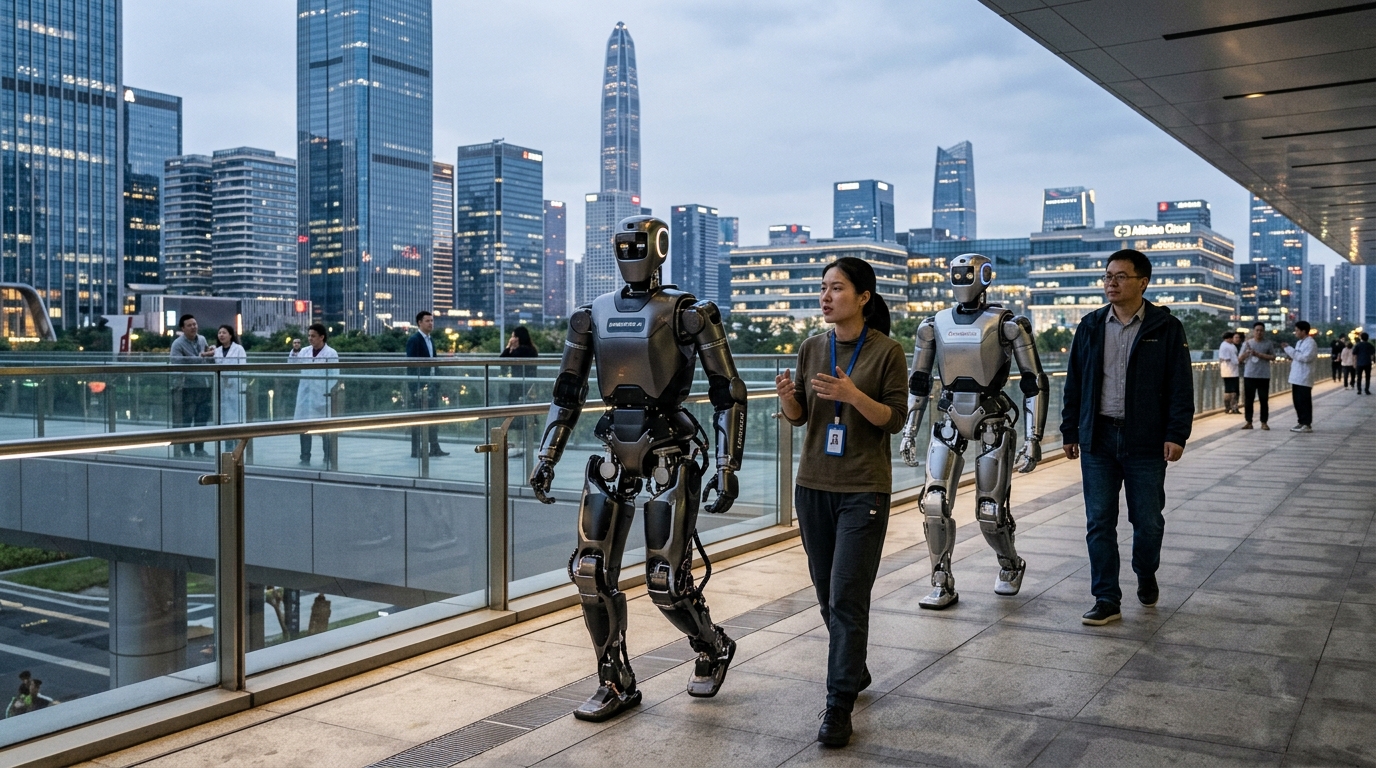
Embodied AI refers to AI systems that possess a 'body'—whether it is a robotic arm on a factory floor or a humanoid robot performing domestic chores. The challenge here is monumental: the AI must learn spatial perception, understand physics, and execute delicate movements with millimeter precision. Alibaba, through its Cloud division, is integrating its Tongyi Qianwen model into industrial robots, allowing them to understand voice commands and adjust their operations without the need for manual reprogramming.
Demographic Deadlocks and State Strategy
The pivot toward robotics is no coincidence. China is facing one of the most severe demographic crises in its history, with its working-age population shrinking rapidly. The shortage of labor in manufacturing—the backbone of the Chinese economy—makes automation the only viable path forward. The Chinese government, recognizing this existential threat, has designated Embodied AI as a priority under the banner of 'New Quality Productive Forces'.
Tencent, for its part, is utilizing its Robotics X Lab to develop robots like Max (a quadruped robot) and Ollie, which use advanced algorithms to maintain balance and navigate uneven terrain. Tencent's strategy focuses on creating a 'nervous system' for robots, where AI serves as the brain controlling motors and sensors in real-time. Analysts suggest the goal is to create systems capable of replacing humans in dangerous or repetitive tasks, maintaining productivity levels despite the declining population.
The Competition with the West and Supply Chain Dominance
The move by Alibaba and Tencent puts China on a direct collision course with American giants like Tesla (with its Optimus project) and Figure AI (backed by OpenAI). However, China holds a critical advantage: the supply chain. The country controls the vast majority of the world's production of sensors, motors, and batteries. While the US leads in the design of high-end AI chips, China can manufacture and test robots at a scale and speed that the West struggles to match.
"The next frontier of AI is not in the cloud, but in the joints and gears of machines that can perceive and act," says a lead researcher at Tencent's lab.
The integration of Vision-Language-Action (VLA) models is the secret sauce here. Unlike traditional robots that follow a pre-set script, VLA-powered robots can 'see' an object, 'understand' a command like 'pick up the red cup', and 'act' to execute it in an unstructured environment. This level of autonomy is what will separate the winners from the losers in the next decade.
Conclusion: The Future of Work and Identity
The transition to Embodied AI marks a new phase in technological history where the distinction between software and hardware becomes blurred. For Alibaba and Tencent, this is a high-stakes, high-reward gamble. If they succeed in creating robots that think and act autonomously, they will have solved not only China's production woes but also laid the groundwork for a new global industrial revolution. The challenge is no longer to build an AI that writes poetry, but an AI that can hold a hammer or care for the elderly.