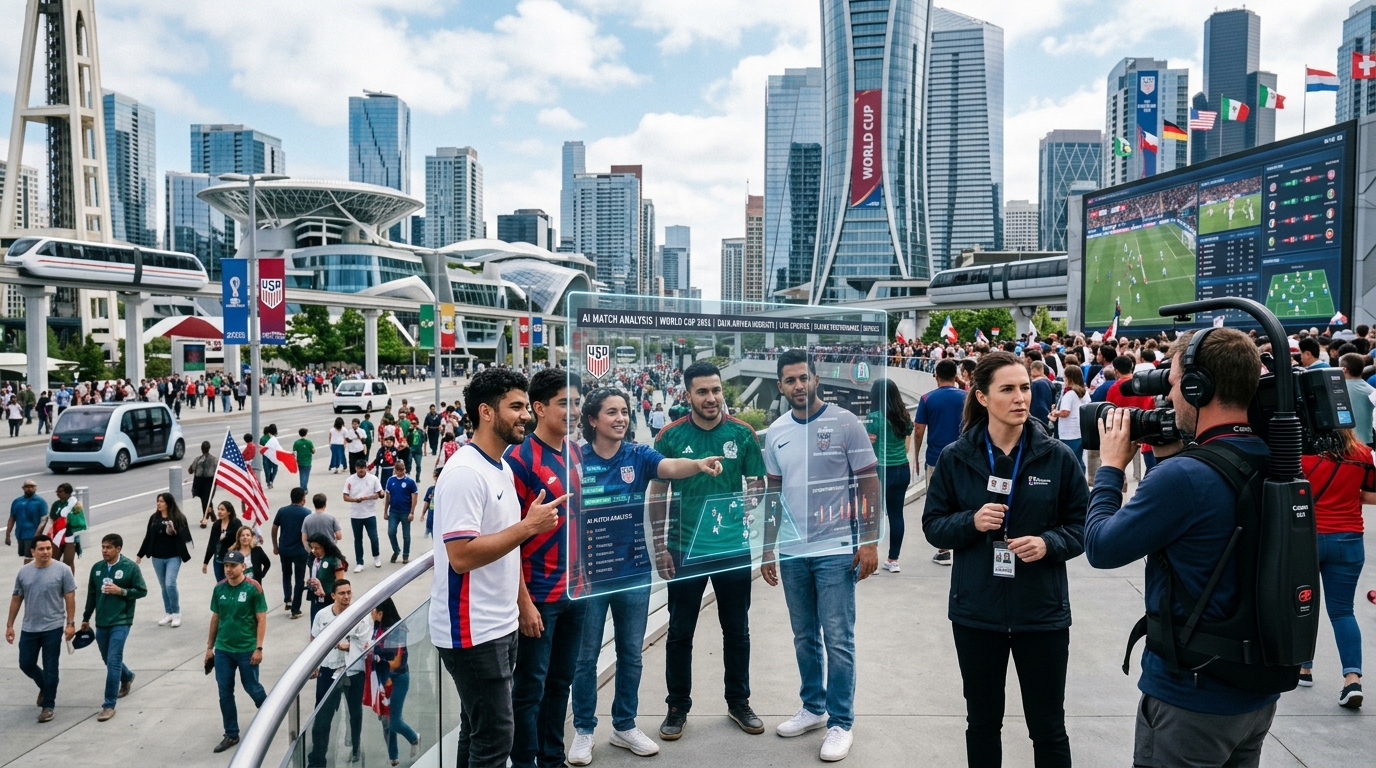
As the world prepares for the 2026 World Cup, to be hosted across the USA, Canada, and Mexico, it is becoming increasingly clear that this tournament will not just be about football, but a showcase of the most advanced technology sports has ever seen. Artificial Intelligence (AI) is no longer a futuristic promise; it is the backbone upon which the planet's largest sporting celebration is being built. With 48 teams and 104 matches spread across an entire continent, the logistical challenges are immense, and AI is the tool designed to meet them.
The Evolution of Officiating: From VAR to Semi-Automated Precision
One of the most critical areas where AI will play a decisive role is in officiating. Following the introduction of VAR, the next step is the full integration of Semi-Automated Offside Technology (SAOT). This technology utilizes a network of tracking cameras mounted under the stadium roof, which track 29 data points on each player's body, 50 times per second. AI processes this data in real-time, creating a 3D representation that allows referees to make decisions in seconds, eliminating the lengthy delays that often frustrate fans.
Furthermore, the "smart ball" will feature Inertial Measurement Unit (IMU) sensors, which will send data 500 times per second to the video operation room, allowing for the precise determination of the exact moment the ball is kicked. This combination of body and ball data enables AI to automatically alert VAR officials to any potential violation, making the game fairer and its flow faster.
Security and Crowd Management: The "Smart" Stadium
With millions of fans traveling between 16 cities in three countries, security is the top priority for FIFA and the organizers. AI will be used to analyze crowd flow in real-time. Using high-definition cameras and machine learning algorithms, control centers will be able to predict the formation of bottlenecks before they occur, redirecting fans via digital signage and mobile notifications.
"Technology does not replace human judgment, but enhances it, allowing us to manage the complexity of a continental tournament with unprecedented precision," state experts from the tournament's technical committee.
However, the use of advanced facial recognition systems and biometric data raises serious concerns regarding privacy. Organizers promise that data will be used exclusively for security and deleted after the tournament, but digital rights activists remain skeptical about whether this World Cup will serve as an experiment in mass surveillance.
The Fan Experience: Personalization and Augmented Reality
For the fan in the stands or at home, AI will transform content consumption. FIFA plans to release apps utilizing Augmented Reality (AR). By pointing their phones at the pitch, fans will see live statistics overlaid on players, shot speeds, and real-time goal probabilities. AI will also enable the creation of personalized highlight packages tailored to each user's preferences—for instance, focusing only on goalkeeper saves or the movements of a specific star player.
At the broadcast level, AI will automate production in multiple languages, using synthetic voices and real-time translations, making the World Cup accessible to billions of people in their native tongue without the need for armies of translators.
Logistics and Sustainability: The Three-Country Challenge
The 2026 edition is the largest in geographical scale. AI will play a central role in reducing the environmental footprint. Optimization algorithms will be used to schedule team flights and equipment transport, minimizing CO2 emissions. Additionally, stadium energy management systems will be AI-controlled to regulate lighting and air conditioning based on occupancy and weather conditions, saving vast amounts of energy.
In conclusion, the 2026 World Cup will not just be a football tournament, but a milestone for how Artificial Intelligence can be integrated into the human experience on a massive scale. The challenge remains to preserve the "romance" of the sport amidst an ocean of data and algorithms.