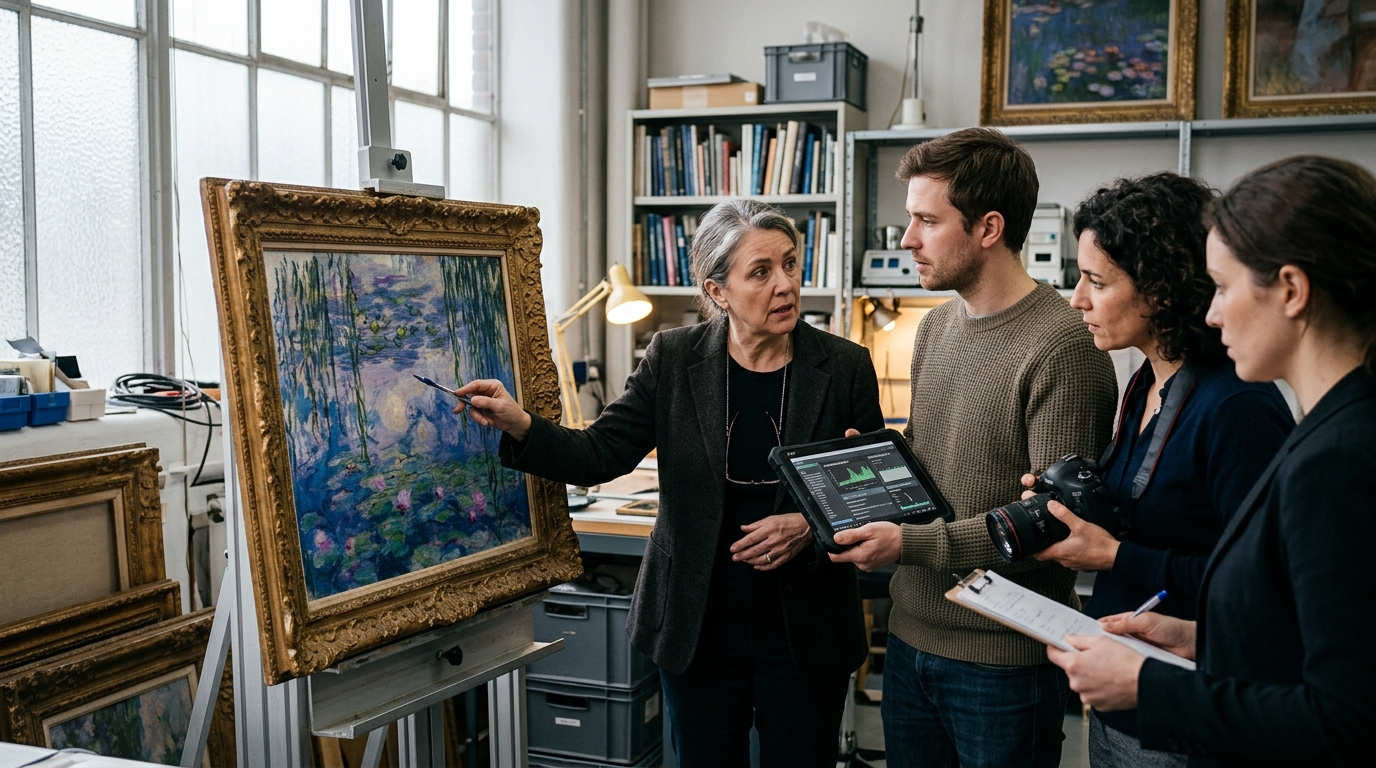
In an era where the lines between human creativity and algorithmic output are becoming increasingly blurred, a recent social media incident served as a stark mirror reflecting our deepest fears and biases. A user, driven by a desire for a sociological experiment or perhaps just a devious prank, posted a masterpiece by Claude Monet—the iconic father of Impressionism—claiming it was a product of Artificial Intelligence (AI). What followed was not just a debate about art, but a mass demonstration of what psychologists call "confirmation bias."
The audience, convinced they were looking at a creation from a model like Midjourney or DALL-E, immediately began identifying "flaws" that supposedly betrayed its non-human origin. Comments about "unnatural lighting," "incoherent brushstrokes," and a "lack of soul" flooded the post. The irony is profound: Monet, who was once ridiculed by critics of his time because his paintings looked "unfinished" and "messy," found himself in the crosshairs again, this time because his brilliant ambiguity was misinterpreted as an algorithmic glitch.
The Anatomy of a Collective Hallucination
The public's reaction to this prank reveals a critical shift in how we consume visual information. We no longer observe art to appreciate it; we observe it to "audit" it. The suspicion that something might be AI-generated has birthed a new form of paranoia. In Monet’s case, viewers invented problems where only artistic intent existed. Impressionist techniques—the emphasis on shifting light and the rapid, almost frantic brushwork—paradoxically resemble the "artifacts" produced by early iterations of generative image models.
This phenomenon can be described as a "Reverse Turing Test." Instead of trying to see if a machine can pass for a human, we are beginning to dismiss the human as a machine. Our inability to discern authenticity is not necessarily due to the perfection of AI, but to the erosion of our visual literacy. We have become so accustomed to smooth, digital surfaces that the actual, organic texture of a 19th-century oil painting appears "wrong" to the modern eye.
The Erosion of Artistic Literacy in the Digital Age
The incident also highlights the collapse of authority. In the past, the presence of a work in a museum or the signature of a grandmaster was enough to confer value. Today, in the chaos of the internet, the context accompanying an image is often more powerful than the image itself. When the prankster wrote, "Look what AI made," that context acted as a cognitive filter that distorted reality.
Self-proclaimed "experts" in the comments, who claimed they could spot AI from a mile away, were utterly exposed. This raises a serious question for the future of art history and journalism: how will we protect the truth when our senses are so easily manipulated? Technology does not just threaten the jobs of artists; it threatens our ability to recognize our own human heritage. When we lose the capacity to distinguish a masterpiece from a prompt, we lose a piece of our collective identity.
The Reverse Turing Test: When Masterpieces Become "Glitches"
There is a historical symmetry to all of this. In 1874, when Monet exhibited "Impression, Sunrise," a critic used the term "Impressionism" mockingly, believing the work lacked technique and seriousness. Today, history repeats itself in a postmodern fashion. The very freedom that liberated art from realism in the 19th century now makes it suspicious to an audience addicted to digital precision.
The takeaway from this prank is unsettling. If we can be convinced that a Monet is "fake," then the concept of aesthetic value is in danger of evaporating. Art ceases to be an experience of connection with a creator and turns into a puzzle to be solved. We must ask ourselves: if an image evokes awe, does it matter if it was made by Monet or an algorithm? And if the answer is "yes," then why are we so ready to discard greatness the moment we are told it comes from a machine? The prank wasn't just on the commenters; it was on our entire modern perception of truth.