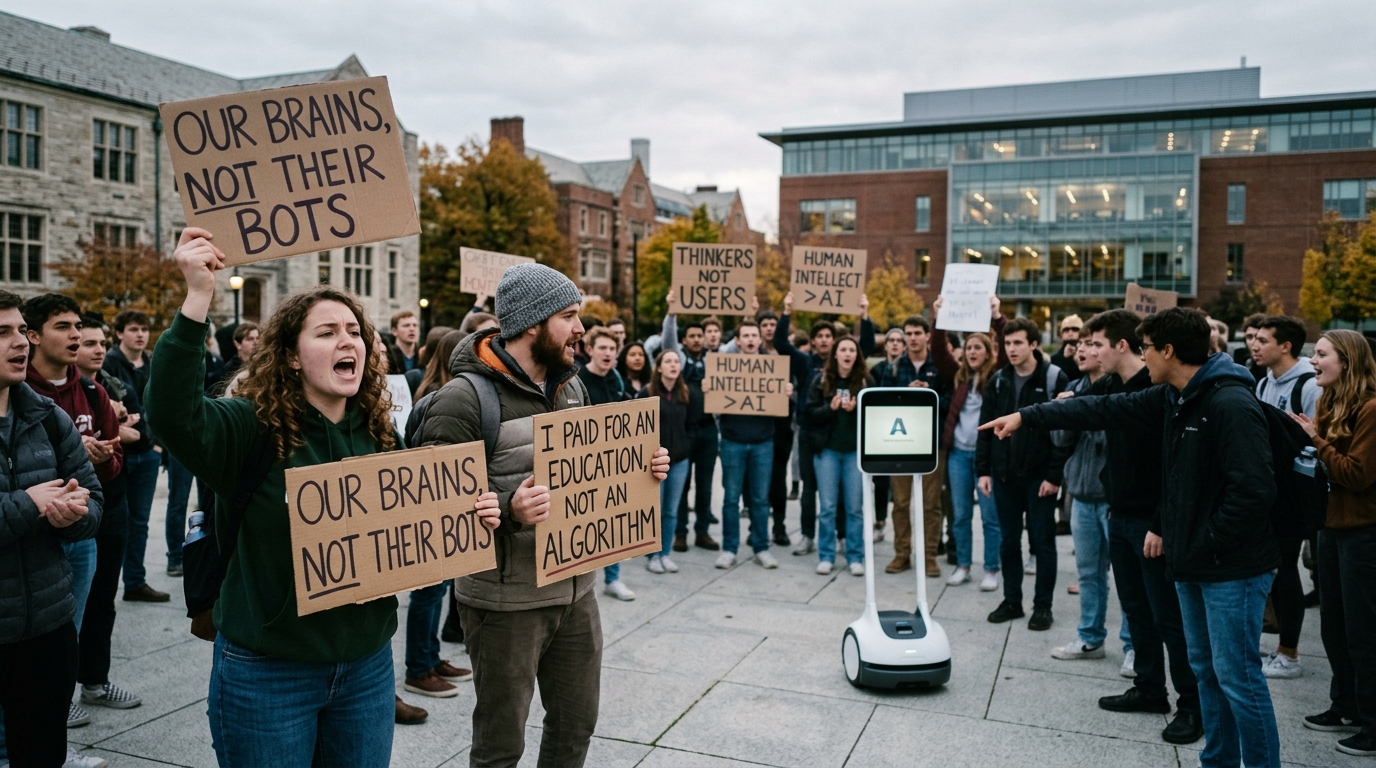
May 2026. The atmosphere at the graduation ceremonies of the world's leading universities is far from celebratory. Instead of the traditional tossing of caps and cheers, speeches praising the "AI revolution" are being met with a wave of heckling and boos. At Stanford and MIT, students are no longer just protesting geopolitical issues; they are targeting the very technology that promises to "democratize" knowledge while simultaneously threatening to render their hard work obsolete.
A recent report from Bloomberg Tech reveals a profound crack in the Silicon Valley narrative. Students, who were supposed to be the early adopters and champions of AI, are emerging as its most vocal critics. This resistance does not stem from Luddite tendencies but from an existential dread: What is the value of a degree that cost hundreds of thousands of dollars when the skills it provides can be replicated by an algorithm in seconds?
The Demystification of Digital Authority
For decades, the university was seen as the sacred space for human critical thinking. However, the mass intrusion of Large Language Models (LLMs) into the educational process has turned learning into an exercise in "prompt engineering." Students feel their education is being degraded into a mere interaction with machines, losing the essential mentorship of professors and the authentic generation of ideas.
"We are paying to learn how to think, not to learn how to operate a tool that will eventually replace us," says Maria Papadopoulos, a computer science senior who participated in a recent campus protest. The sense of betrayal is palpable. Universities, in their rush to appear cutting-edge, have signed lucrative deals with tech giants to integrate AI into curricula, often without student consent or ethical oversight.
"AI on college campuses is not a tool of empowerment, but a Trojan horse bringing the devaluation of human effort," Bloomberg notes.
The Ghost of Unemployment and the Junior Role Crisis
The biggest flashpoint remains the labor market. This year's graduates are entering a world where "junior" level positions—the traditional first rung of any career—are disappearing at an alarming rate. Companies increasingly prefer using AI agents for copywriting, basic programming, and data analysis, leaving new graduates in a professional vacuum.
Resistance, therefore, is an act of self-preservation. Students are demanding that institutions guarantee the value of their degrees and set strict ethical boundaries on AI use. The protests during graduation ceremonies are the final cry of a generation that sees its future being automated before it even begins.
- Loss of Motivation: When AI can write a paper better than a human, the process of learning feels futile.
- Economic Inequality: Access to premium AI models creates a new divide between privileged and underprivileged students.
- Psychological Pressure: The constant threat of replacement is driving record levels of anxiety and apathy on campus.
Toward a New Social Contract in Education
The solution is not a total ban but a redefinition of educational value. Some universities have begun returning to oral exams and handwritten in-class assignments to safeguard academic integrity. However, this does not solve the broader market problem.
The conflict we see today is just the beginning. As technology evolves, the demand for "human-centric" education will become more urgent. Students do not want to be mere users of AI; they want to be the architects of a world where technology serves humanity, not the other way around. The booing at the 2026 graduations is a distress signal that no government or university board can afford to ignore any longer.