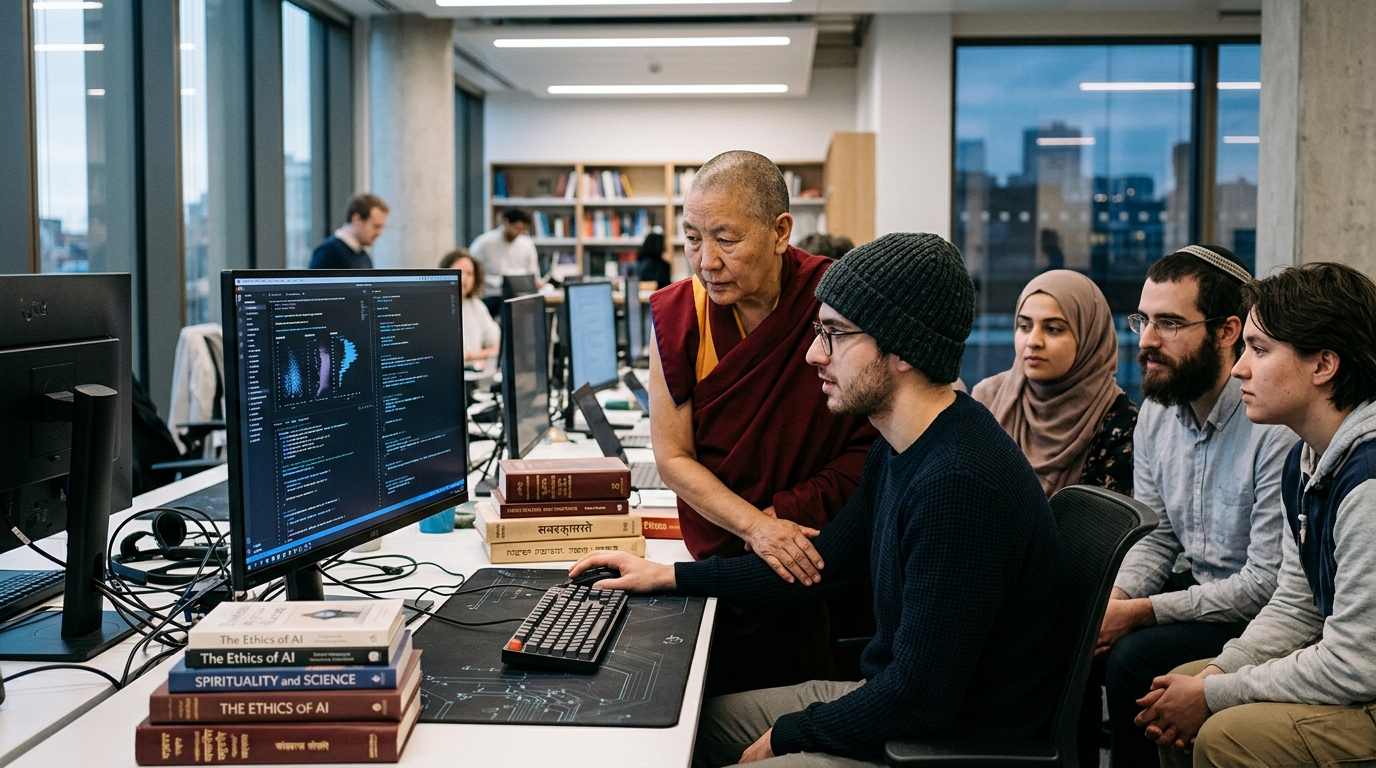
At the dawn of the third decade of the 21st century, humanity faces a challenge that transcends the boundaries of technological innovation and enters the realm of metaphysics. The rapid rise of Artificial Intelligence (AI) is not only reshaping our economy and daily lives but also raising fundamental questions about the nature of consciousness, ethics, and spirituality. Recent insights, such as those highlighted by the Jewish Journal, underscore that religious thought is not merely a passive observer of this evolution but a crucial pillar that can provide the necessary ethical guardrails.
The Modern Golem: From Myth to Reality
In Jewish tradition, the Golem—a being fashioned from clay and brought to life through the use of sacred names—serves as the archetypal warning regarding the creation of artificial life. Like the Golem of Prague, Artificial Intelligence lacks a "Neshama" (soul) but possesses immense power that can be either beneficial or destructive, depending on the moral framework of its creator. Modern computer science meets ancient theology here: if AI is a modern Golem, what is the "Emeth" (truth) that we must etch onto its forehead to ensure it serves humanity?
Spirituality in the age of AI is not just about worship; it is about understanding responsibility. The concept of "Tikkun Olam"—repairing the world—offers a framework for developing algorithms that do not magnify inequalities but heal social wounds. When developers ignore these ethical precepts, they risk creating systems that, while intelligent, are morally blind.
Ethical Precepts and Algorithmic Justice
One of the central issues concerning religious leaders and philosophers is algorithmic bias. From the perspective of religious moral precepts, bias is not just a technical error but a form of "Loshon Hara" (evil tongue) or slander, embedded in the code. If an algorithm discriminates against specific social groups, it violates the principle that every human being is created "B'tzelem Elohim" (in the image of God).
- The Sanctity of Data: Data are not just numbers; they are digital traces of the human experience. Their management requires respect for privacy and dignity.
- Accountability: Who is responsible for an AI's decisions? Religious legal traditions (such as Halakha) emphasize individual and collective responsibility, rejecting the idea that technology can serve as an alibi for unethical acts.
- Transparency: The need for "Explainable AI" reflects the spiritual quest for truth and the rejection of the "black box" acting as an arbitrary authority.
The Role of the "Digital Rabbi" and Spiritual Guidance
We are already witnessing the emergence of AI applications offering religious advice or even composing sermons. This raises the question: can a machine understand the sacred? The answer from most religious thinkers is a resounding no. Spirituality requires empathy, lived experience, and a connection to the transcendent that AI, as a product of pure logic and statistics, cannot simulate.
However, AI can serve as a powerful tool for study. The digitization and analysis of sacred texts through Large Language Models (LLMs) allow believers to discover new connections and interpretations. The danger lies in "technological idolatry"—our tendency to attribute divine qualities to systems we ourselves created. Religious ethics remind us that technology must remain the means, not the end.
Conclusion: Towards an Ethical Convergence
Integrating spiritual and religious principles into AI development is not a regressive move but a necessary evolution to secure our future. As machines become smarter, we must become wiser. Collaboration between technologists and religious thinkers can lead to a "human-centric AI" that respects the sanctity of life and free will. The search for the divine in the code is nothing less than the search for our own humanity within the digital mirror.