As we navigate the summer of 2026, the discourse surrounding Artificial Intelligence (AI) has shifted from mere wonder at its capabilities to existential anxiety regarding the future of labor. With large language models now deeply embedded in every facet of daily life—from legal discovery to medical diagnostics—a pressing question remains: Is there anything that makes us irreplaceable? The answer, according to recent analyses and the long tradition of Western philosophy, lies not in processing speed, but in the capacity for moral judgment and empathetic decision-making.
Phronesis: The Human Monopoly
Artificial Intelligence, regardless of its sophistication, operates on the basis of statistical probability. It can predict the next word in a sentence or the next fluctuation in a stock market, but it lacks what Aristotle termed 'phronesis.' Phronesis is not mere knowledge (episteme), nor is it technical skill (techne). It is the practical wisdom that enables a human to do the right thing in specific circumstances, weighing moral gravity and long-term social consequences.
In the workplace of 2026, we see AI performing 90% of technical tasks. However, the ultimate responsibility—accountability—remains stubbornly human. An algorithm can suggest a layoff strategy to optimize profits, but only a human can weigh the cost to human dignity, team morale, and the social fabric of the local community. This ability to 'feel' the context beyond the data points is the skill no machine can simulate, because a machine lacks lived experience.
The Paradox of Empathy and Strategic Intuition
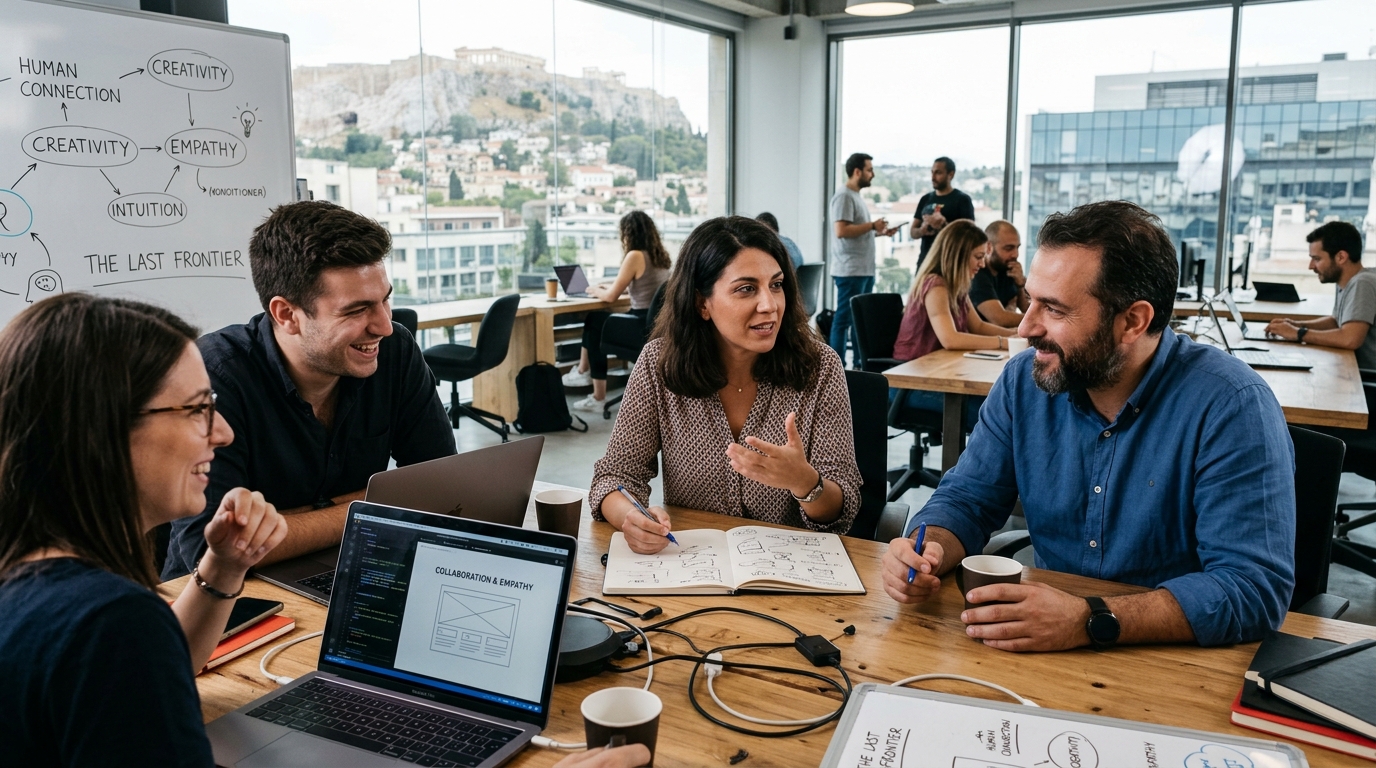
Many believed that creativity would be the final fortress. They were proven wrong. AI now generates art, music, and prose that can evoke deep emotion. However, empathy—the ability to understand another's position not as a data entry, but as a felt experience—remains out of reach. In corporate leadership, a CEO's ability to inspire trust during a crisis is not based on logical syllogisms, but on an intangible connection that requires biological existence and shared vulnerability.
Furthermore, strategic thinking under conditions of radical uncertainty (Black Swan events) requires intuition. Algorithms are trained on the past. Humans, however, possess the capacity to envision a future that looks nothing like what has come before. This 'leap of faith' is what drives innovation and progress. In contexts where personal relationships and cultural nuances (such as the Greek 'philotimo') dictate economic activity, the skill of building bonds of trust emerges as the most significant asset.
Education for the Future: From Information to Wisdom
If AI replaces technical knowledge, then our educational systems must be radically overhauled. We no longer need human encyclopedias; we need human adjudicators. The teaching of humanities, philosophy, and psychology is no longer a luxury—it is a vocational necessity. The ability to ask the right questions (prompt engineering) is only the beginning; the ability to evaluate the ethical quality of the answer is the end of the road.
- Ethical judgment in gray zones where no clear 'right' or 'wrong' exists.
- Conflict resolution that demands high emotional intelligence.
- Synthesizing disparate information with a view toward the common good.
- Authenticity and personal accountability for outcomes.
In conclusion, Artificial Intelligence is not coming to replace us, but to force us to become 'more human.' It liberates us from mechanical labor to return us to our primary duty: using reason and emotion to shape a better world. The skill that will never be replaced is the human soul in action—the unique ability to care about the consequences of our choices.