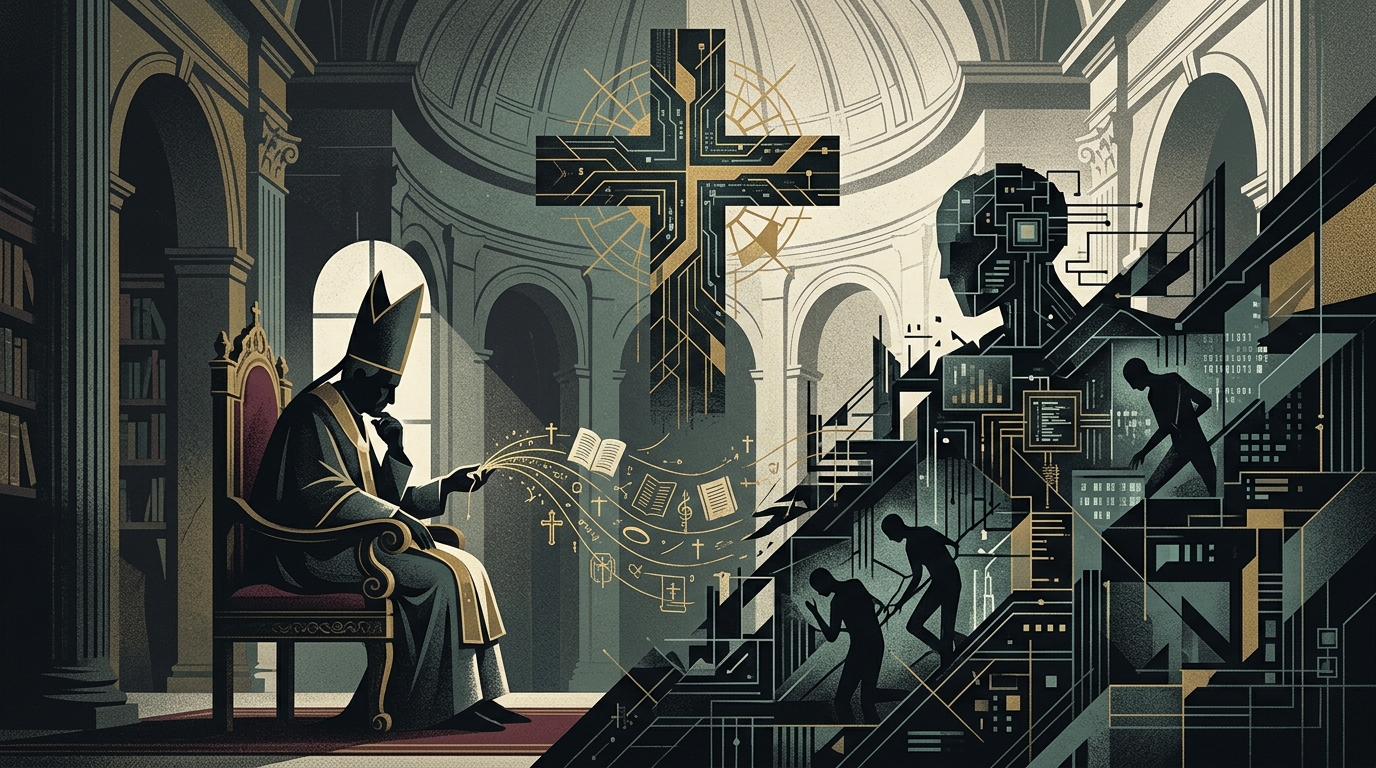
In an era where technological advancement seems to outpace human moral capacity, the Vatican has raised a cautionary voice that resonates globally. Pope Leo, during an international symposium on the ethics of technology in Rome, issued a stark warning regarding the dangers of Artificial Intelligence (AI), describing it as a "double-edged sword" capable of either elevating or obliterating human dignity.
This intervention is not merely a religious appeal but a profound political and social analysis of the power structures shaped by algorithms. The Pontiff focused on the necessity of what he terms "algor-ethics," a framework introduced by the Holy See to describe the set of rules that must govern the design and deployment of autonomous systems.
The Threat of 'Technocratic Tyranny'
At the heart of Pope Leo’s address was the concept of the "technocratic paradigm." According to the Pontiff, blind trust in data and efficiency risks reducing human beings to mere statistical values. "When decisions regarding life, death, labor, and freedom are outsourced to opaque codes, we lose the essence of Christian and humanistic liberty," he stated before an audience that included Silicon Valley executives and prominent academics.
The Pope warned that AI could exacerbate existing social inequalities. He noted specifically:
"Technology is never neutral. If an algorithm is trained on the prejudices of the past, our future will be a prison of stereotypes and exclusions. We cannot allow digital intelligence to replace human judgment, especially when it concerns the most vulnerable among us."
Particular emphasis was placed on autonomous weapons systems, which the Pope labeled a "moral affront." The idea of a machine deciding to take a human life without direct human intervention represents, for the Vatican, the ultimate boundary that humanity must never cross.
Digital Colonialism and Global Peace
Beyond the ethical dimension, Pope Leo touched upon the geopolitical implications of AI. He denounced what he termed "digital colonialism," where a handful of multinational corporations and powerful states consolidate control over the data of entire populations. This concentration of power, he argued, undermines democracy and the national sovereignty of less developed nations.
- Transparency and Accountability: Algorithms must be explainable, and their creators held responsible for their consequences.
- Human-Centric Design: Technology must serve humanity, not the other way around.
- International Regulation: The need for a global treaty binding states to the ethical use of AI.
The Pope urged the international community not to be seduced by the "allure of speed." He maintained that the slow, reflective process of ethical deliberation is essential to ensure that AI does not become the tool of a new form of totalitarianism.
The Legacy of Prudence
Concluding his speech, Pope Leo reminded the world that progress is measured not by the teraflops of processors, but by our ability to protect the dignity of every individual. His warning comes at a critical juncture, as the European Union and the United States are in the process of shaping new legislative frameworks for AI.
The Vatican’s stance indicates that the Church does not intend to remain a bystander to these developments. On the contrary, it seeks to act as a moral mediator in a world that seems to be losing its orientation amidst digital noise. The question remains whether the voices of Silicon Valley will heed the warnings of an institution with two millennia of history, or if the momentum of profit will override all ethical barriers.