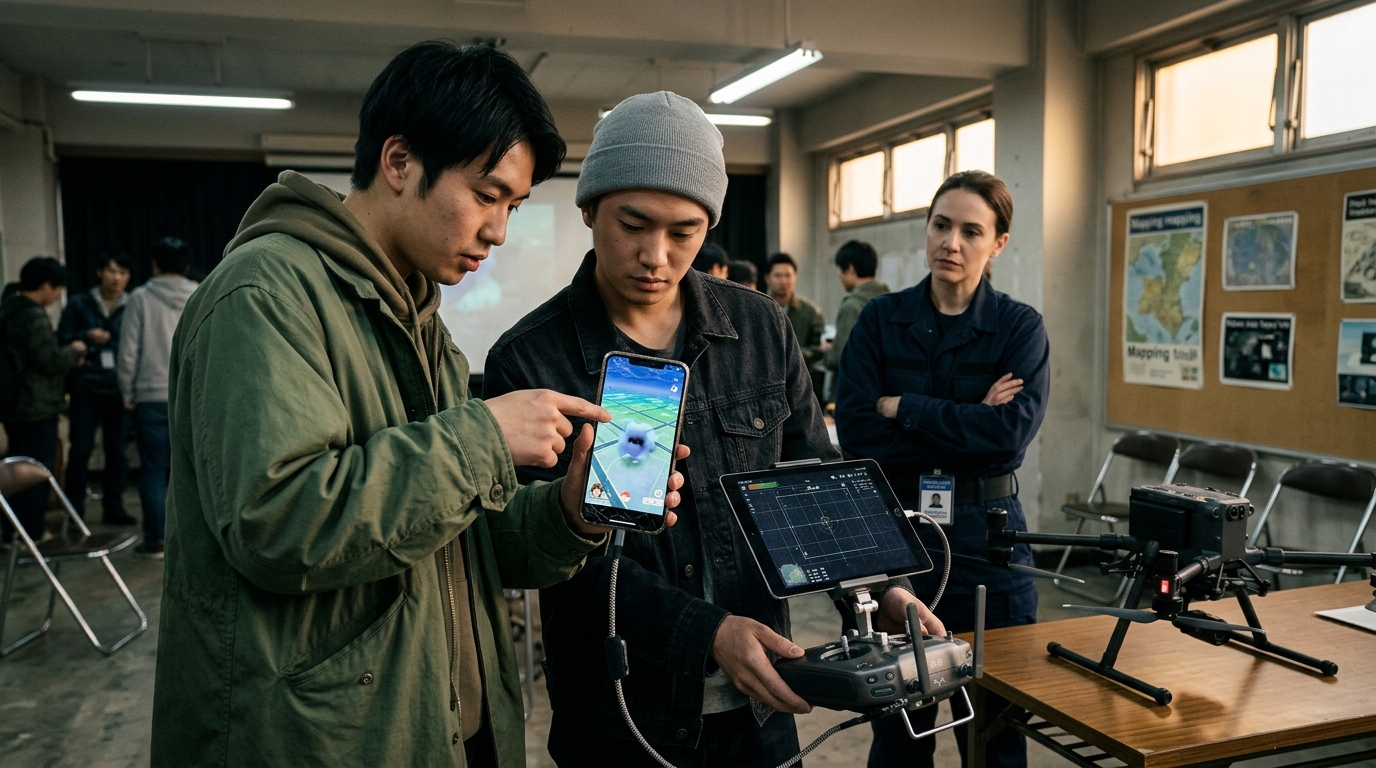
When Niantic released Pokémon Go in 2016, the world witnessed a revolution in Augmented Reality (AR). However, nearly a decade later, the innocent quest for digital creatures in city streets appears to have a much darker and militarized side. According to recent analyses and reports, the massive database of 3D scans generated by players is now being used to train Artificial Intelligence models intended for autonomous drones, particularly in environments where GPS signals are non-existent or jammed.
The Large Geospatial Model (LGM)
Niantic recently announced the development of what it calls the "Large Geospatial Model" (LGM). This is an AI model that, instead of being trained on text or images from the internet, is trained on the 3D real-world scans submitted by Pokémon Go and Ingress players. Every time a player "scans" a PokéStop or Gym to earn rewards, they provide the company with a high-fidelity 3D representation of a public space.
This data is unique. While satellites see the world from above and Google's cars from street level, Pokémon Go players provide data from angles no other system can reach: building entrances, narrow alleys, squares, and the interiors of monuments. This "raw material" allows the AI to understand the geometry of space with terrifying detail.
From Gaming to the Battlefield
The question that arises is why this data is so valuable to the military. The answer lies in navigation within "GPS-denied environments." In modern warfare, the ability of a drone to orient itself without satellite assistance is critical. By using Niantic's LGM, a drone can "see" its surroundings through its cameras and compare the images in real-time with the 3D model built by players.
- Visual Localization: The drone recognizes specific architectural elements to determine its position with centimeter precision.
- Obstacle Avoidance: A deep understanding of spatial geometry enables autonomous flight in densely populated urban areas.
- Strategic Mapping: The ability to create updated maps in real-time without the need for external navigation systems.
"This is no longer just a game; it is the most extensive mapping operation in human history, funded by the users themselves who hand over their data for free," say digital ethics analysts.
The Ethics of "Inadvertent" Contribution
The ethical dilemma is immense. Most players are unaware that their entertainment might be contributing to the development of technologies used in armed conflicts. App terms of service are often obscure, covering the "commercial use of data" in general terms without specifying military applications.
Furthermore, there is the issue of public space sovereignty. Players scan public squares, parks, and historical monuments, turning communal space into the private property of a corporation, which can then "sell" it as data to defense contractors. This form of "digital extractivism" undermines the concept of privacy in public spaces.
Conclusion: The Future of Play-to-Train
The case of Pokémon Go is only the beginning. As augmented reality becomes part of our daily lives through AR glasses and smart devices, the line between gaming and surveillance will become increasingly blurred. Society must demand greater transparency from tech companies regarding where our data ends up. If we fail to do so, we risk turning every step we take in the city into an inadvertent act of military reconnaissance. Pikachu might be cute, but the data collected on behalf of its creators is a powerful weapon in the hands of those designing tomorrow's wars.