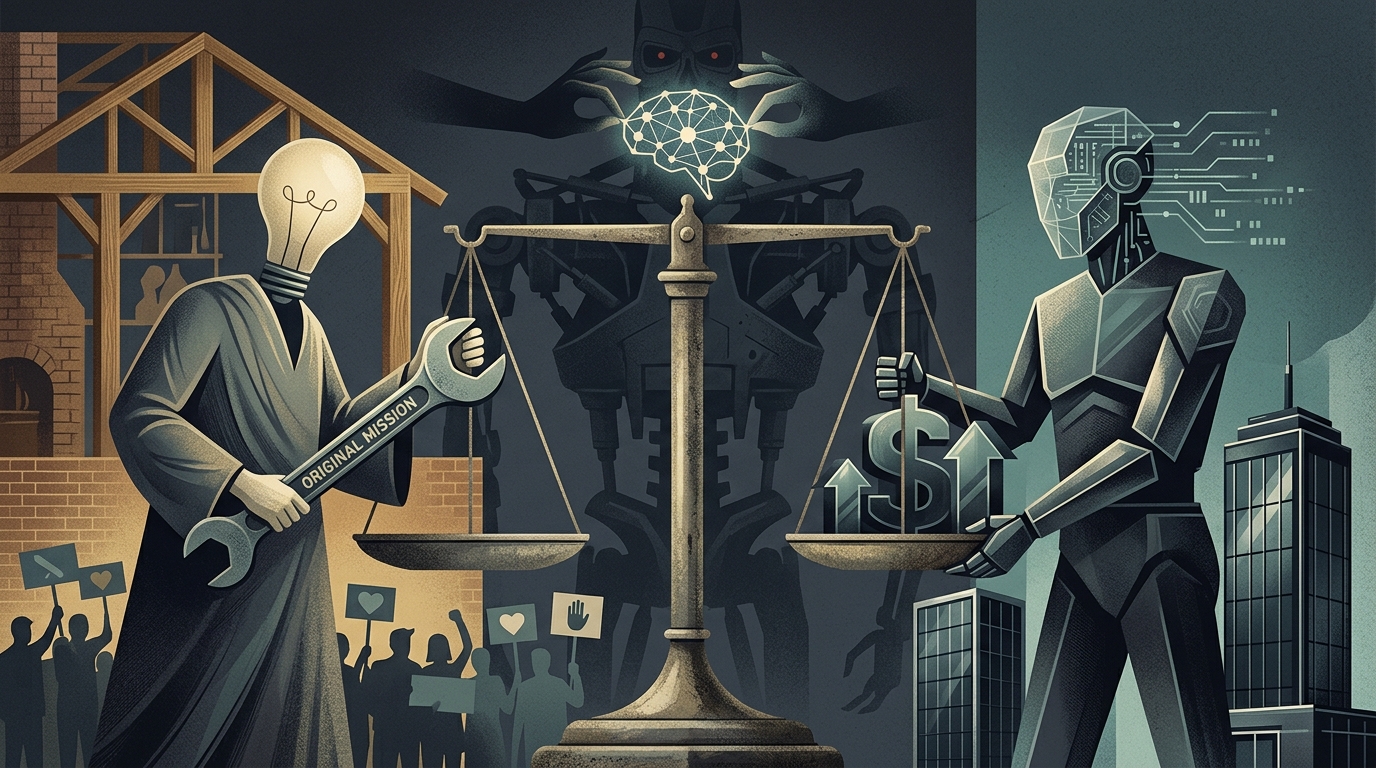
In the heart of Silicon Valley, where ambition often outpaces the boundaries of human imagination, a legal battle is unfolding that is set to define the future of humanity. Elon Musk, the man who once helped establish OpenAI as a counterweight to Google’s dominance, is now in a state of total war with the company he helped birth. His legal action is not merely a corporate dispute; it is an existential cry of concern—or a calculated tactical maneuver—against what he terms a "betrayal" of the organization's original mission.
The Mutation of a Mission: From Public Good to Closed Profit
When OpenAI was founded in 2015, its manifesto was clear: the development of Artificial General Intelligence (AGI) had to be done in a way that benefited all of humanity, free from the constraints of shareholders and quarterly balance sheets. Musk alleges that this promise has been sacrificed on the altar of profitability. In his lawsuit, he describes OpenAI as a "de facto subsidiary" of Microsoft, arguing that the tech giant now controls the pace of development, turning an open source of knowledge into a hermetically sealed profit-driven model.
Musk’s argument centers on the fact that OpenAI Inc., the non-profit arm, has been sidelined by OpenAI Global LLC. This structure, according to his legal team, constitutes a flagrant breach of the founding charter. "We don't want a future like Terminator," he famously stated, referencing the cinematic dystopia where AI turns against its creator. For Musk, the lack of transparency and the pursuit of maximum profit are the ingredients that could lead to an uncontrollable and dangerous AI.
The Shadow of Microsoft and the AGI Threshold
The partnership between OpenAI and Microsoft, which has seen billions of dollars in investment, is the central point of friction. The agreement stipulates that Microsoft holds rights to OpenAI's technology until AGI is achieved. The question now before the courts is: who defines when we have reached AGI? Musk argues that GPT-4, or its successors, already approach this threshold, and therefore the technology should be public property rather than a commercial product of Microsoft.
- The legal standing of the "Founding Agreement" as a binding contract.
- Sam Altman’s role in pivoting the corporate culture toward commercialization.
- AI safety used as a justification for closing off source code.
- The economic dependence on Microsoft Azure’s massive computing power.
For its part, OpenAI has responded aggressively, releasing old emails from Musk showing that he himself had once accepted the need for massive capital, even suggesting a merger with Tesla to ensure viability. This counter-offensive aims to damage Musk’s credibility, portraying him not as a concerned visionary, but as a disgruntled former partner who missed the train of success.
Ethical Dilemmas and the Future of Governance
Beyond the legal technicalities, the case highlights the fundamental problem of our era: Who controls the most powerful technology ever built by humans? If OpenAI prevails, the "closed-profit" model will become the standard, with mega-corporations holding the keys to intelligence. If Musk succeeds in forcing a return to the open model, we might see a renaissance of collaborative science, but with the added risk of the technology falling into the "wrong hands" without sufficient oversight.
"Artificial intelligence is too important to be left in the hands of an oligopolistic elite. Transparency is not an option; it is a prerequisite for survival."
This trial is expected to last years, but its impact is already being felt. Regulators in the US and the EU are watching closely, looking for evidence of whether OpenAI is operating as a monopoly. The "Terminator effect" Musk cites may seem hyperbolic, but at its core lies a truth: the speed of evolution has outpaced our ability to set ethical and legal boundaries. The Musk-OpenAI clash is the first great battle of a war that will determine whether AI will be the liberator or the jailer of the 21st century.