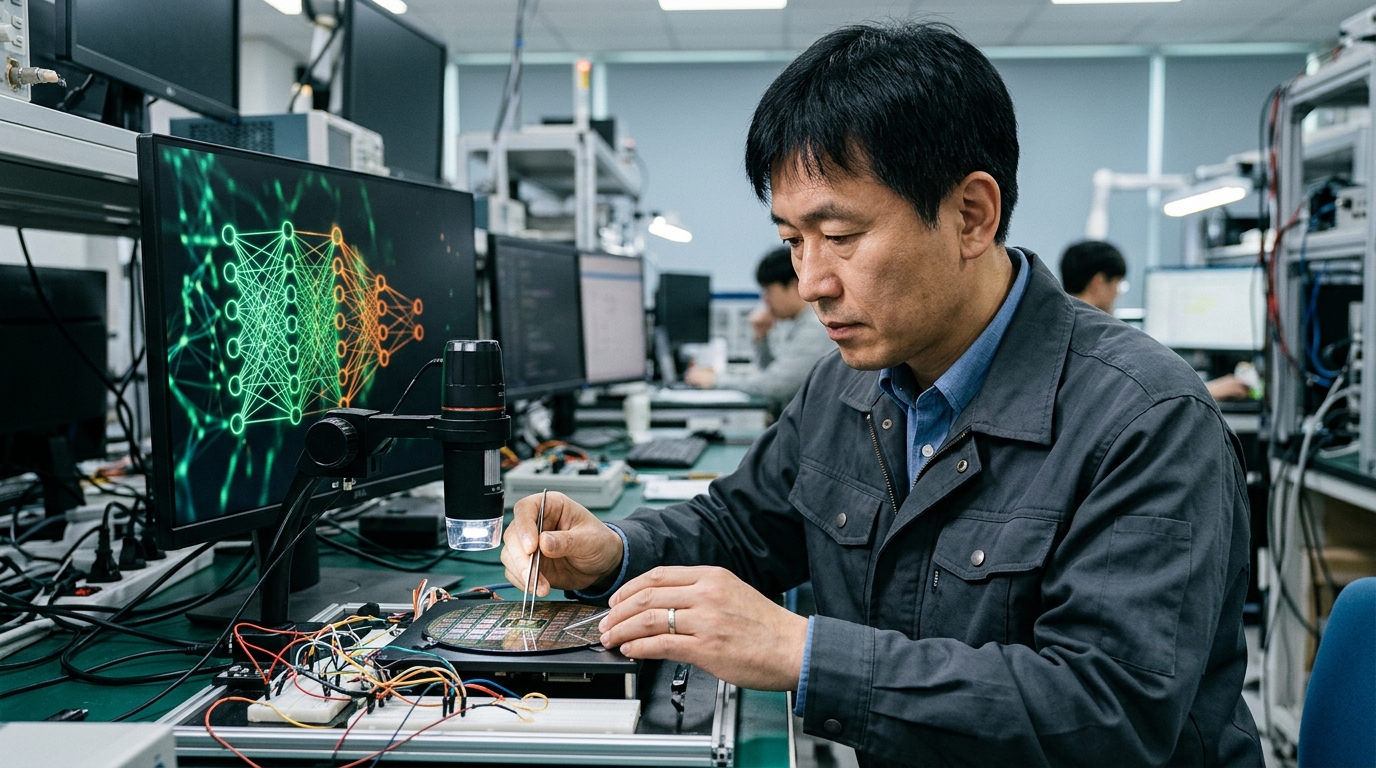
The global AI landscape is undergoing a seismic shift. For years, the prevailing narrative suggested that Silicon Valley held an unassailable lead, with China struggling to keep pace due to stringent US semiconductor sanctions. However, the recent unveiling of models by DeepSeek — a Hangzhou-based AI lab — is not merely a technical update; it is a geopolitical statement. DeepSeek has managed to develop models that rival OpenAI’s GPT-4o and Anthropic’s Claude while using a fraction of the computational resources and capital previously thought necessary.
The Architecture of Efficiency
The secret to DeepSeek's success lies not in brute computational power, but in architectural ingenuity. While American giants rely on scaling massive clusters of Nvidia GPUs, DeepSeek pivoted toward innovation through Mixture-of-Experts (MoE) and Multi-head Latent Attention (MLA). These techniques allow the model to activate only the necessary parameters for any given query, dramatically reducing both energy consumption and operational costs.
According to the company’s technical reports, training DeepSeek-V3 cost approximately $5.68 million — a figure that looks like pocket change compared to the billions spent by Microsoft and Google. This efficiency shatters the dogma that AI dominance is the exclusive province of those with the most H100 cards. China, forced to survive in an environment of limited access to high-end chips, has developed a culture of "optimization under pressure" that is now yielding significant dividends.
Geopolitical Implications and the End of Monopoly
The rise of DeepSeek raises serious questions about the effectiveness of US export controls. If China can produce top-tier AI with less sophisticated hardware, then Washington’s strategy to technologically contain Beijing may require a radical rethink. Furthermore, DeepSeek’s decision to release its model weights as open source is a strategic masterstroke that undermines the closed-door business models of OpenAI and Google.
- Democratization of Power: Smaller firms and research institutions now have access to cutting-edge technology without the prohibitive costs of major cloud providers.
- Challenging US Exceptionalism: The "Sputnik moment" of AI might not be an American breakthrough, but the Chinese response to Western constraints.
- Shifting Investment Paradigms: Investors are beginning to question whether the massive Capital Expenditure (CapEx) of Silicon Valley is truly necessary or just a byproduct of inefficiency.
The Challenge for the West
The Western reaction to DeepSeek’s success oscillates between admiration and anxiety. On one hand, the open-source community celebrates the access to such a powerful tool. On the other, US policymakers see their national security advantage evaporating. DeepSeek is not just a market player; it is a catalyst forcing the global community to reevaluate what "leadership" means in the age of artificial intelligence.
"Innovation knows no borders, and necessity is indeed the mother of invention. When you restrict resources, you force the human spirit to find shorter paths to the summit."
In conclusion, the gap between the US and China is not just closing; it is changing shape. The battle is no longer fought solely in the semiconductor fabs of Taiwan, but in the optimization algorithms and neural network architectures. DeepSeek has proven that in the realm of artificial intelligence, ingenuity can indeed triumph over brute force.