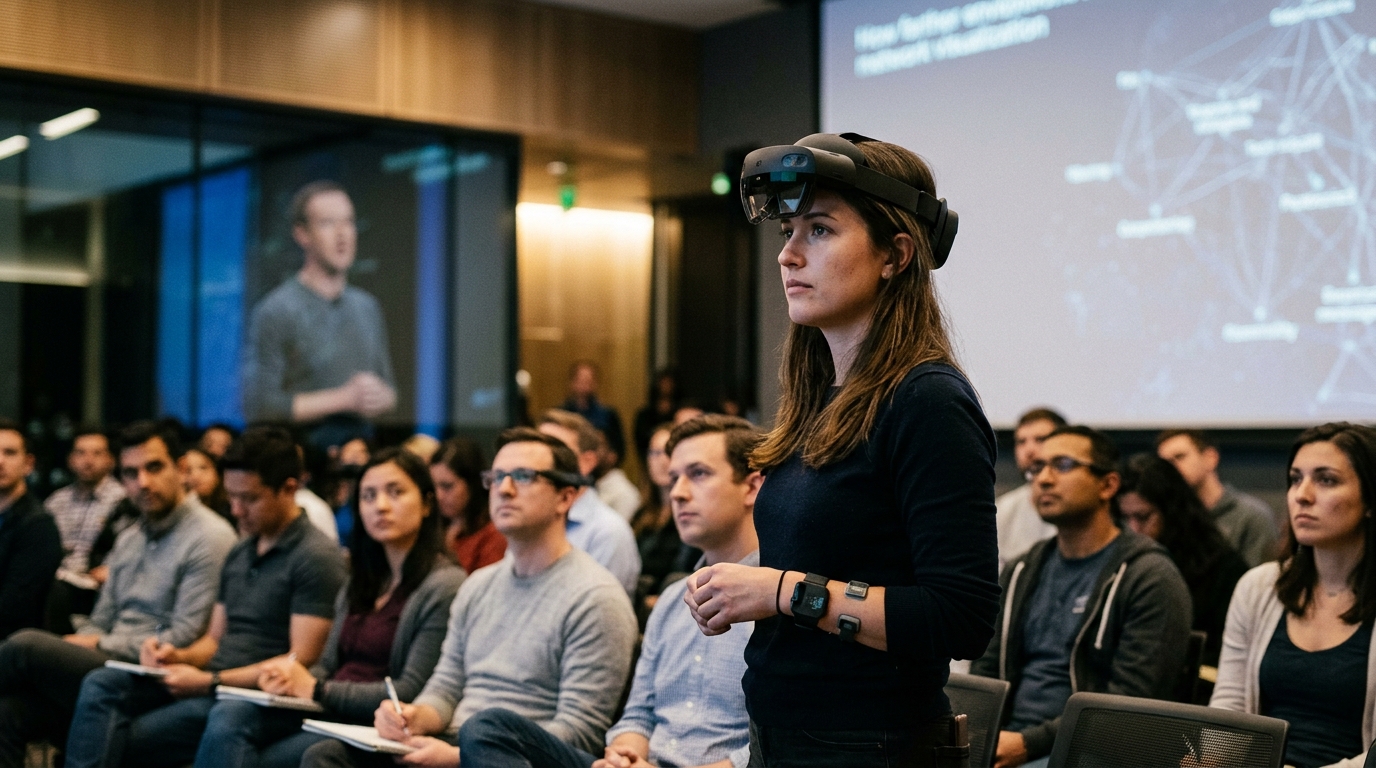
In an era where data is hailed as the 'new oil,' Meta (formerly Facebook) appears to have tapped into a fresh, inexhaustible reservoir: the physical existence and daily movements of its own employees. According to recent reports, the tech giant is implementing surveillance programs within its campuses, utilizing sensors, cameras, and wearables to gather data on how humans move, interact, and navigate physical space. The objective? To train the next generation of 'Embodied AI.'
The 'Living Laboratory' of Menlo Park
Meta’s strategy is not merely an attempt to boost productivity; it represents a fundamental shift in how AI models are trained. Until now, artificial intelligence was primarily trained on digital footprints—text, images, and videos harvested from the internet. However, to realize Mark Zuckerberg’s vision of robots and digital assistants that comprehend the physical world, the company requires real-world data. Meta employees, often wearing Ray-Ban Meta smart glasses or participating in research initiatives like Project Aria, are becoming the anonymous donors of human kinesiology.
This practice transforms the workplace into a vast experimental field. Hand gestures during a meeting, the way someone walks down a corridor, or the gaze angle when looking at a screen are converted into mathematical vectors. Meta maintains that the process is voluntary and that data is anonymized, yet the thin line between 'voluntary participation' and 'corporate pressure' remains dangerously blurred.
The Ethics of 'Consensual' Surveillance
The central issue is the ethical dimension of consent. In the high-stakes environment of Silicon Valley, how easy is it for an employee to refuse participation in a project that leadership deems critical to the company’s future? Labor law experts warn that this level of tracking creates a new type of 'digital panopticon,' where an individual's physical presence ceases to belong to them and becomes the property of the employer.
- Anonymizing movement data is technically challenging, as 'gait analysis' can often identify an individual with high precision.
- Data collection in communal areas may inadvertently capture individuals who have not provided explicit consent.
- There is a risk that this data could eventually be repurposed for performance evaluations, even if that is not the stated intent.
The Race for Embodied Intelligence
Why is Meta taking such a reputational risk? The answer lies in the fierce competition with Tesla, OpenAI, and Google. Developing AI that can manipulate objects or guide autonomous systems requires massive volumes of 'first-person' data. If Meta succeeds in encoding the human experience within physical space, it will gain a competitive edge that cannot be bought from any digital library.
"We are no longer just training AI to think like us, but to move and exist in our world," says a company insider speaking on condition of anonymity. "And who better to teach it than humans in real-time?"
In conclusion, Meta’s move marks a milestone in the history of technology and labor. If this practice becomes normalized, we may witness a new form of employment contract, where employees are compensated not just for their skills, but for the right of the corporation to 'mine' their biometric and kinesiological data. The challenge for regulatory bodies, particularly in the European Union, will be to define where innovation ends and the violation of human dignity begins.