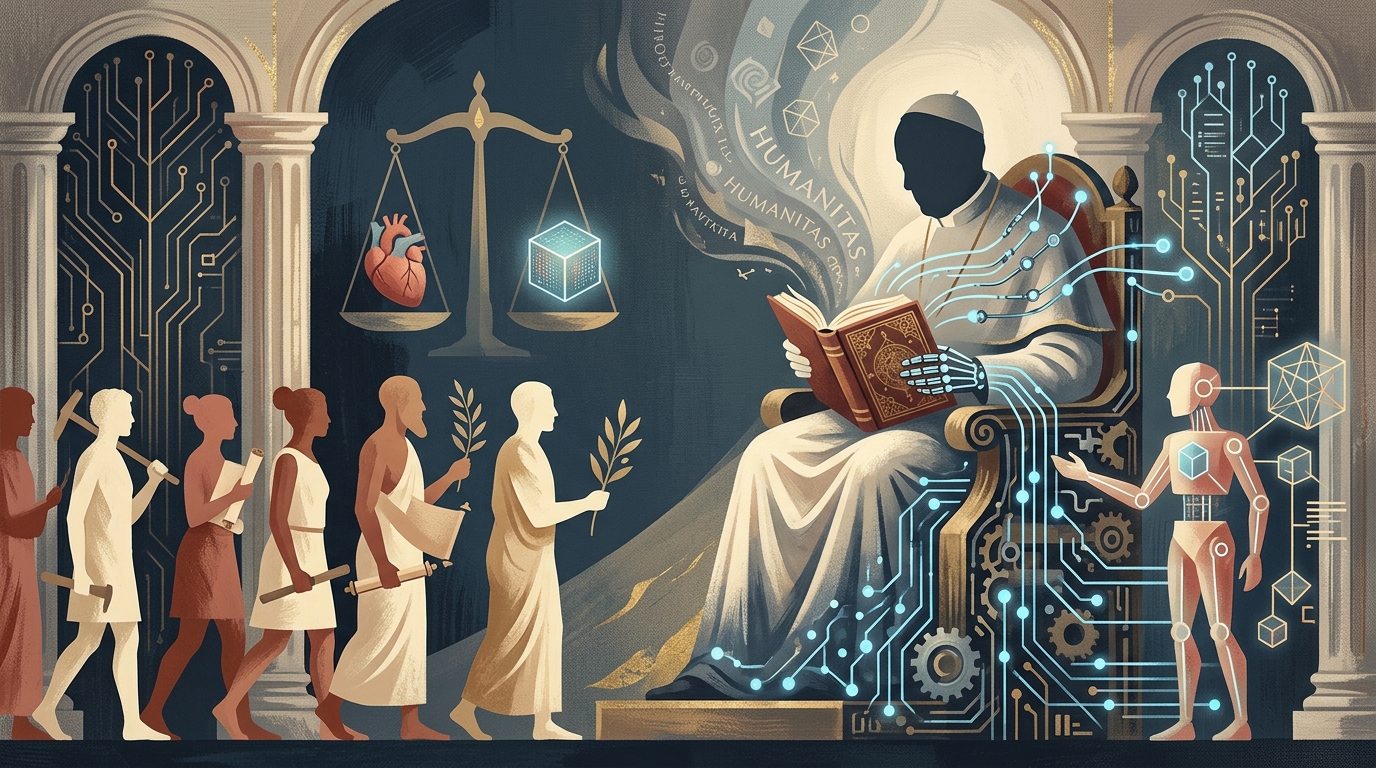
In an era where Artificial Intelligence (AI) is no longer a mere productivity tool but a structural force reshaping social, economic, and spiritual reality, the Vatican has made a move that will go down in history. The new encyclical by Pope Leo, titled "Magnifica Humanitas" (Magnificent Humanity), is a bold manifesto that transcends the narrow boundaries of theology, entering forcefully into the arena of global politics and the ethics of algorithms.
Algorethics at the Core
The central argument of the encyclical revolves around the concept of "Algorethics." Pope Leo argues that technology is never neutral. Every line of code contains values, biases, and worldviews. "Magnifica Humanitas" warns that if AI development is left solely to market forces, we risk degrading the human person to a mere data point.
The encyclical places particular emphasis on the need for "transparency of intent." It is not enough for AI to be efficient; it must be understandable and accountable. The Vatican calls for the creation of an international framework to ensure that algorithms making critical decisions about human lives—from healthcare to the administration of justice—are subject to strict human oversight (human-in-the-loop).
The New "Rerum Novarum" of the Digital Age
Many analysts compare "Magnifica Humanitas" to the historic 1891 encyclical "Rerum Novarum," which addressed the challenges of the Industrial Revolution. Today, Pope Leo recognizes that AI constitutes the "Fourth Industrial Revolution" and expresses deep concern for the future of work. The encyclical does not oppose progress, but rather the "idolatry of efficiency."
- The Value of Work: Labor is not just a means of survival, but also a means of self-actualization. The mass replacement of humans by machines without provision for social cohesion is described as "spiritual suicide."
- Global Digital Tax: For the first time, the Catholic Church suggests considering a global tax on profits derived from automation, aimed at funding retraining programs and strengthening the welfare state.
- Digital Colonialism: The encyclical denounces the concentration of power in a few companies and states, calling for a fairer distribution of computational resources toward the Global South.
Political Sovereignty and the "Soul" of the Machine
One of the most controversial points of the encyclical is the reference to the "illusion of consciousness." Pope Leo clarifies that no matter how advanced an AI becomes, it will never possess an "anima" (soul). This distinction is fundamental for the Vatican, as it sets the boundaries of moral responsibility. Machines can calculate, but only humans can exercise moral judgment.
"Technology is a gift from God, but when the gift overshadows the giver and our fellow human beings, it turns into shackles," the text states poignantly.
The encyclical concludes with a call to the global community for the conclusion of a "Global Treaty on Artificial Intelligence," which would place the human person at the center of technological development. This is not merely a religious admonition, but a clear political stance against unchecked techno-capitalism and digital authoritarianism.
Conclusions and Perspectives
"Magnifica Humanitas" is expected to provoke intense debate in decision-making centers. With this intervention, the Vatican reasserts its role as a moral guardian in a rapidly changing world. The challenge now shifts to political leaders and tech executives: will they accept the invitation for an "anthropocentric" AI, or will they continue the march toward digital feudalism?