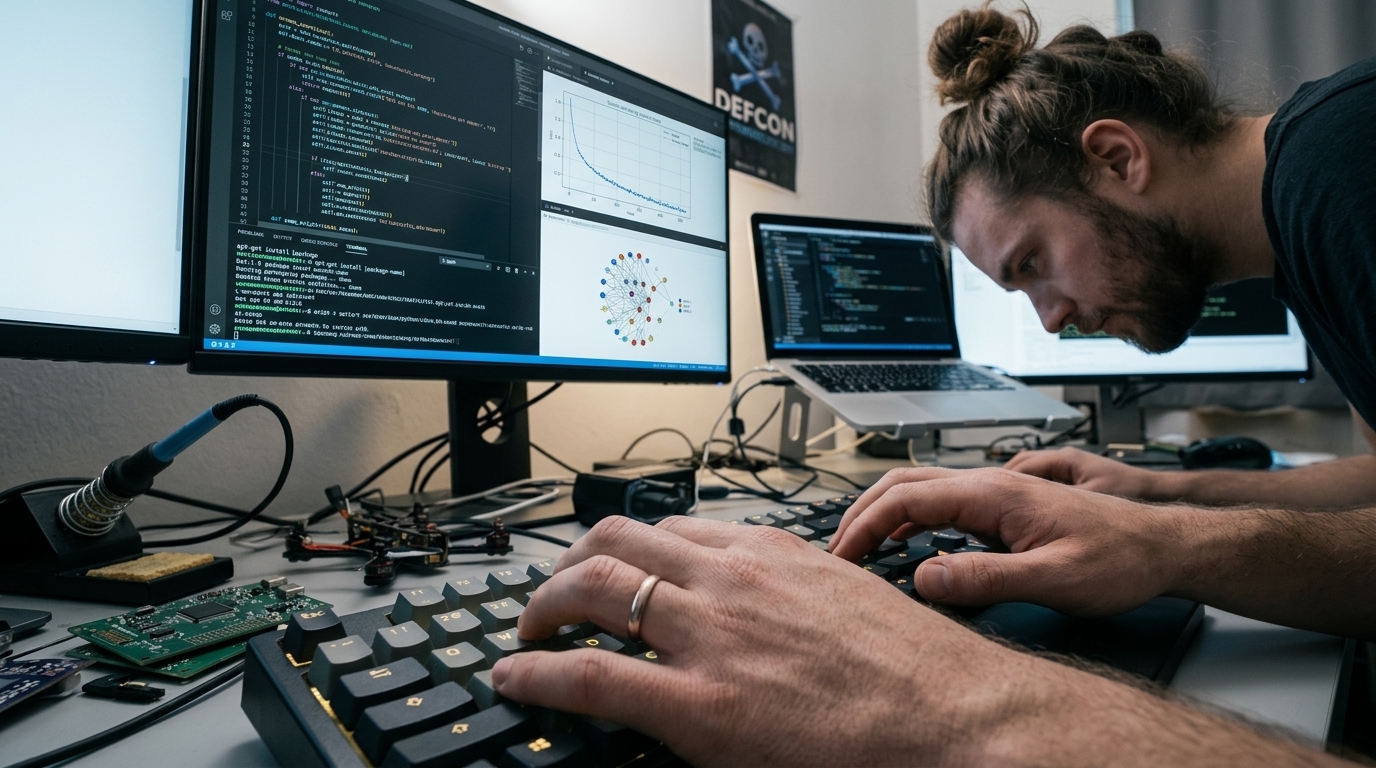
Last August, in the sweltering heat of the Nevada desert, some of the sharpest minds in cybersecurity gathered in Las Vegas for more than just a typical hacker convention. At DEF CON, DARPA (the Defense Advanced Research Projects Agency) launched the Artificial Intelligence Cyber Challenge (AIxCC), a two-year competition aimed at building AI systems capable of automatically finding and fixing vulnerabilities in critical software infrastructure. The stakes? The very survival of our digital world in the face of a new generation of threats.
The Democratization of Destruction
For decades, the term "script kiddie" was used pejoratively within the hacker community to describe individuals with limited technical skills who used pre-made scripts to launch attacks. They were the internet's annoying amateurs. However, the advent of Large Language Models (LLMs) and generative AI is dramatically altering this equation. Today, a "script kiddie" armed with a specialized AI model can analyze millions of lines of code in seconds, identifying security flaws that previously required months of expert research.
The concern isn't just about speed; it's about scale. When DARPA fed AI systems 54 million lines of actual software code—injected with intentional vulnerabilities—the results were eye-opening. AI is no longer just an assistant; it is becoming an autonomous agent capable of "thinking" creatively about how to bypass security systems. This creates an ethical and practical paradox: the very tools developed to fortify the world can be repurposed to tear it down.
The DARPA Challenge: Defense at Machine Speed
AIxCC isn't just a contest; it's an attempt to shift the paradigm of cybersecurity. Historically, the attacker has always held the advantage. They only need to find one mistake, while the defender must be perfect everywhere. DARPA, in collaboration with giants like Google, Microsoft, and Anthropic, seeks to reverse this dynamic through Cyber Reasoning Systems (CRS). These systems don't just find bugs; they synthesize and apply patches in real-time.
- Automated code analysis at petabyte scale.
- Generation of fixes without human intervention.
- Integration of ethical guardrails in offensive AI development.
- Public-private partnerships to protect open-source infrastructure.
However, the challenge remains: if defense becomes automated, the offense will follow suit. We are on the brink of a war of attrition between algorithms, where human oversight may become the weak link due to the slow reaction time of the biological brain.
The Ethical Minefield of Dual-Use
The concept of "dual-use" technology refers to tools that can be used for both peaceful and military purposes. In the case of AI cybersecurity, the line is razor-thin. A model trained to understand how to fix a buffer overflow by definition understands how to trigger one. DARPA's decision to release some of these tools as open-source is sparking intense debate.
"We cannot lock knowledge in a vault and hope that malicious actors won't discover it on their own," says one AIxCC researcher. "Our only option is to run faster than they do."
This "security through transparency" approach clashes with traditional military logic of secrecy. If a teenager in their bedroom can use an AI tool to paralyze a city's power grid, then the concept of national security must be redefined from the ground up.
Conclusion: The Need for a Digital Immune System
As we head toward 2027, cybersecurity will no longer be about firewalls; it will be about resilience. We must accept that attacks will happen and that the "script kiddies" of the future will possess the power of digital armies. The solution is not to ban AI, but to create a global, autonomous "immune system" for the internet. DARPA's initiative is the first step toward this, but the path is fraught with danger. The ethical responsibility of AI developers is now on par with that of the nuclear physicists of the last century.