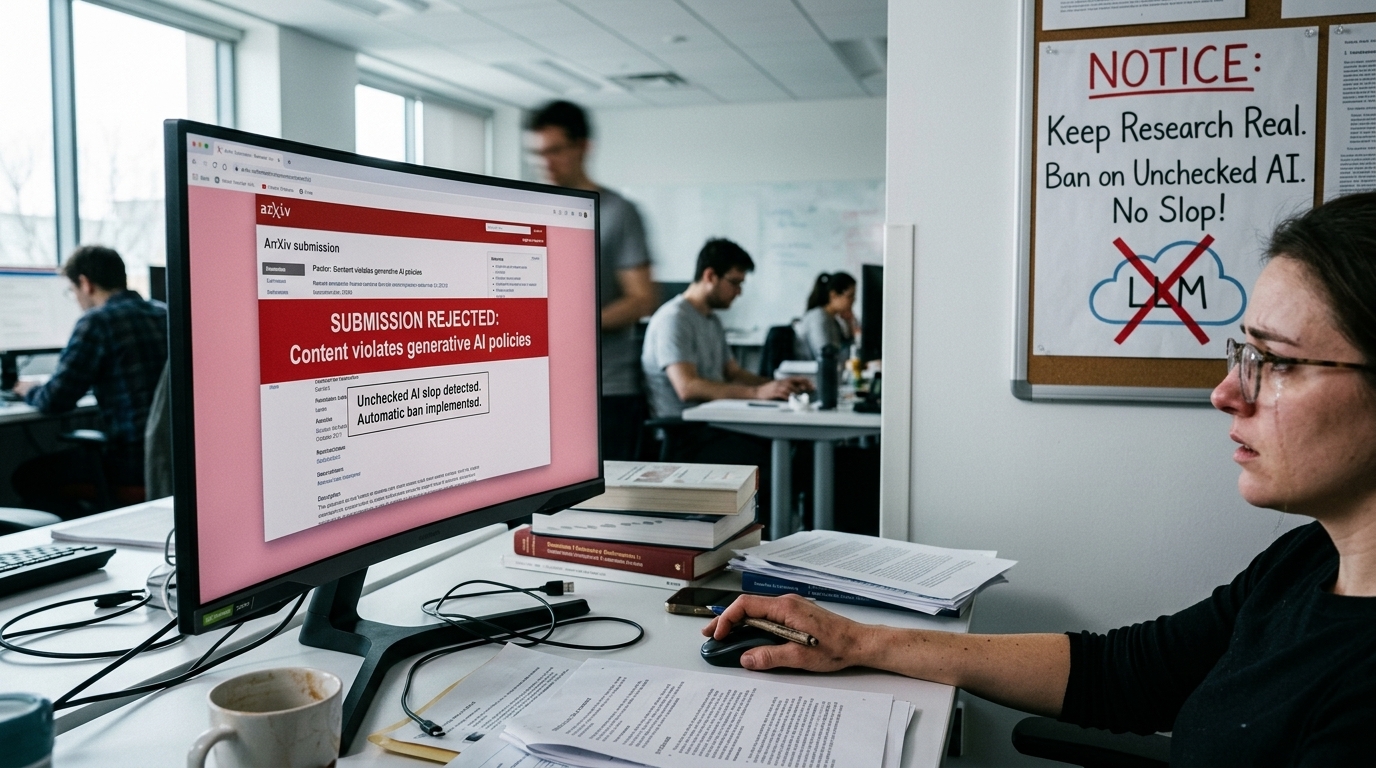
In the hallowed halls of scientific research, where precision and verifiability are the cornerstones of progress, a new threat has begun to erode the foundations: "AI slop." ArXiv, the Cornell University-run preprint server that hosts over two million scientific papers, has decided to take drastic measures. In a move that marks a turning point in academic ethics, the platform announced it will impose temporary or permanent bans on researchers who submit papers containing "incontrovertible evidence" that the authors did not check the output of Large Language Models (LLMs).
The Epidemic of Hallucinations and Negligence
The problem is not the use of Artificial Intelligence as a supportive tool, but the complete abdication of human oversight. In recent months, the academic community has faced a flood of papers containing glaring errors: from bibliographic references to non-existent studies (hallucinations) to the inclusion of tell-tale chatbot phrases, such as the infamous "As an AI language model..." These signs of negligence do more than just undermine ArXiv's credibility; they threaten to pollute the entire body of scientific knowledge with erroneous data.
ArXiv's leadership clarified that the new policy targets cases where the lack of human intervention is "unpardonable." This is not a witch hunt against AI, but an effort to maintain quality standards. As noted, if a paper includes "meta-comments" from the AI that the researcher forgot to delete, it serves as proof that the paper was not even read before submission.
The Penalty System and the Review Process
The new rules provide for a tiered approach. Researchers who submit low-quality, AI-generated content will initially face warnings, but repeated violations or cases of serious deception will lead to bans from the platform for periods ranging from a few months to permanent removal. This is a powerful blow for any academic, as ArXiv is the de facto starting point for the dissemination of research in physics, mathematics, and computer science.
However, implementing this policy is fraught with difficulties. AI content detection is a notoriously inaccurate process. Detection tools (AI detectors) often produce false positives, especially for non-native English speakers who tend to use more standardized language structures. ArXiv states it will rely on a combination of human oversight by its volunteer moderators and "irrefutable evidence" — not just suspicions generated by algorithms.
The 'Publish or Perish' Culture at the Root of the Evil
To understand how we got here, we must look at the researcher evaluation system. The "publish or perish" dogma exerts unbearable pressure on scientists to produce a high volume of papers to secure funding and tenure. In this environment, AI offers a dangerous shortcut. Automated text generation allows "paper mills" to flood repositories with content that looks authoritative but lacks substance.
"Science is based on trust. If we allow LLMs to produce research without a human filter, we turn knowledge into meaningless noise," says an ArXiv official.
ArXiv's decision sends a message to the entire scientific publishing ecosystem. While journals like Nature and Science have already set rules for AI use, ArXiv, as an open-access platform, had remained more flexible. The tightening of its stance shows that tolerance for negligence has been exhausted.
Challenges and the Future of Scientific Writing
One of the biggest concerns is the potential for bias. Researchers from developing countries often use AI tools to improve their syntax and grammar in English. ArXiv will need to be extremely careful not to punish these users, but only those who use AI to fabricate data or bypass intellectual labor. The distinction between "linguistic assistance" and "content generation" will be the great challenge of the coming years.
In conclusion, ArXiv's move is a necessary defense against the devaluation of scientific truth. In a world where AI can produce human-like text in seconds, the value of human judgment, source verification, and ethical responsibility becomes more critical than ever. Science is not just the accumulation of words, but the pursuit of truth — and truth cannot be produced with a simple prompt.