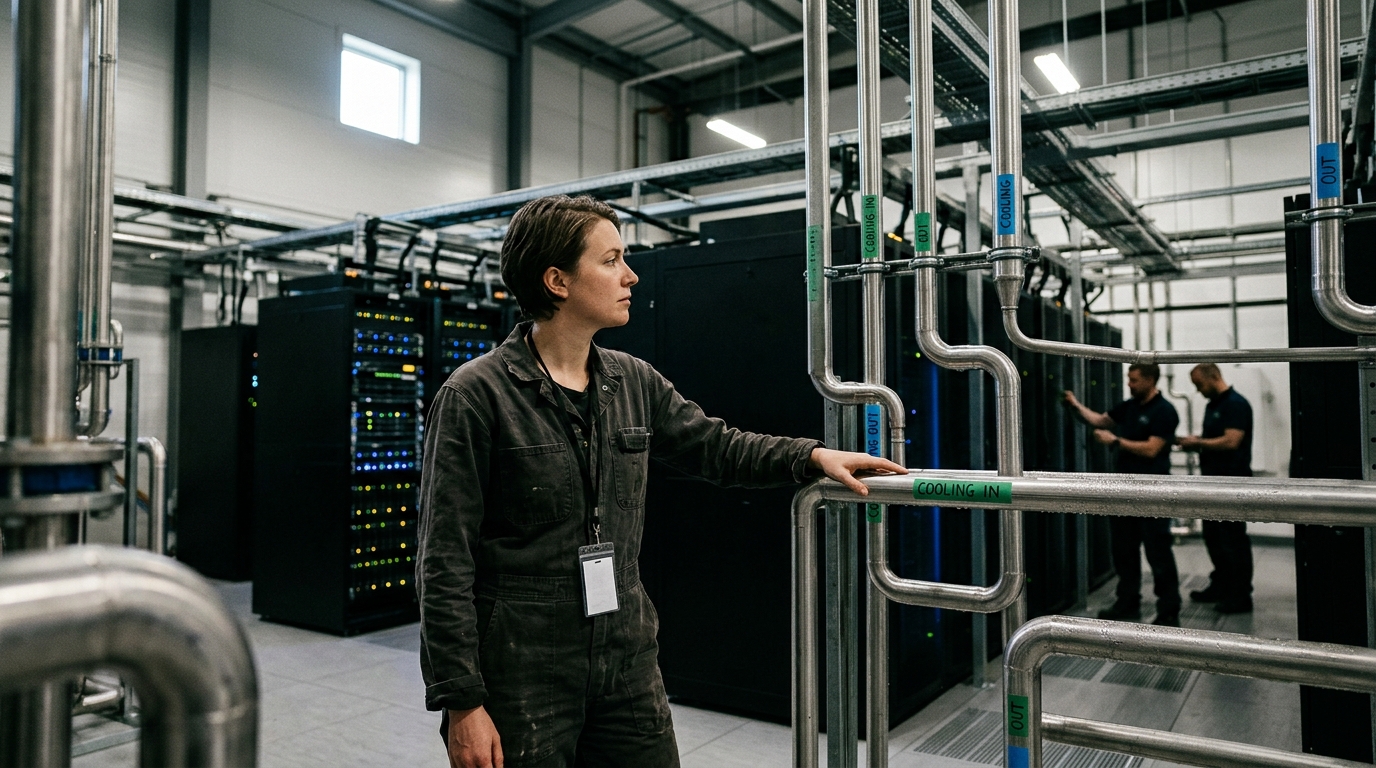
At the dawn of the digital revolution, we grew accustomed to thinking of Artificial Intelligence as an ethereal entity residing in "the cloud." However, the reality is far more material, noisy, and, above all, liquid. Behind every ChatGPT response and every Midjourney image lies a vast mechanism of heat-generating servers that must be cooled at all costs. The medium for this cooling is, traditionally and effectively, water. Today, in 2026, the conflict between the need for technological progress and the preservation of natural resources is reaching a breaking point.
The Scale of Consumption
The numbers are revealing and often staggering. According to recent studies, training a large language model like GPT-4 can require millions of liters of water. But consumption doesn't stop at training. Every time a user submits a query to an AI chatbot, it is estimated that about half a liter of water is "spent" — roughly the equivalent of a small bottle. If we multiply this number by the billions of queries submitted daily worldwide, we realize that AI is not just energy-intensive, but extremely water-intensive.
Tech giants like Microsoft, Google, and Meta have reported sharp increases in water consumption in their annual sustainability reports. For instance, Microsoft saw its global water consumption jump by 34% in a single year, an increase directly attributed to AI infrastructure development. This water is primarily used in cooling towers to keep graphics processing units (GPUs) at temperatures that allow them to operate without failure.
The Local Problem of a Global Technology
The issue is not just quantitative but also geographical. Data centers are often built in areas where land and power are cheap, but water may be scarce. In Arizona, USA, or parts of Spain and Chile, data centers compete directly with local agriculture and domestic use. When a community is hit by drought, the priority given to cooling servers over irrigating crops creates intense social and ethical friction.
"We cannot drink algorithms. The tech industry must understand that digital abundance cannot be built upon physical deprivation," environmental activists state.
Furthermore, there is the issue of water quality. Water used for cooling is often treated with chemicals to prevent corrosion and bacterial growth. When this water is discharged or evaporated, it leaves behind environmental footprints that are often overlooked in companies' "green" growth reports.
Seeking "Thirsty" Innovation
The industry is not standing still, as pressure from regulators and public opinion grows. We are already seeing a shift toward more sustainable methods. "Dry cooling," which uses air instead of water, is one solution, though it is less efficient in hot climates. Other companies are experimenting with placing data centers on the seabed or in regions with permanently low temperatures, such as Iceland and Norway, to leverage the natural environment.
However, the most promising direction is water recycling. Many new data centers are designed to use "gray water" (treated wastewater) instead of potable water. Additionally, Microsoft and Google have pledged to become "Water Positive" by 2030, meaning they will return more water to the environment than they consume, through wetland restoration projects and improving water infrastructure in affected areas.
Conclusion: An Ethical Choice
Artificial Intelligence promises to solve some of humanity's greatest problems, from diagnosing diseases to tackling climate change. Yet, it is ironic that the tool that could save us from environmental catastrophe is accelerating the depletion of one of our most vital resources. Transparency is the first step. Users need to know the environmental cost of their digital interactions, and governments must impose strict limits on water consumption by Big Tech. Intelligence, artificial or otherwise, is worth little if it is not accompanied by the wisdom of preserving life.