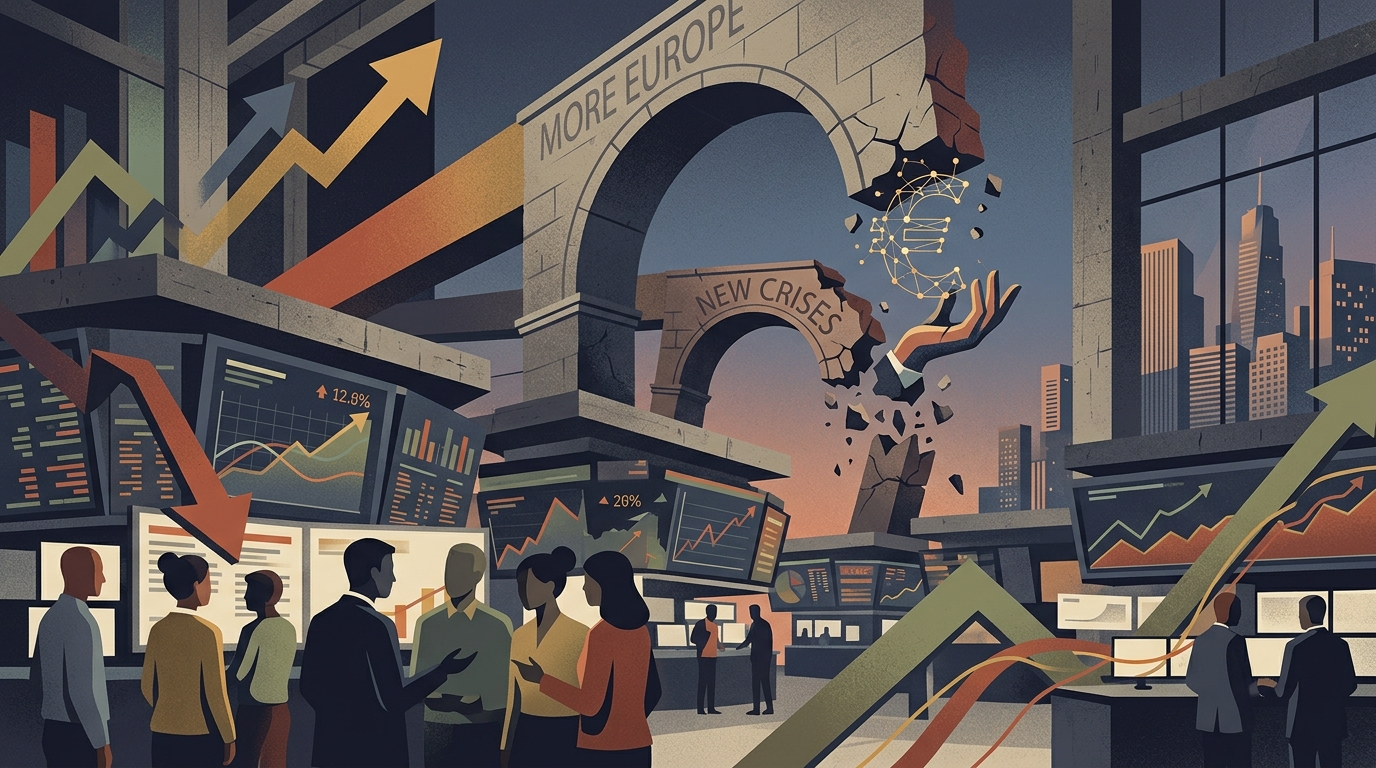
In an era of intense geopolitical turbulence and economic uncertainty, the Governor of the Bank of Greece, Yannis Stournaras, is issuing a stark warning and a simultaneous call to action. His central thesis is clear: the Eurozone can no longer afford to remain an "incomplete construction." The choice facing European leaders is binary and relentless: either move towards deeper political and economic integration or face successive crises that will threaten the cohesion of the single currency.
The Missing Architecture: Banking Union and Capital Markets
Mr. Stournaras focuses primarily on the need to complete the Banking Union. Despite the steps taken following the debt crisis of the previous decade, the third pillar—the European Deposit Insurance Scheme (EDIS)—remains frozen due to political disagreements, mainly from Northern member states. Without it, the banking system remains fragmented along national borders, hindering the free flow of capital and increasing borrowing costs for businesses in the South.
Simultaneously, the Capital Markets Union (CMU) is, according to the Governor, the key to financing the green and digital transitions. Today, European companies rely excessively on bank lending, in contrast to US firms that raise capital through markets. Integrating capital markets would allow the mobilization of the vast private savings of European citizens toward productive investments, bolstering the continent's competitiveness.
The Draghi Report as a Survival Roadmap
Stournaras’s positions align fully with the conclusions of Mario Draghi’s recent report on European competitiveness. The Governor emphasizes that Europe is losing ground to the US and China, not only because of energy costs but primarily due to an innovation deficit and a lack of economies of scale. The solution cannot be national. No single member state, not even Germany, possesses the scale required to compete with global giants in cutting-edge technologies like Artificial Intelligence.
In this context, Mr. Stournaras advocates for common European investment tools. The experience of the Recovery and Resilience Facility (RRF) demonstrated that Europe can act collectively in times of crisis. However, the goal now is to create a permanent fiscal mechanism to fund "European public goods," such as defense, energy interconnections, and basic research. Without a common fiscal capacity, the ECB's monetary policy will continue to bear a disproportionate burden for stabilizing the economy.
The Risk of Political Fragmentation
Beyond technocratic indicators, the BoG Governor warns of the social and political consequences of inertia. The rise of populism and Eurosceptic forces is fueled by the perception that Europe cannot protect its citizens from external shocks. If the Eurozone fails to produce growth and prosperity for all, social cohesion will fracture.
- Fiscal Discipline vs. Investment: Stournaras calls for a balance that does not stifle growth in the name of austerity.
- Energy Autonomy: The need for a unified European energy market is now a matter of national security.
- Institutional Reforms: Abolishing unanimity in critical economic matters is seen as essential for the speed of decision-making.
In conclusion, Yannis Stournaras’s intervention is not merely an economic analysis but a political manifesto for Europe’s survival. The "new normal" of perpetual crises demands a Europe that does not just react to events but shapes them through the power of its integration. For Greece, such a development is vital, as the fortification of the Eurozone represents the best guarantee for the stability of the domestic economy.