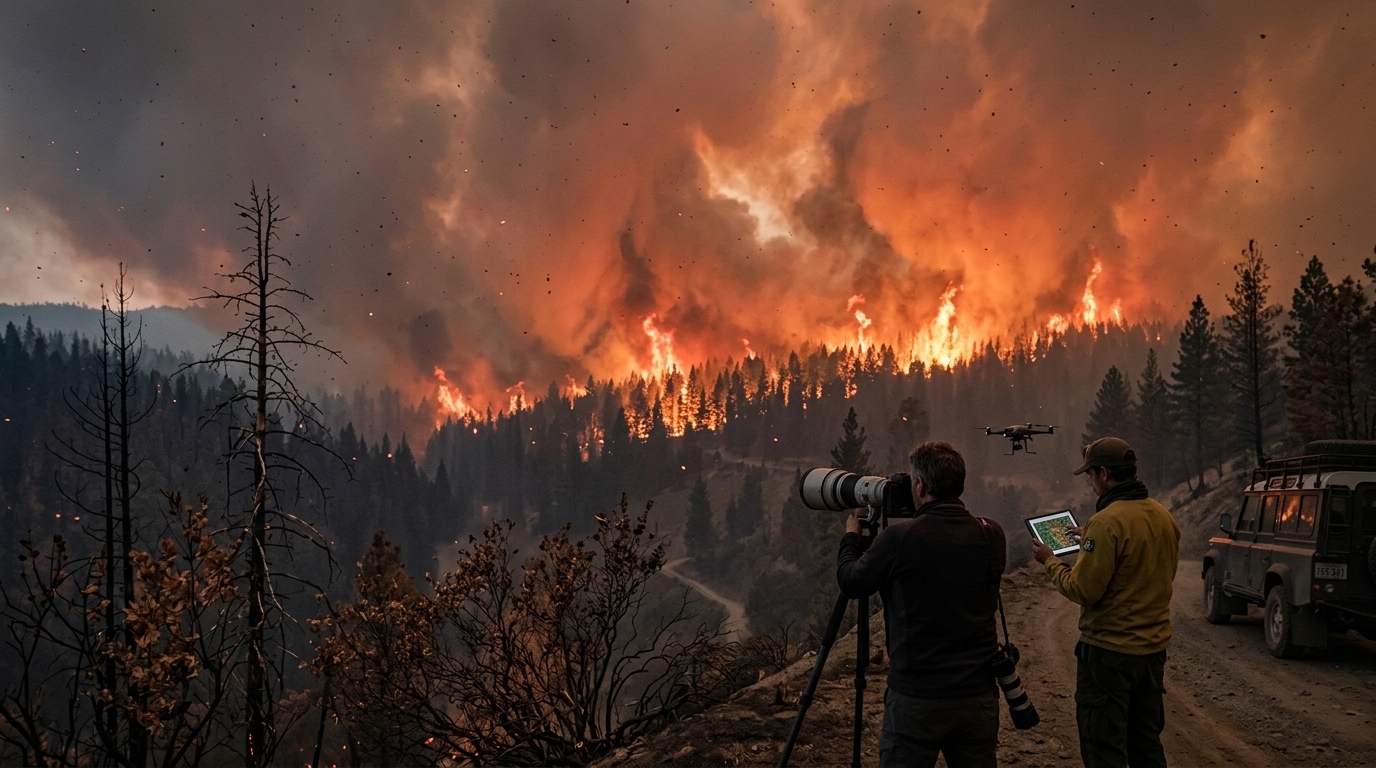
California, a state that has increasingly become a perennial battleground for wildfires, is now facing a new, digital threat that stems not from climate change, but from financial engineering. The emergence of Wyldfyre, a prediction market platform that allows users to bet on the probability and scale of wildfires, has ignited a fierce debate over the boundaries of the "prediction economy" and the dangers inherent in commodifying disaster.
The Mechanics of Betting on Catastrophe
Wyldfyre is not a traditional sportsbook; it is a prediction market utilizing "event contracts." Users can purchase shares in outcomes such as "Will more than 10,000 acres burn in Sonoma County by August?" If the event occurs, the contract pays out at a predetermined value. If not, the investment is lost. This binary structure is similar to platforms like Polymarket or Kalshi, which have gained massive popularity in recent years.
The platform's creators argue that Wyldfyre provides a valuable service: the ability to hedge risk. For instance, a homeowner in a high-risk zone who cannot secure affordable fire insurance could theoretically bet on a fire occurring. If their property is damaged, the winnings from the bet could offset their financial losses. However, this logic bypasses the rigorous regulations of the insurance industry, specifically the requirement for "insurable interest"—the legal proof that the policyholder would suffer an actual loss from the event, preventing people from insuring someone else's house just to profit from its destruction.
The Nightmare of Moral Hazard and Arson
The most severe criticism leveled against Wyldfyre concerns the "perverse incentive" problem. Unlike betting on election results or the Oscars, wildfires can be deliberately caused by human intervention. The possibility that a user could place a significant bet on a fire and then commit arson to collect the payout is no longer a dystopian fiction but a direct threat to public safety.
Law enforcement agencies and fire departments in California have expressed profound alarm. "We are creating a financial incentive for the destruction of our environment and properties," security analysts warn. Although the platform claims to have monitoring mechanisms to detect suspicious activity and cooperate with authorities, the pseudonymity often provided by digital transactions makes effective oversight extremely difficult. The "Cobra Effect"—where an attempted solution to a problem actually makes the problem worse—is a looming shadow over this business model.
Regulatory Vacuums and the Future of Event Markets
The Wyldfyre case highlights the massive regulatory vacuum surrounding prediction markets. In the United States, the Commodity Futures Trading Commission (CFTC) has long attempted to restrict betting on events deemed "contrary to the public interest," such as elections, gaming, or terrorist attacks. Wyldfyre appears to be operating in the legal gray areas, exploiting the slow pace of regulatory response to technological innovation.
In regions like the Mediterranean, where wildfires are a devastating annual reality, the news of Wyldfyre's existence is met with horror. If such platforms were to expand globally, disaster management could devolve into a macabre stock exchange. In such a world, life and nature would be valued solely in terms of yield and risk, undermining preventative efforts and social cohesion.
Conclusion: Ethics vs. Market Efficiency
Ultimately, Wyldfyre represents the zenith of a trend where everything is transformed into a betting product. While economic theory suggests that prediction markets are the most accurate way to aggregate information about the future, their application to catastrophic events crosses a clear ethical line. Society must decide whether "market efficiency" is worth the risk of incentivizing criminal acts that could incinerate entire ecosystems for the sake of digital profit. The fire this time isn't just in the forests; it's in the very fabric of our financial ethics.