The history of space exploration has, until recently, been a narrative of magnificent but disposable achievements. When a costly instrument malfunctioned or depleted its fuel, its fate was sealed: silence and a slow descent into Earth's atmosphere. However, NASA is preparing to overturn this paradigm, embarking on a mission that reads like science fiction. The target is the Neil Gehrels Swift Observatory, a 20-year-old veteran that has provided invaluable insights into gamma-ray bursts and the universe's most violent phenomena.
The Challenge of Non-Cooperative Docking
The Swift telescope was launched in 2004, an era when the concept of "on-orbit servicing" was almost exclusively limited to the Hubble Space Telescope and the crewed Space Shuttle missions. Unlike Hubble, Swift was never designed to be visited. It lacks handles, specialized docking ports, or easily accessible components. This classifies it as a "non-cooperative target."
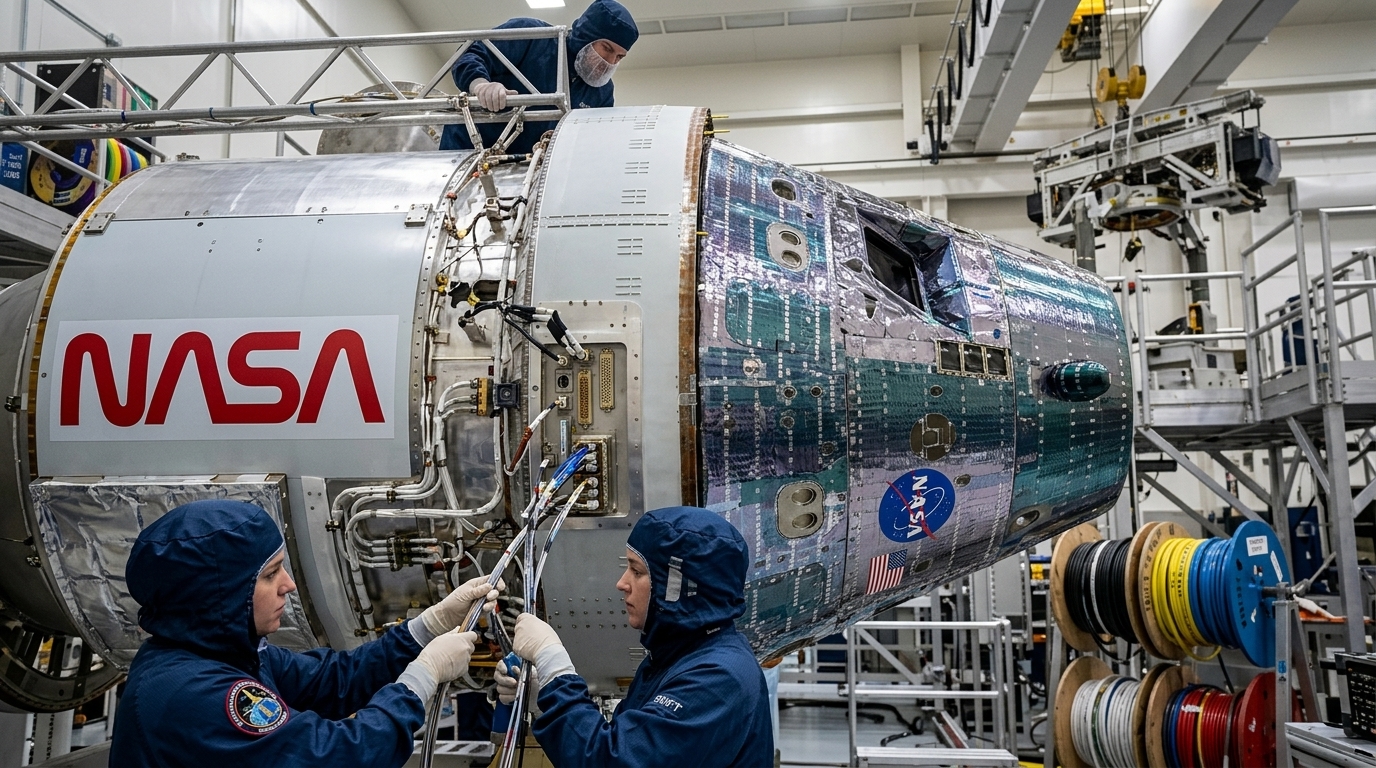
The rescue mission will rely on an autonomous robotic spacecraft equipped with advanced computer vision sensors and machine learning. The robot must approach Swift with millimeter precision, identify its structural components, and use robotic arms to stabilize it. This process requires immense local computing power on the spacecraft, as communication latency with Earth makes remote control impossible for such delicate maneuvers.
From Disposable Tech to a Space Circular Economy
The significance of this mission extends far beyond saving a single telescope. If NASA succeeds in extending Swift's life, it will have proven that On-orbit Servicing, Assembly, and Manufacturing (OSAM) is both feasible and economically viable. This marks a transition toward a "space circular economy," where satellites are no longer abandoned as space debris but are upgraded and refueled instead.
- Cost Reduction: Launching a new telescope costs hundreds of millions of dollars; a robotic maintenance mission is a fraction of that cost.
- Space Debris Mitigation: Repairing existing craft reduces the number of inactive objects orbiting Earth, which threaten other missions.
- Technological Maturation: The technologies developed for Swift will serve as the foundation for building large space stations and asteroid mining operations in the future.
"We are not just trying to save a telescope. We are trying to change how humanity operates in space," says a NASA official involved in the program.
The Geopolitical Dimension of Space Robotics
Of course, such technology does not only have scientific implications. The ability of a robot to autonomously approach and manipulate a satellite is a "dual-use technology." While NASA presents it as a rescue tool, defense analysts point out that the same technology could be used to disable adversary satellites. In an environment of increasing tension between the US, China, and Russia, dominance in orbital robotics is the new frontier of power competition.
Despite its age, Swift remains humanity's "quickest eye" in the cosmos. Its ability to pivot toward a gamma-ray source within seconds is unique. The success of the robotic mission will allow it to continue observing neutron star collisions and the birth of black holes for at least another decade, proving that the wisdom of old instruments can coexist with the innovation of new robots.