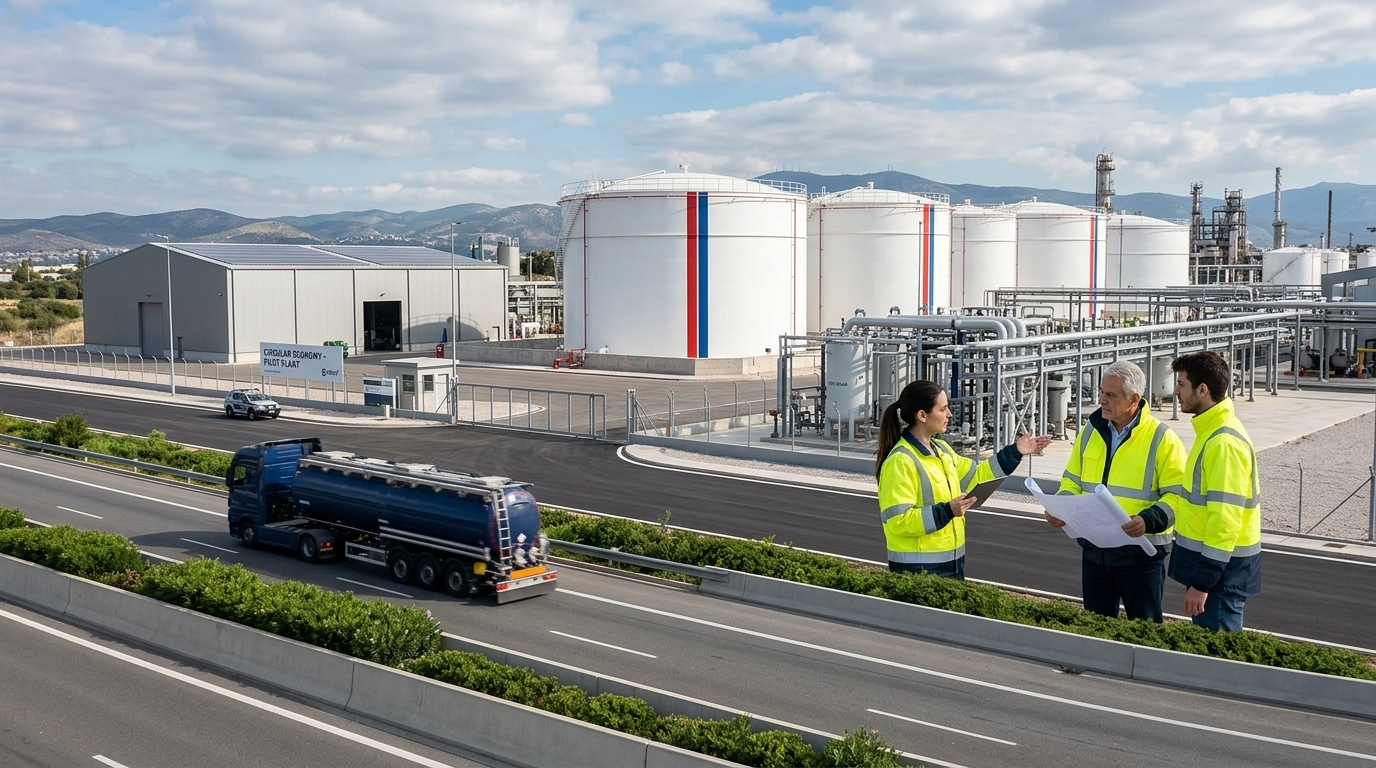
Motor Oil, one of the leading energy groups in Greece and the Eastern Mediterranean, has announced a move of strategic importance that underscores its determination to lead the green transition. Through its subsidiary, the company has signed an agreement to acquire 60% of the share capital of ENACT, a firm with a strong footprint in environmental management and the circular economy. This move is not merely an acquisition but a clear statement of intent regarding the group's future, as it gradually moves away from the traditional refinery model to become a multidimensional energy pillar.
The Strategic Importance of ENACT
ENACT operates across a wide spectrum of services, including waste collection, transportation, and management, as well as providing consultancy services for environmental projects. At a time when the European Union is setting increasingly stringent targets for recycling and reducing waste sent to landfills, owning a company with ENACT's expertise provides Motor Oil with a critical advantage. The circular economy is no longer a theoretical concept but a necessary business practice that transforms waste into resources, reducing environmental costs and creating new revenue streams.
Integrating ENACT into the group's portfolio allows Motor Oil to vertically integrate its activities in the environmental sector. The group is already active through LPC in the regeneration of lubricant oils, one of the most successful applications of the circular economy in Greece. With ENACT, the scope of action expands to municipal and industrial waste, creating synergies that can lead to innovative 'Waste-to-Energy' solutions—a sector expected to see explosive growth in the coming years.
Group Transformation and the 2030 Plan
This acquisition is part of Motor Oil's broader strategic plan for 2030, which envisions billions of euros in investments to diversify its energy mix. The group is systematically investing in Renewable Energy Sources (RES) via MORE, hydrogen, alternative fuels, and now, even more dynamically, in environmental management. The group's leadership appears to recognize that the survival of traditional oil companies depends on their ability to adapt to a low-carbon world.
Furthermore, this move strengthens Motor Oil's ESG (Environmental, Social, and Governance) profile, making it more attractive to institutional investors who now impose strict environmental criteria for capital allocation. Waste management is a sector with stable cash flows and long-term contracts, providing financial stability against the fluctuations of international oil prices. The completion of the transaction is subject to approval by the Hellenic Competition Commission, which will examine the market share the group acquires in this specific sector.
Challenges and Prospects in the Greek Market
The Greek waste management market is in a phase of intense activity and consolidation. Large construction and energy groups, such as GEK TERNA and Intrakat, are vying for a significant share of PPP (Public-Private Partnership) projects for waste treatment plants. Motor Oil's entry with the acquisition of ENACT reshapes the balance of power, bringing a player with vast financial resources and international experience into a sector that has traditionally been fragmented.
However, challenges remain. Bureaucracy in licensing new plants, local opposition, and the need for technological modernization of existing infrastructure are hurdles that Motor Oil will have to overcome. ENACT's success will depend on its ability to integrate digital solutions in fleet management and sorting at the source—areas where Greece still lags behind the European average. In conclusion, Motor Oil's move represents a decisive step toward a 'green' capitalism, where profitability is inextricably linked to environmental responsibility.