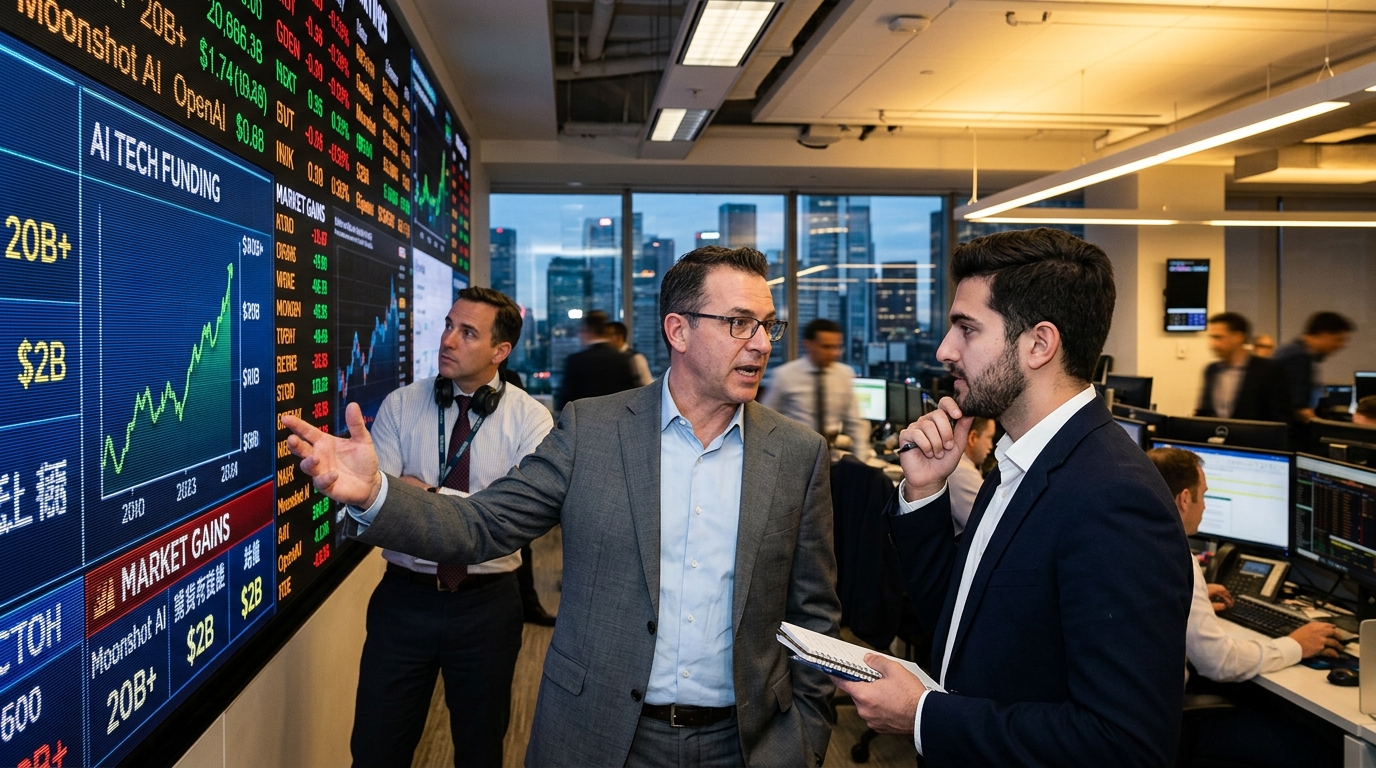
In a move that recalibrates the global AI power structure, Moonshot AI, the Chinese startup behind the popular Kimi chatbot, has announced a massive $2 billion funding round. This new capital injection propels the company's valuation past the $20 billion mark, cementing its status as one of the most formidable "unicorns" in the generative AI space worldwide.
The Strategy of Long-Context Windows
Founded by Yang Zhilin, a preeminent computer scientist with a pedigree from Google and Meta, Moonshot AI has carved out a distinct niche by focusing on "large context windows." Its flagship chatbot, Kimi, gained widespread recognition for its ability to process vast amounts of data—up to 2 million Chinese characters in a single prompt—surpassing OpenAI’s GPT-4 in specific long-form processing metrics.
This technical edge is more than just a vanity metric. In practice, it enables lawyers, researchers, and software engineers to analyze entire libraries of documents or complex codebases in seconds. The market response has been electric, leading to an explosion in user growth, which in turn caught the eye of institutional investment titans.
Investment Landscape and Geopolitical Context
The latest funding round saw participation from heavyweights such as Alibaba, Tencent, and HongShan (formerly Sequoia China). The involvement of Chinese tech giants underscores a significant shift: China is no longer merely attempting to replicate Silicon Valley’s successes; it is aiming for leadership. Despite stringent US export controls on advanced semiconductors, Moonshot AI appears to have optimized its algorithms to extract maximum performance from available hardware.
However, the rise of Moonshot AI is not just about code. It is a narrative of economic survival and dominance. At a time when the global venture capital market is increasingly cautious, the fact that an AI firm can secure such a substantial sum reflects a profound belief among investors that generative AI is the next general-purpose technology that will reshape the global economy.
Challenges and the Path Ahead
Despite the triumph, the road ahead is fraught with obstacles. The cost of training these models remains astronomical, with Moonshot AI spending hundreds of millions of dollars on compute resources. Furthermore, domestic competition within China is cutthroat, with rivals like Zhipu AI and Kai-Fu Lee’s 01.AI vying for the same market share and talent pool.
While the company frames itself as a developer-friendly, open-source-adjacent entity, its strategy balances providing APIs for developers with maintaining proprietary models for enterprise clients. Its ability to maintain independence while being funded by its own potential competitors (Alibaba and Tencent) will be the ultimate test of its longevity. Moonshot AI is no longer just a high-potential startup; it is the cornerstone of China's AI ambitions in 2026.