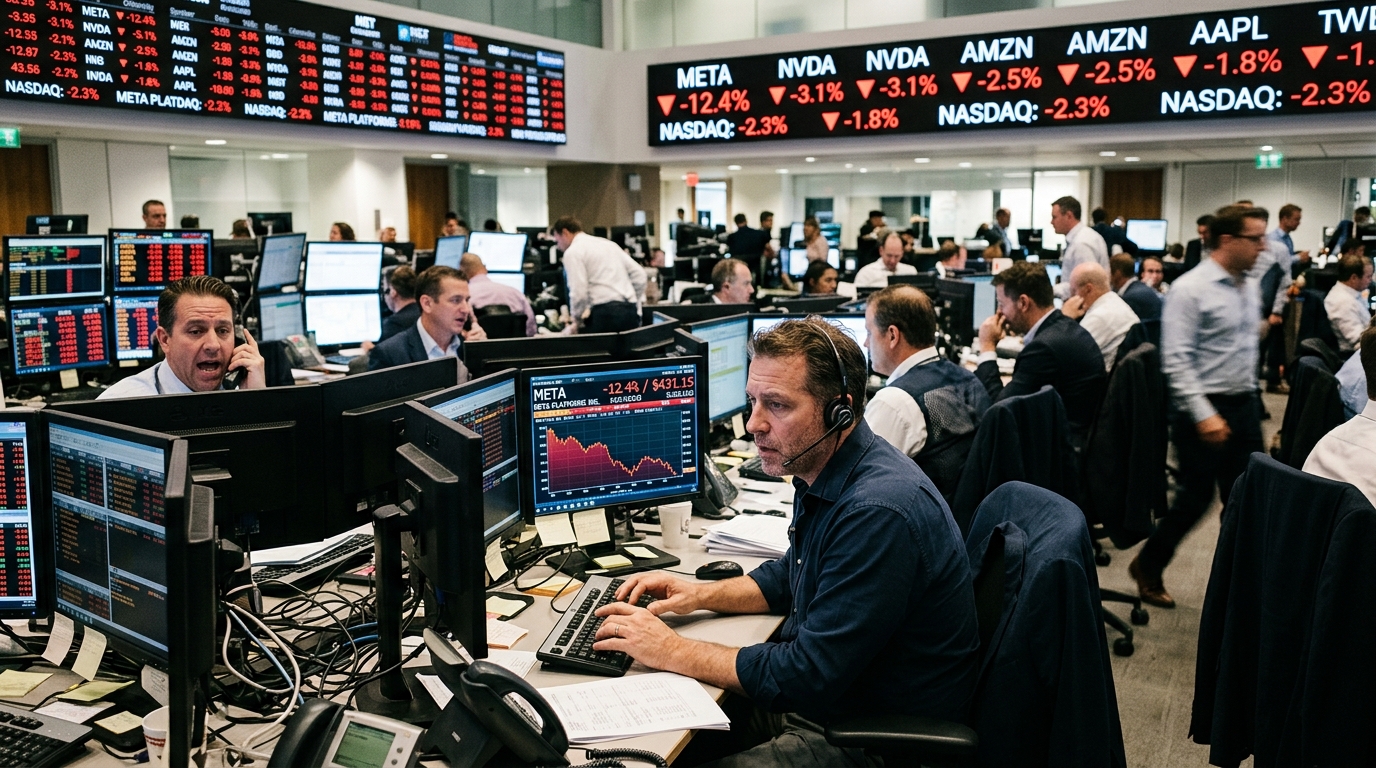
History seems to be repeating itself for Mark Zuckerberg and the tech giant Meta. In a trading session reminiscent of the dark days of 2022, when the obsession with the Metaverse sent the stock into a tailspin, Meta Platforms Inc. is once again in the crosshairs of investors. This time, the cause is not a virtual world that few visit, but the astronomical surge in capital expenditures for Artificial Intelligence (AI), which appears to be testing Wall Street's patience.
The $125 Billion Shock
During the announcement of financial results for the first quarter of 2026, Meta made a move that caught analysts off guard: it raised its forecast for full-year capital expenditures (CapEx) to a staggering range of $125 billion to $140 billion. This is an unprecedented investment in the history of technology companies, as the firm rushes to equip its data centers with the next generation of semiconductors and train its Llama 5 model, which promises to revolutionize productivity.
Despite the fact that advertising revenue remains strong, investors reacted negatively, driving the stock down by over 12% in after-hours trading. The fear is simple and clear: will these expenditures pay off? Or is Meta building infrastructure for a demand that will never materialize to the extent expected?
From the 'Year of Efficiency' to the 'Infrastructure War'
2023 and 2024 were characterized by Zuckerberg as the 'years of efficiency,' featuring massive layoffs and cost-cutting measures that propelled the stock to record highs. However, 2026 seems to mark a complete reversal. Meta is no longer trying to save money but to dominate the AI arms race, competing with Microsoft, Google, and Amazon.
- Hardware: The lion's share of spending is directed toward purchasing tens of thousands of new processing units (GPUs) from Nvidia and other suppliers.
- Energy: Operating these systems requires vast amounts of energy, leading Meta to invest even in nuclear energy and renewable sources.
- Open Source: Meta's strategy of releasing Llama models as open source costs billions, without yet having a direct revenue model to justify the expense.
Mark Zuckerberg, during the earnings call, was emphatic: 'We are at a turning point. Anyone who does not invest in AI infrastructure now will find themselves out of the game in the next decade. We don't have the luxury of waiting.' However, Wall Street seems to disagree with the pace of this transition.
The Monetization Challenge
The primary question posed by analysts from Goldman Sachs and Morgan Stanley is when AI will begin to contribute significantly to the company's bottom line. While AI tools have improved ad targeting on Instagram and Facebook, direct revenue generation from AI agents and new generative AI features remains in the early stages.
'Meta is asking investors to sign a blank check for the future, while the present requires massive sacrifices in free cash flow,' one analyst noted.
The concern is intensified by the fact that the competition is equally aggressive. If all major tech companies are building the same infrastructure simultaneously, there is a risk of an 'infrastructure bubble,' where the supply of compute power far exceeds actual market need, leading to asset devaluation.
Conclusion: A High-Stakes Gamble
The plunge in Meta's stock is not necessarily a condemnation of Zuckerberg's vision, but a reminder that markets operate based on quarterly results rather than decadal forecasts. Meta is betting its survival on AI, transforming itself from a social media company into an AI infrastructure powerhouse. If the bet pays off, today's drop will look like a minor blip on the chart. But if AI adoption slows, Zuckerberg will face a credibility crisis that he may not be able to overcome this time.