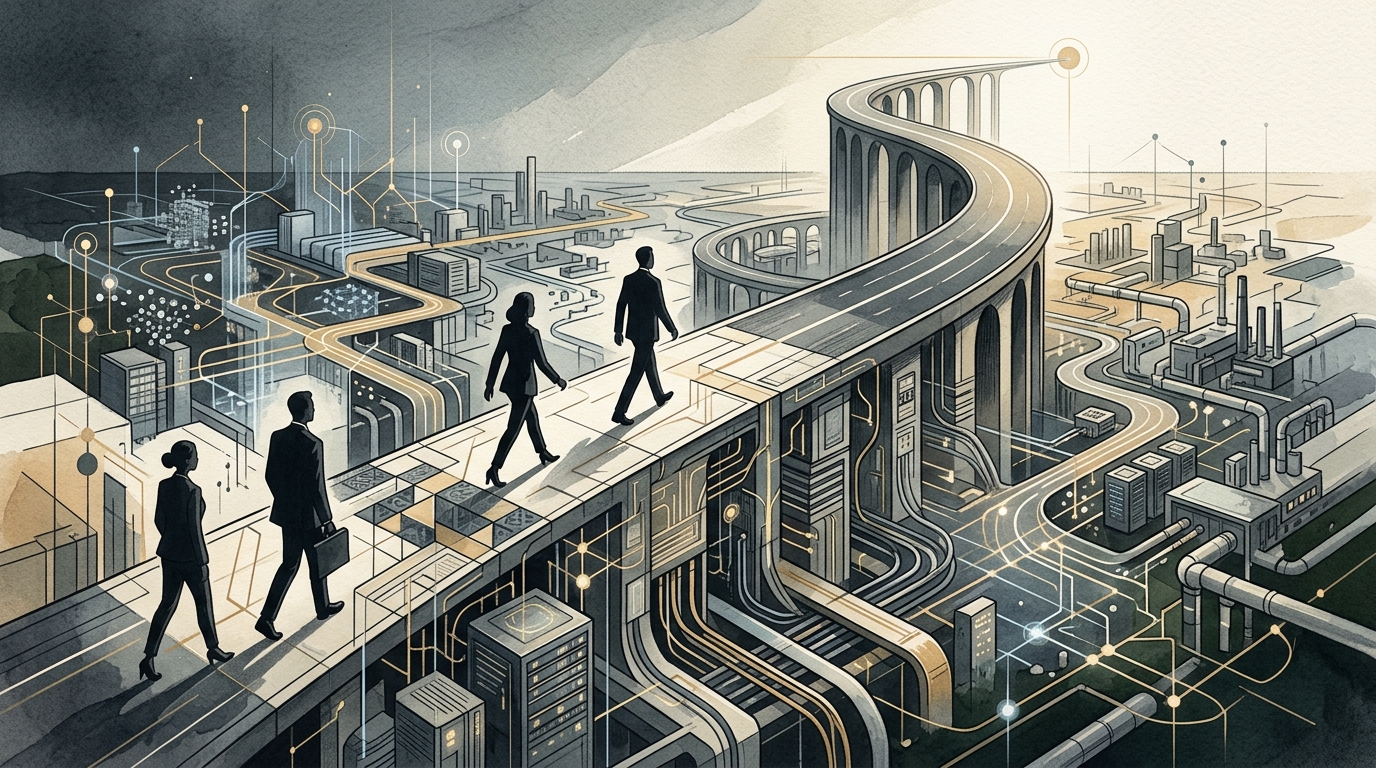
The global IT market, which for decades served as the 'safe haven' of growth and full employment, is currently facing a structural crisis that threatens to fundamentally alter its DNA. According to recent reports, including analysis from Forbes Greece, the sector is being hit by a double blow: on one hand, the cost of hardware infrastructure to support Artificial Intelligence (AI) has skyrocketed to staggering heights, and on the other, AI technology itself is beginning to drastically reduce the need for new hires, especially at the entry level.
The Hardware Trap: The Price of Power
The first 'bomb' concerns capital expenditure (CAPEX). The transition from traditional cloud computing to AI-ready computing requires specialized processors (GPUs) that cost tens of thousands of dollars per unit. NVIDIA's dominance in the market has created an environment where demand far outstrips supply, driving prices to levels that only Big Tech giants can afford. For small and medium-sized IT enterprises, even in regional markets like Greece, accessing this computational power is becoming prohibitive, creating a two-tier digital divide.
But it's not just the cost of chips. Operating these systems requires vast amounts of energy and specialized data centers with advanced cooling systems. This 'explosive' hardware cost is forcing companies to revise their budgets, shifting funds from human resources to infrastructure. The strategic choice is clear: a preference for investing in 'silicon' rather than 'human capital.' This shift represents a move from a labor-intensive industry to a capital-intensive one, mirroring the industrial revolutions of the past.
The Hiring Freeze and the Threat to Juniors
The second 'bomb' is knocking on the employees' door. For years, the recipe for success for any software company was the mass hiring of junior developers who were trained within the firm. Today, Generative AI tools such as GitHub Copilot and ChatGPT can generate code, perform debugging, and write documentation at speeds that surpass any human. The result? Companies no longer need the 'armies' of junior developers they once did.
According to industry executives, there is a clear trend of hiring freezes for entry-level and mid-level roles. Businesses are now seeking only a few highly specialized senior engineers who can oversee AI systems. This creates an existential risk for new IT graduates, who find the door to the labor market tightly shut, as 'internships' and junior tasks are increasingly handled by algorithms. The ladder of professional progression is effectively losing its bottom rungs.
Economic Implications and the Path Forward
In markets like Greece, where the IT sector has been trying to fill a gap of thousands of job openings in recent years, the situation is ambiguous. On one hand, Greek outsourcing firms are seeing their profit margins squeezed as international clients demand lower prices due to AI integration. On the other hand, the high cost of hardware makes it difficult to develop domestic AI models, forcing the local market to remain dependent on foreign platforms and APIs.
The solution, according to analysts, is not to reject technology but to undergo radical retraining. Information technology is ceasing to be a craft of 'writing code' and is transforming into a science of 'system orchestration.' Those who do not adapt to this new model—where hardware is expensive and code is a commodity—will find themselves excluded from a market that is accelerating at an unprecedented pace. The future belongs to those who can bridge the gap between expensive compute power and creative human oversight.