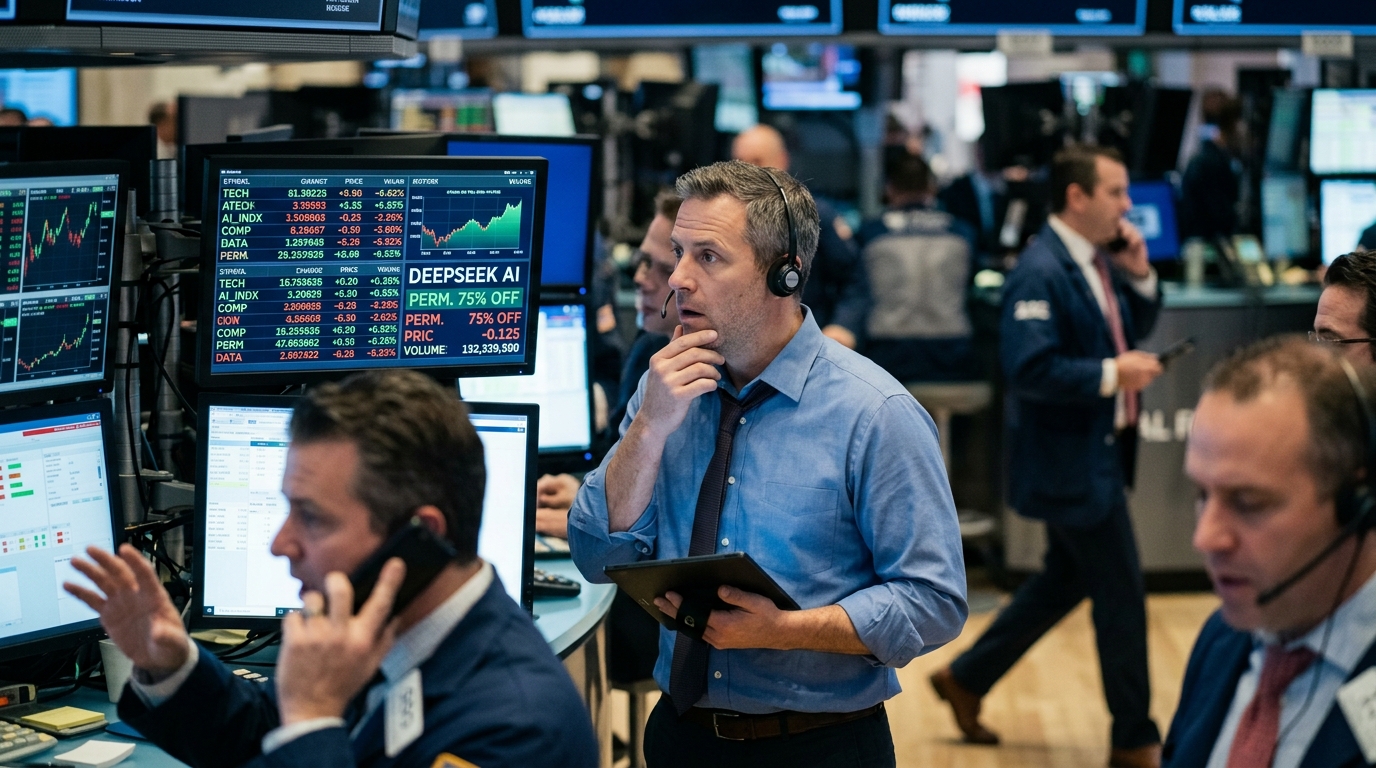
In a move set to fundamentally reshape the economic landscape of Artificial Intelligence, the Chinese firm DeepSeek has announced that the 75% discount on its flagship model API pricing is now permanent. This decision, coming amidst intense competition between American giants and emerging Chinese labs, marks the beginning of a ruthless price war that threatens the profit margins of OpenAI, Google, and Anthropic.
The 'Scorched Earth' Pricing Strategy
DeepSeek is no longer just another player in the market; it has become the primary advocate for "efficient intelligence." While American companies focused for years on raw computational power, spending billions on Nvidia infrastructure, DeepSeek invested in algorithmic optimization. The result is models that offer performance comparable to GPT-4o or Claude 3.5 Sonnet, but at a fraction of the operating cost.
The permanent 75% discount is not merely a promotional stunt; it is a declaration of dominance. For developers and enterprises, the cost disparity is staggering. When calling a million tokens costs a few cents on DeepSeek versus several dollars on OpenAI, economic logic dictates a shift toward the Chinese solution, despite any geopolitical reservations. This pricing policy undermines the business model of Big Tech, which relies on high API revenues to recoup massive hardware investments.
Technological Innovation Behind the Cost Reduction
How does DeepSeek manage to remain viable—or even profitable—at such prices? The answer lies in its Mixture of Experts (MoE) architecture and innovations like Multi-head Latent Attention (MLA). These technologies allow the model to activate only a small portion of its parameters for each query, drastically reducing VRAM requirements and energy consumption during inference.
- Inference Optimization: DeepSeek has developed custom CUDA kernels that enable faster data processing on GPUs.
- Model Compression: Advanced quantization techniques allow models to run on less expensive hardware without significant loss in accuracy.
- Vertical Integration: The company controls the entire stack, from training data to the deployment environment.
This approach proves that model "intelligence" is becoming a commodity. If intelligence is cheap and abundant, then value shifts from the model itself to the applications and proprietary data that power it.
Geopolitical and Economic Implications
DeepSeek's move also carries a strong political dimension. As the U.S. attempts to restrict China's access to advanced semiconductors, DeepSeek demonstrates that Chinese ingenuity can bypass hardware limitations through superior software engineering. This creates a headache for Washington: if American startups begin relying heavily on Chinese APIs due to cost, dependence on China will shift from manufacturing to the very logic layer of software applications.
"DeepSeek isn't just selling AI; it's selling the demystification of Silicon Valley's cost structure," market analysts state.
In the coming months, the pressure on OpenAI and Google to slash their prices will be unbearable. We are already seeing a trend toward "small and mighty" models, but DeepSeek made the leap before anyone else. If Western firms cannot reduce their costs by 80-90% within the next year, they risk losing the developer market—the true gatekeepers of technology adoption.
The Outlook for 2026
As we move through 2026, the AI market is entering a maturity phase where efficiency wins over excess. DeepSeek's permanent discount is the first domino in a series of changes that will lead to more accessible tools for everyone, but also to potential industry consolidation as smaller players fail to compete at these price points. The question remains: is this a sustainable path or an aggressive penetration strategy that will pivot once market dominance is achieved?