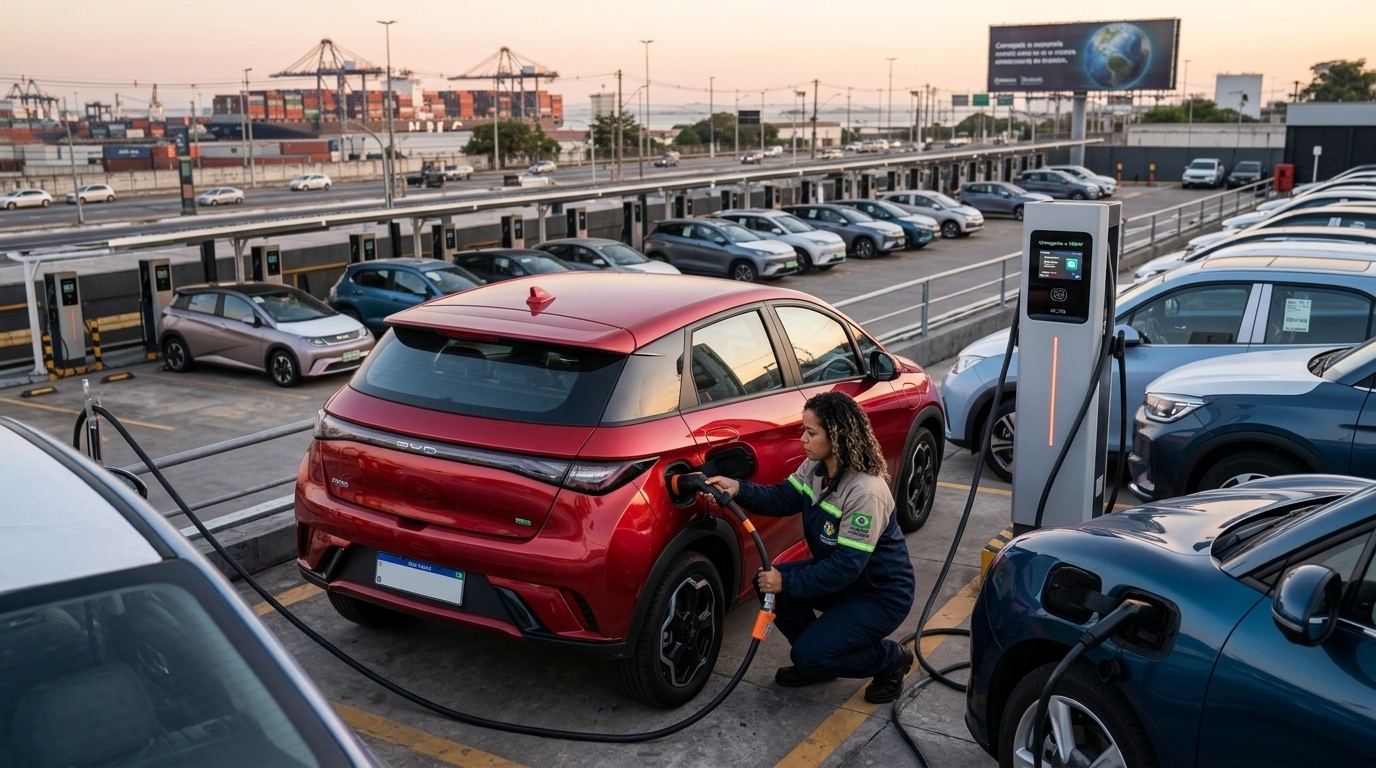
The global automotive industry is undergoing a seismic shift that is redrawing the trade maps of the 21st century. According to the latest data, exports of Chinese electric vehicles (EVs) have surged by an impressive 40%, a development that highlights Beijing's resilience against Western efforts to curtail its economic influence. While the United States and the European Union raise tariff walls, China is finding fertile ground in emerging markets, with Brazil emerging as a protagonist in this new era.
The Strategic Pivot to the Global South
The 40% increase is not just a number; it is the result of a coordinated "Going Out" strategy. As North American markets become essentially inaccessible due to the 100% tariffs imposed by the Biden administration, and the EU implements provisional countervailing duties, Chinese automakers such as BYD, Geely, and Great Wall Motor are turning their gaze toward the Global South. Brazil, in particular, has seen an unprecedented explosion in demand, with imports of Chinese EVs tripling within a single year.
The case of Brazil is illustrative. The lack of strong domestic EV production, combined with President Lula's administration's desire for a green transition, created a vacuum that China rushed to fill. BYD is not limiting itself to sales; it is investing billions to establish local production facilities in the state of Bahia, turning the country into a regional hub for all of Latin America. This model of "localization" is China's answer to protectionism: if we cannot export the product, we will export the factory.
Technological Superiority and Economies of Scale
Beyond geopolitical balances, China's success is built on two pillars: technological leadership in batteries and unmatched economies of scale. Companies like CATL and BYD control most of the global supply chain for lithium and battery production. This allows Chinese manufacturers to offer vehicles that are not only cheaper but often more technologically advanced than their European competitors, particularly in software and connectivity.
- Vertical Integration: BYD produces almost everything in-house, from chips to batteries, reducing costs by 25-30% compared to traditional automakers.
- State Support: A decade of subsidies from Beijing created an ecosystem that is now bearing fruit, despite Western accusations of unfair competition.
- Speed of Innovation: The development cycle for a new model in China is nearly half of what it is in Germany or Japan.
The Challenge for Europe and the West
For Europe, the rise of Chinese EVs poses an existential threat to its historic industrial base. The European Commission's decision to impose tariffs is an attempt to buy time for domestic players like Volkswagen, Stellantis, and Renault. However, analysts warn that tariffs alone are insufficient without a radical restructuring of production costs within the EU. In markets like Greece, the presence of Chinese brands such as MG and BYD is becoming increasingly visible, offering affordable electromobility solutions in a market struggling with the high acquisition costs of European models.
"We are not just seeing trade dominance, but a shift in the technological paradigm. China is no longer following the West; the West is trying to catch up to China in electromobility," industry experts note.
In conclusion, the 40% jump in exports is the prelude to a new global order. China is using electric vehicles as a "Trojan horse" to consolidate its influence in developing economies, creating dependencies that go beyond trade and touch upon infrastructure and energy. The battle for the future of mobility has only just begun, and for now, Beijing is firmly in the driver's seat.